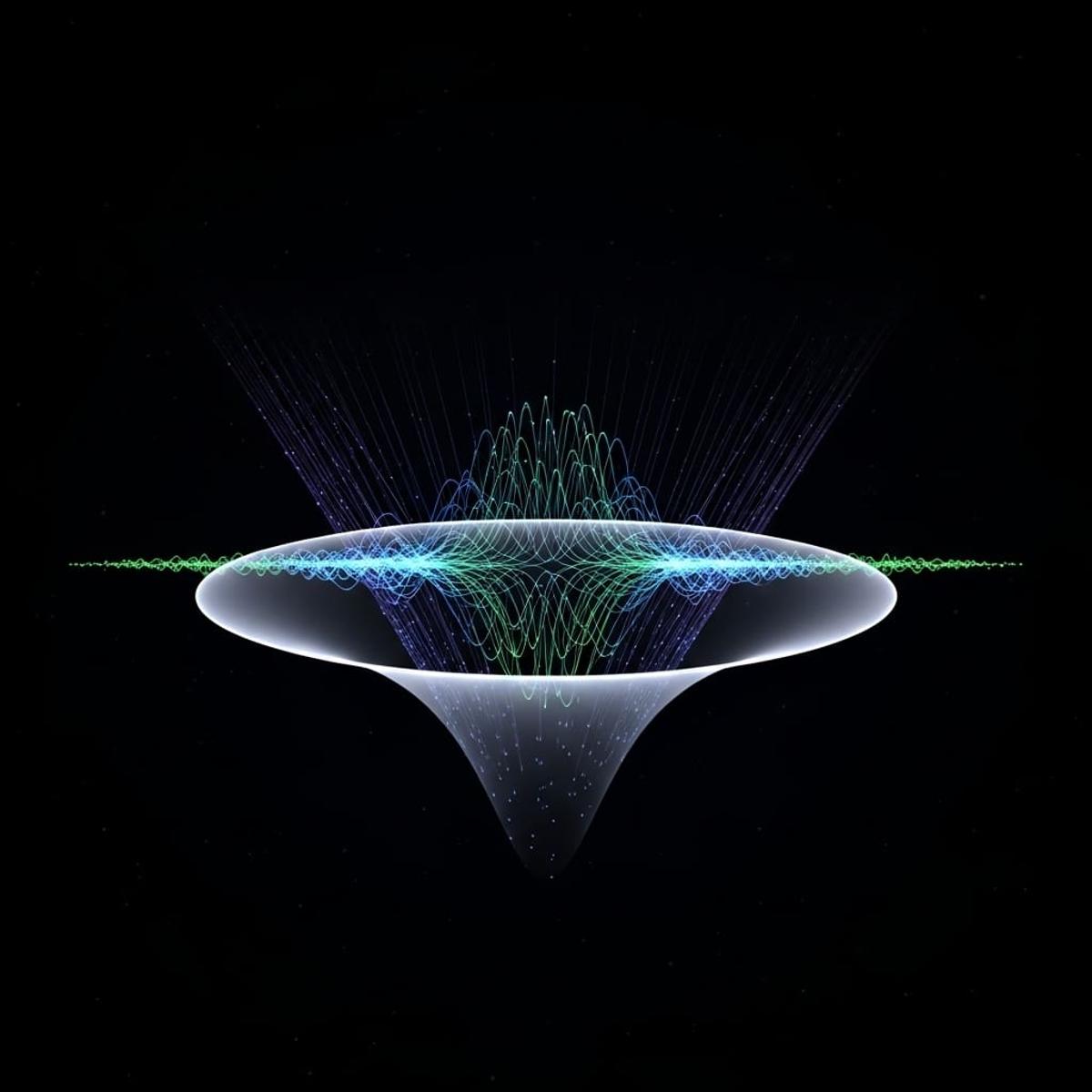
Advances Quantum Computing: Broadcasting Nonlinearity with Quadratic Potential Systems
•January 31, 2026
0
Why It Matters
Enabling unconditional nonlinear gates on linear oscillators removes a key bottleneck for continuous‑variable quantum processors, expanding scalability and fault‑tolerance.
Key Takeaways
- •Light‑mediated QND gates transfer nonlinearity without feed‑forward.
- •Cubic‑phase transformation achieved on atomic ensembles via levitated nanoparticle.
- •Nonlinear variance metric confirms genuine non‑Gaussian state generation.
- •Protocol compatible with existing optomechanical and atomic‑ensemble setups.
- •Decoherence mitigation essential for practical quantum computing applications.
Pulse Analysis
Linear bosonic oscillators—light pulses, mechanical resonators, and atomic ensembles—are the workhorses of many quantum technologies, yet their intrinsic Gaussian dynamics limit computational universality. Researchers have long sought a way to embed genuine non‑Gaussian operations without redesigning the hardware. The new hybrid scheme leverages the strong intrinsic nonlinearity of an optically levitated nanoparticle and uses squeezed‑light pulses to mediate quantum non‑demolition interactions with a linear atomic cloud. By arranging four linear QND gates around a single local cubic‑phase transformation, the protocol effectively imprints the desired nonlinearity onto the target system while keeping its own dynamics linear.
The protocol’s feasibility rests on experimentally demonstrated QND couplings between light, mechanics, and atomic ensembles. Recent experiments have achieved high‑efficiency, low‑loss light‑mediated interactions, providing the necessary gain control (g) and squeezing levels to suppress added noise. Numerical simulations, calibrated with parameters from state‑of‑the‑art levitated‑nanoparticle and cold‑atom setups, predict a clear reduction in the nonlinear variance σ(λ) and distinct non‑Gaussian features in the Wigner function of the atomic state. These signatures confirm that the broadcasted cubic‑phase gate surpasses the performance of any purely Gaussian operation, opening a practical pathway to universal continuous‑variable processing.
From a business perspective, the ability to retrofit existing linear platforms with unconditional nonlinear gates accelerates the roadmap toward fault‑tolerant quantum processors. Companies investing in optical quantum networks or atomic‑memory architectures can now consider scaling their systems without awaiting entirely new hardware. Future work will focus on minimizing decoherence—through cryogenic environments, improved vacuum, and refined optical loss management—and on extending the method to multi‑mode networks, potentially enabling complex quantum algorithms and error‑correcting codes on currently available infrastructure.
Advances Quantum Computing: Broadcasting Nonlinearity with Quadratic Potential Systems
0
Comments
Want to join the conversation?
Loading comments...