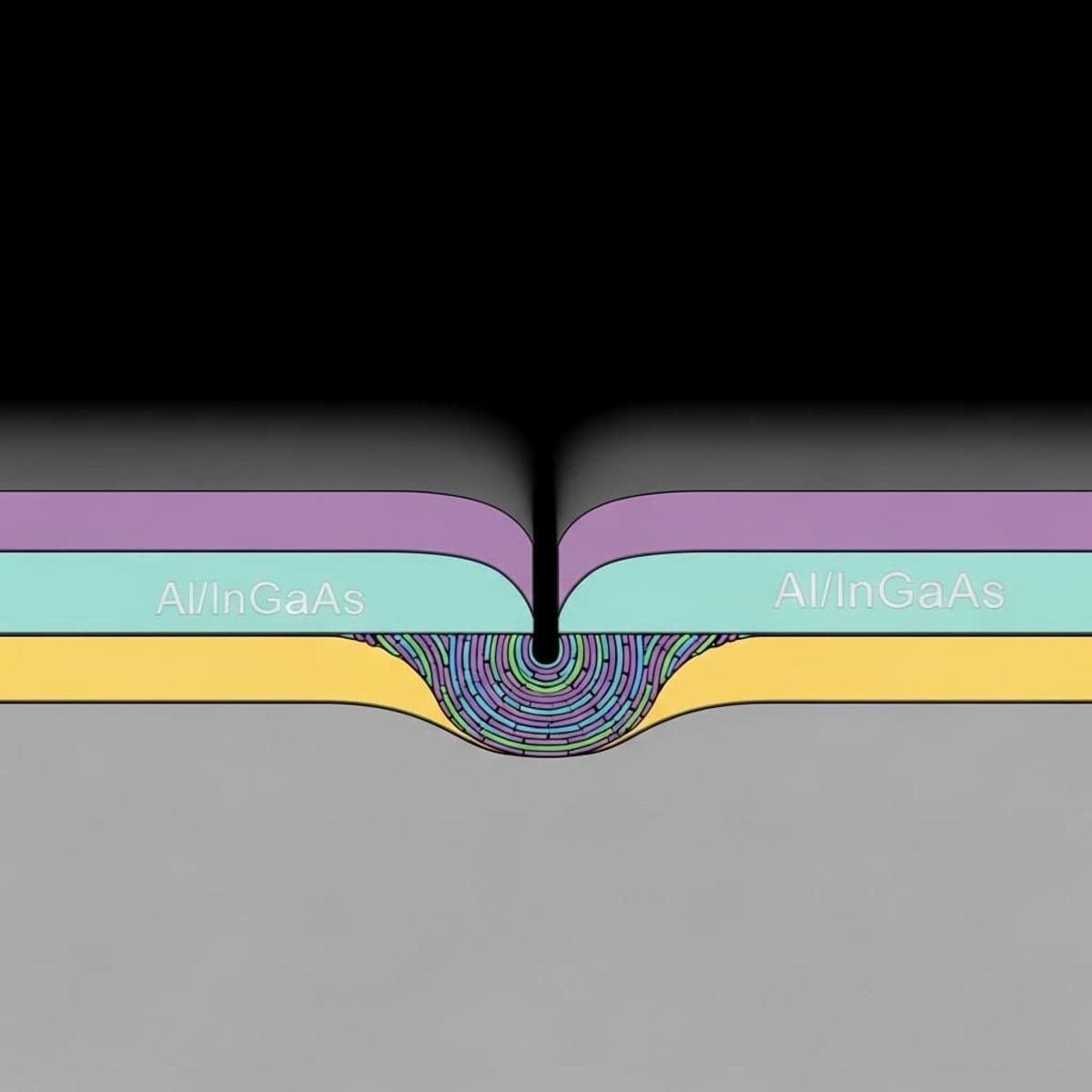
Al/Ingaas System Achieves Continuous Films with No Detectable Indium Interdiffusion
•January 22, 2026
0
Why It Matters
The breakthrough removes a major materials bottleneck, enabling reliable fabrication of topological qubits and other hybrid quantum devices at industrially viable temperatures.
Key Takeaways
- •Near‑room‑temperature Al deposition yields continuous epitaxial films.
- •Deposition rate 3 Å/s prevents indium interdiffusion.
- •Dewetting starts above 165 °C, limiting thermal budget.
- •Interface remains abrupt, preserving superconducting properties.
- •Guidelines enable scalable Majorana and gatemon device fabrication.
Pulse Analysis
Hybrid superconductor‑semiconductor platforms sit at the heart of next‑generation quantum technologies, yet their commercial viability has been hampered by interfacial instability. When aluminium contacts III‑V semiconductors like InGaAs, high‑temperature processing often triggers indium diffusion and film dewetting, degrading superconductivity and device performance. The new approach leverages molecular‑beam epitaxy to deposit aluminium at a rapid 3 Å s⁻¹ while keeping the substrate near 14 °C, effectively freezing the interface and preserving its abruptness. This low‑temperature, high‑rate regime sidesteps the diffusion pathways that traditionally plague Al/InGaAs heterostructures.
Thermal characterization reveals a sharp dewetting threshold around 165 °C, well above typical device‑fabrication steps, granting engineers a generous processing window. In‑situ post‑growth heating and ex‑situ oxidation studies confirm that unoxidized aluminium remains continuous until this limit, while surface passivation further shields the film from rapid diffusion. Transmission electron microscopy and electron energy‑loss spectroscopy validate the absence of indium migration, and transport measurements show a critical in‑plane magnetic field near 0.97 T, matching benchmark epitaxial aluminium films. These metrics underscore that the method delivers both structural integrity and superconducting quality.
For the quantum‑hardware ecosystem, the implications are immediate. Reliable, scalable Al/InGaAs interfaces open pathways to fabricate Majorana‑based topological qubits, gatemon transmons, and Andreev spin qubits with higher yield and reduced variability. The defined growth parameters simplify integration into existing semiconductor fabs, accelerating the transition from laboratory prototypes to manufacturable quantum processors. Future work may explore oxide barrier engineering or alternative III‑V substrates, but the current findings already set a new standard for material stability in quantum device engineering.
Al/ingaas System Achieves Continuous Films with No Detectable Indium Interdiffusion
0
Comments
Want to join the conversation?
Loading comments...