Batio Waveguides Achieve 2.75x Enhanced Nonlinear Frequency Conversion Efficiency
•February 2, 2026
0
Why It Matters
The breakthrough offers a fabrication‑robust, mass‑producible route to high‑efficiency frequency conversion, accelerating integrated photonics and quantum‑optics platforms that previously relied on complex poling techniques.
Key Takeaways
- •2.75× SHG efficiency boost over monolithic BaTiO₃.
- •Hybrid design uses TiO₂ to improve mode overlap.
- •Relies on modal phase‑matching, avoids periodic poling.
- •CMOS‑compatible fabrication enables scalable photonic circuits.
- •Comparable efficiency to lithium‑niobate waveguides.
Pulse Analysis
Barium titanate (BaTiO₃) has long been prized for its strong electro‑optic and χ² nonlinear coefficients, positioning it as a leading candidate for integrated photonic circuits. However, traditional quasi‑phase‑matching methods that work for lithium‑niobate falter with BaTiO₃ because of its high coercive fields and unstable ferroelectric domain switching. These limitations have constrained the material’s adoption in commercial frequency‑conversion devices, prompting researchers to explore alternative architectures that preserve BaTiO₃’s intrinsic nonlinearity while simplifying fabrication.
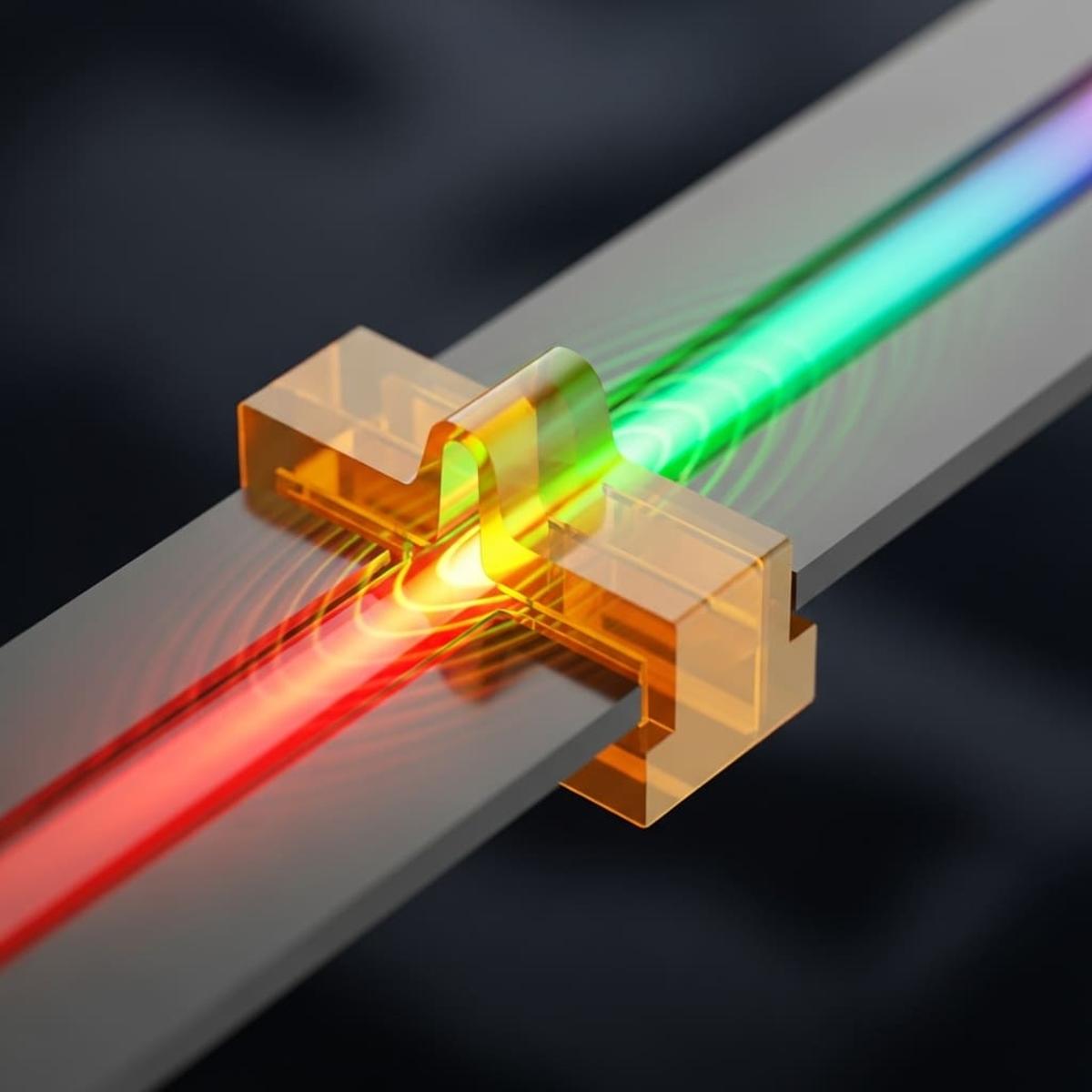
The hybrid waveguide approach solves this dilemma by inserting a thin titanium‑dioxide (TiO₂) layer into the BaTiO₃ ridge. This modest refractive‑index contrast reshapes the optical mode profile, dramatically increasing the overlap between the fundamental and second‑harmonic fields. Coupled‑mode‑theory simulations identified the optimal ridge dimensions, and experimental measurements confirmed a 2.75× rise in normalized SHG efficiency, rivaling the performance of state‑of‑the‑art lithium‑niobate platforms. Crucially, the design relies solely on modal phase‑matching, removing the need for periodic poling and its associated reliability issues.
Beyond the immediate efficiency gains, the fully lithographic, CMOS‑compatible process unlocks mass‑production potential for a new class of nonlinear photonic components. Uniform cross‑sections ensure reproducibility, while the hybrid architecture can be adapted to different wavelengths and nonlinear processes, supporting broadband quantum‑photonics, on‑chip frequency combs, and advanced signal‑processing applications. As the industry pushes toward integrated, low‑power photonic systems, this BaTiO₃‑TiO₂ hybrid platform offers a practical pathway to combine strong χ² response with scalable manufacturing, likely reshaping the roadmap for next‑generation optical interconnects and quantum devices.
Batio Waveguides Achieve 2.75x Enhanced Nonlinear Frequency Conversion Efficiency
0
Comments
Want to join the conversation?
Loading comments...