Beyond Qubits: A Systems View of Hybrid CV-DV Quantum Computing
Key Takeaways
- •Hybrid CV-DV computing merges qubits with oscillator modes as computational resources
- •Symbolic compilation avoids matrix blowup using algebraic rule rewriting
- •HyQBench shows hybrid circuits cut gate count from hundreds to single digits
- •Hybridlane extends PennyLane to manage heterogeneous qubit‑qumode registers
- •Sandia QSCOUT cat‑state benchmark achieved 0.71 fidelity, validating hybrid tools
Pulse Analysis
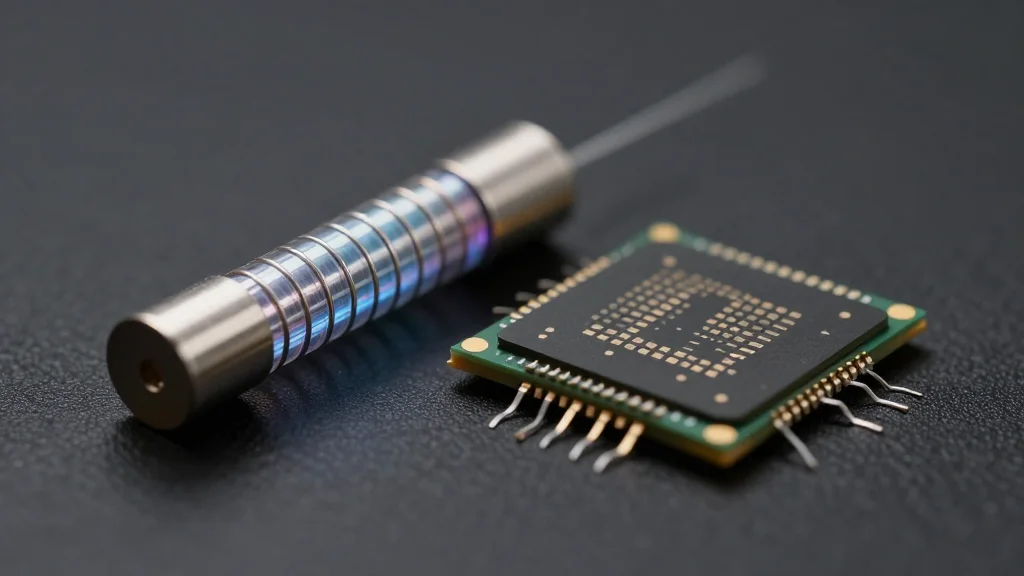
Hybrid continuous‑discrete‑variable quantum computing is emerging as a distinct computational model that leverages the large Hilbert spaces of bosonic oscillators alongside traditional qubits. By treating cavities, vibrational modes, or photonic fields as first‑class resources, platforms such as superconducting circuit QED and trapped‑ion systems can execute algorithms with far fewer discrete qubits. This architectural shift reshapes instruction set design, demanding new abstractions that capture both phase‑space and Fock‑space operations while preserving universality.
A central challenge lies in compiling CV‑DV programs into executable gate sequences. Symbolic compilation, exemplified by the Genesis compiler, sidesteps exponential matrix growth by applying algebraic rewrite rules—Trotter‑Suzuki formulas, BCH expansions, and bosonic commutation relations—to decompose Hamiltonians into native primitives. While this approach curtails resource blowup, it introduces trade‑offs between approximation error and circuit depth, highlighting the need for richer gate sets, more accurate cost models, and optimization passes that exploit commutativity. Ongoing research aims to broaden programmability and integrate pulse‑level control for tighter hardware coupling.
Benchmarking and software tooling are essential for maturing the hybrid ecosystem. The open‑source HyQBench suite demonstrates that hybrid encodings can shrink a three‑site Jaynes‑Cummings‑Hubbard simulation from nine qubits and 393 CNOTs to three qumodes, three qubits, and eight gates, underscoring resource efficiency. Complementary tools like the browser‑based HyQSim simulator and the Hybridlane programming framework—built on PennyLane—lower entry barriers, enabling researchers to design, simulate, and compile heterogeneous circuits across platforms. Together, these advances position hybrid CV‑DV quantum computing as a promising pathway toward scalable, near‑term quantum advantage.
Beyond Qubits: A Systems View of Hybrid CV-DV Quantum Computing
Comments
Want to join the conversation?