Db Signal Boost Achieved by Mitigating Nonlinear Transduction Noise in Cavity Optomechanics
•January 20, 2026
0
Key Takeaways
- •Nonlinear transform removes all orders of thermal intermodulation noise
- •Achieves ~10 dB signal‑to‑noise improvement in high‑cooperativity cavity
- •First experimental observation of third‑order TIN in optomechanics
- •Enables room‑temperature quantum‑limited displacement measurements
- •Protocol implementable on FPGA for broader Lorentzian systems
Summary
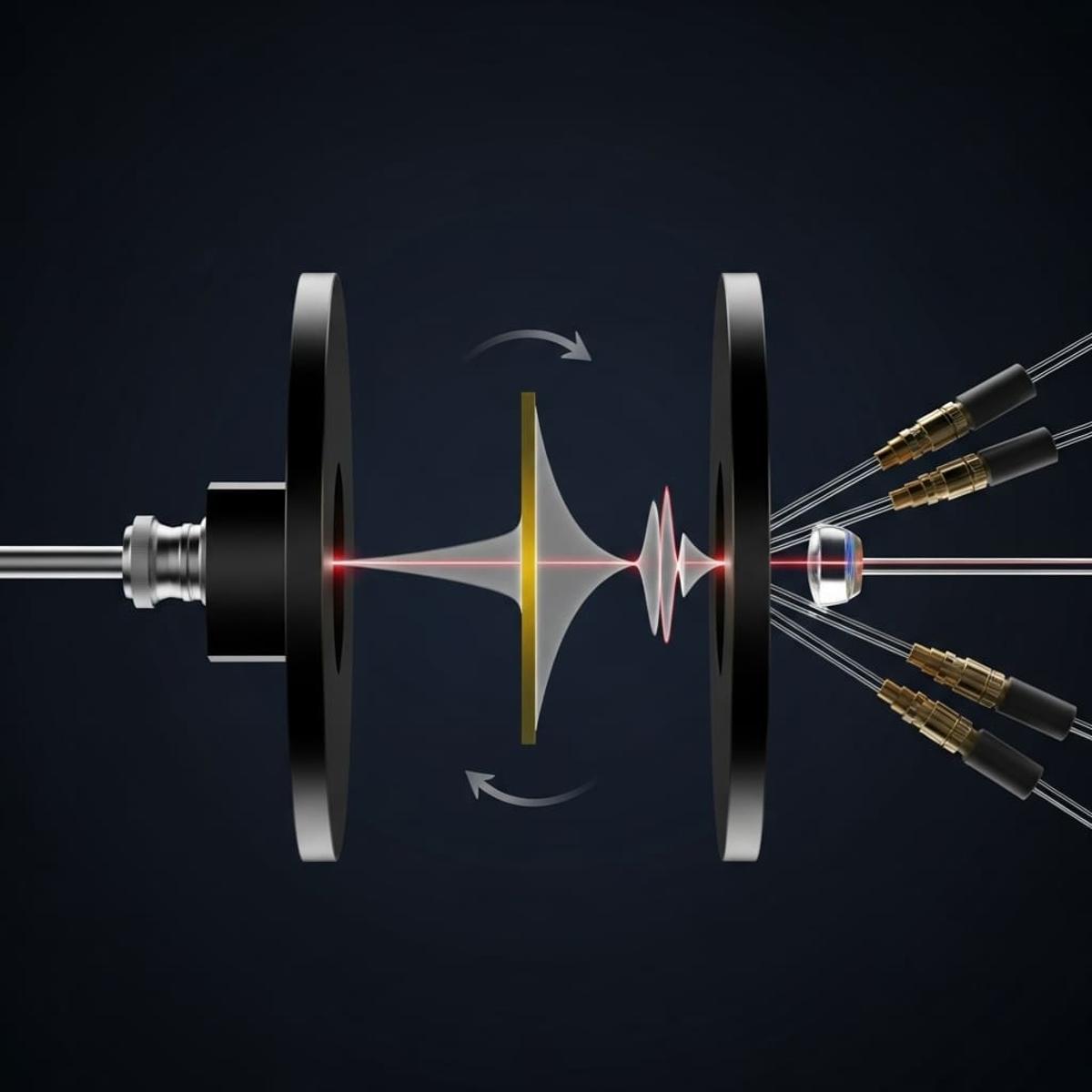
Researchers at the Technical University of Denmark introduced a nonlinear transform that fully suppresses thermal intermodulation noise (TIN) in high‑cooperativity cavity optomechanics. By inverting the full cavity response, they eliminated TIN of all orders, including the first experimental detection of third‑order TIN. The method delivered roughly a 10 dB boost in mechanical signal‑to‑noise ratio, bringing room‑temperature displacement measurements closer to the quantum limit. The approach is digitally implementable, extending its relevance beyond optomechanical microcavities.
Pulse Analysis
Cavity optomechanics has become a cornerstone for ultra‑precise displacement sensing, yet its performance is often throttled by thermal intermodulation noise that escalates with cooperativity. Traditional linearized models fail when thermomechanical motion mixes nonlinearly with the cavity field, creating excess imprecision that masks quantum back‑action. By rigorously analyzing the full Lorentzian response and applying a data‑domain nonlinear transform, the Danish team sidestepped these limitations, offering a systematic pathway to reclaim linear readout even in strongly coupled regimes.
The experimental platform—a membrane‑in‑the‑middle microcavity with cooperativity surpassing thermal occupation—served as a testbed for the new protocol. Spectral and correlation analyses pinpointed narrow features linked to third‑order TIN, a noise component previously only theorized. Inverting the cavity‑detuning relation without linear approximations removed these artifacts, delivering a near‑10 dB uplift in signal‑to‑noise ratio and unveiling a pristine mechanical spectrum. This breakthrough not only validates the theoretical model of higher‑order TIN but also demonstrates that digital post‑processing can achieve what hardware tuning alone could not.
Beyond the immediate gains in measurement fidelity, the technique reshapes the roadmap for room‑temperature quantum technologies. With TIN mitigated, optomechanical systems can approach the quantum back‑action limit, facilitating ground‑state cooling of massive resonators and enabling ponderomotive squeezing without prohibitive noise penalties. The digital nature of the transform—compatible with FPGA deployment—means it can be transplanted to any Lorentzian‑type sensor, from nitrogen‑vacancy centers to quantum dots. Future work will target residual cavity‑frequency fluctuations, aiming to fully unlock quantum‑limited performance in scalable, ambient‑condition platforms.
Comments
Want to join the conversation?