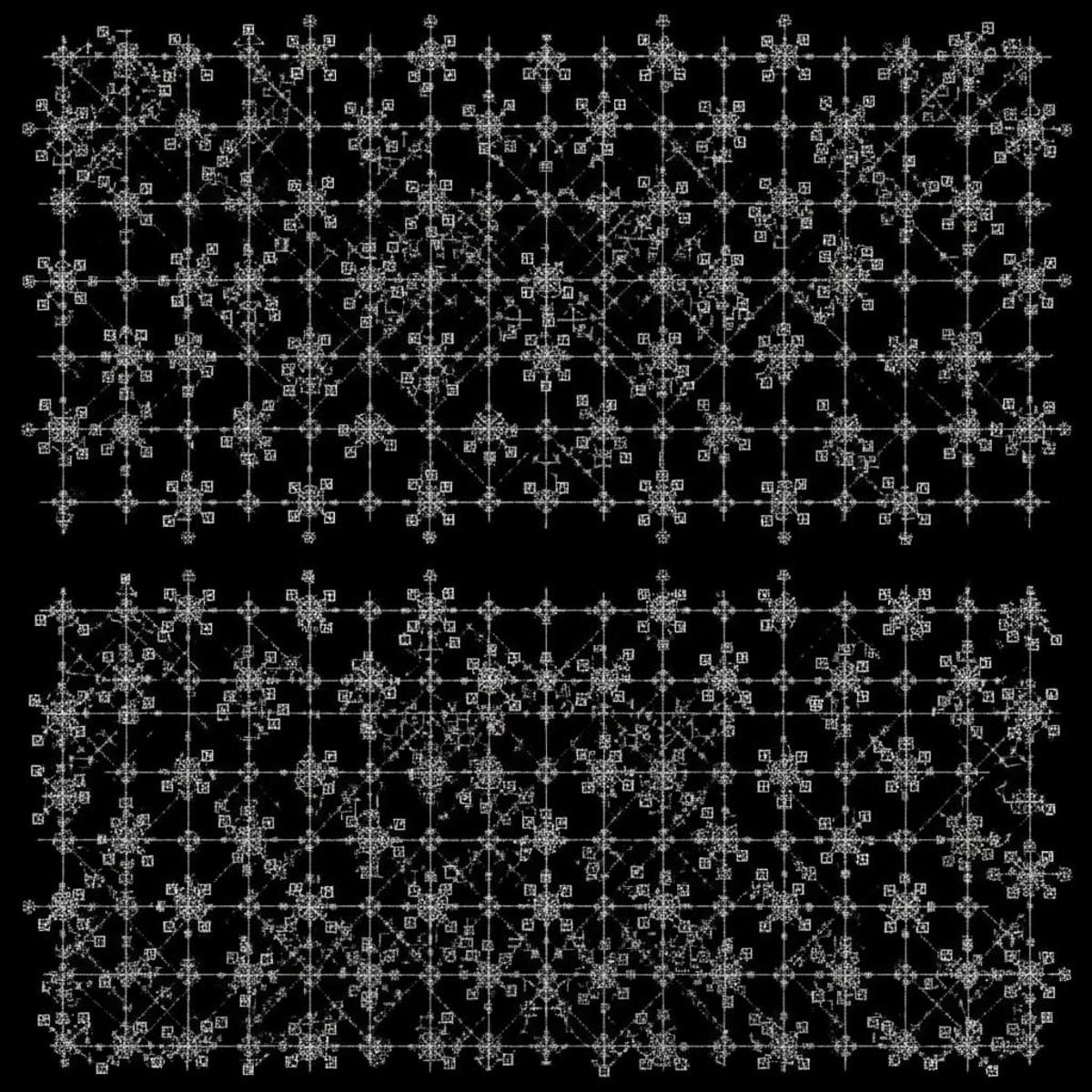
Dmrg Achieves Lowest Energy & Error with Optimal 2D Lattice Layouts
•January 22, 2026
0
Why It Matters
The layout optimisation dramatically lowers computational expense, enabling larger and more accurate quantum material simulations, which accelerates research across condensed‑matter physics and related industries.
Key Takeaways
- •LA_½ correlates strongest with DMRG performance.
- •Optimal Hamiltonian paths halve required bond dimension.
- •Simulated‑annealing finds optimal layout in one second (64×64).
- •Speed‑up factor ≈10 from reduced χ³ computational scaling.
- •Triangular lattices remain challenging, need tailored cost functions.
Pulse Analysis
The Density Matrix Renormalization Group remains the workhorse for simulating low‑dimensional quantum systems, yet its power diminishes when extending to two‑dimensional lattices. The core obstacle is the mapping of a 2D network onto a one‑dimensional chain without inflating entanglement, which directly drives the required bond dimension and runtime. Recent advances focus on geometric representations of the lattice ordering, treating the problem as a linear‑arrangement optimization that balances edge distances against computational cost.
In the new study, the authors introduce a family of cost functions LA_q, discovering that the half‑power variant LA₁⁄₂ serves as the most reliable proxy for DMRG convergence. By coupling this metric with a simulated‑annealing algorithm that explores Hamiltonian paths—especially those resembling Hilbert or "Gilbert" curves—they achieve layouts that consistently outperform traditional snake orderings. Empirical tests on square antiferromagnetic and spin‑glass models reveal that the optimal paths require roughly half the bond dimension to reach the same precision, translating into a ten‑fold reduction in runtime because DMRG scales with χ³.
These findings have immediate implications for computational physics and beyond. Faster, more accurate DMRG simulations open the door to studying larger quantum lattices, probing phase diagrams of frustrated magnets, and benchmarking emerging quantum hardware. Moreover, the underlying linear‑arrangement framework resonates with challenges in circuit layout, bioinformatics sequencing, and network optimization, suggesting cross‑disciplinary benefits. Future work will likely refine cost functions for non‑square geometries and integrate machine‑learning guided searches, further tightening the bridge between algorithmic theory and practical quantum research.
Dmrg Achieves Lowest Energy & Error with Optimal 2D Lattice Layouts
0
Comments
Want to join the conversation?
Loading comments...