Echo Cross Resonance Gate Error Budgeting Achieves 3.7x Performance Improvement
•January 29, 2026
0
Why It Matters
Reducing two‑qubit error rates below 2 % without hardware changes accelerates fault‑tolerant quantum computing and strengthens commercial quantum‑cloud offerings.
Key Takeaways
- •3.7× error reduction on two‑qubit gates
- •Median error fell from 4.6% to 1.2%
- •Pulse‑shaping and compensating gates need no extra hardware
- •Incoherent errors measured between 0.3% and 0.8%
- •Technique equalizes performance across 16‑qubit chain
Pulse Analysis
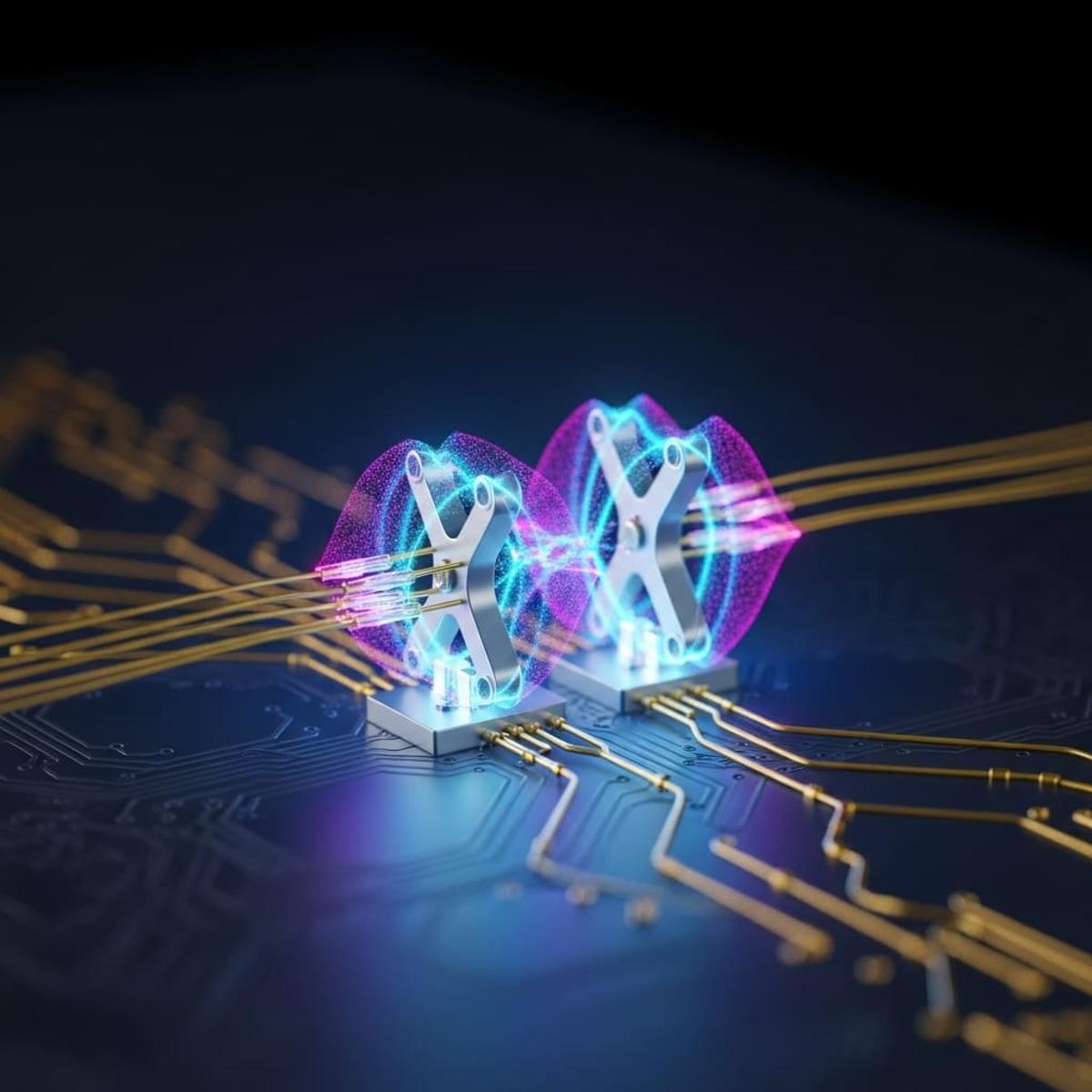
The reliability of superconducting quantum processors hinges on the fidelity of two‑qubit operations, which are the bottleneck for error‑corrected computation. OQC’s Toshiko gen‑1 system, a 32‑qubit device operating in a Tokyo data‑center, employs the native echo cross‑resonance (ECR) gate to entangle qubits. Historically, ECR gates suffer from coherent interactions, control‑qubit leakage, and decoherence, pushing error rates above the 1 % threshold required for practical algorithms. By targeting these specific error channels, researchers aim to bridge the gap between experimental prototypes and scalable quantum hardware.
The team introduced an error‑budgeting framework that quantifies three dominant contributors: incoherent relaxation/dephasing, leakage pathways (Λ₀₁, Λ₁₂, Λ₀₂/₂), and background ZZ‑induced coherent error. Using interleaved randomized benchmarking, they measured median two‑qubit errors of 4.6 % and applied pulse‑shaping to suppress off‑resonant leakage, while compensating rotations countered ZZ coupling. These software‑level adjustments required no additional cryogenic components and reduced the median error to 1.2 %, a 3.7× improvement across a 16‑qubit chain. The approach also leveled performance among previously weak qubit pairs.
Achieving sub‑2 % two‑qubit error rates without hardware redesign accelerates the path toward fault‑tolerant quantum computing and makes near‑term quantum advantage more attainable for commercial users. The methodology can be transplanted to other fixed‑frequency superconducting platforms, offering a cost‑effective route to enhance algorithmic depth and reduce compilation overhead. Future work will refine ZZ‑error cancellation, explore rotary‑echo schemes, and address residual discrepancies between calibrated error models and benchmark outcomes. As quantum service providers seek reliable cloud access, such error‑budgeting techniques become a strategic differentiator in a rapidly maturing market.
Echo Cross Resonance Gate Error Budgeting Achieves 3.7x Performance Improvement
0
Comments
Want to join the conversation?
Loading comments...