Electrical Detection Achieves Direct Readout of Optical Orbital Angular Momentum
•January 22, 2026
0
Why It Matters
Direct, on‑chip OAM detection eliminates bulky optics and exotic materials, enabling high‑capacity, cost‑effective optical networks and quantum information platforms.
Key Takeaways
- •Silicon chip detects OAM from –9 to +9 directly.
- •Record OAM responsivity: 226 nA W⁻¹.
- •Momentum‑matched plasmonic coupling maps vortex to SPPs.
- •Split‑electrode design discriminates beam chirality.
- •Noise‑equivalent OAM resolution reaches 0.05 Hz⁻¹⁄².
Pulse Analysis
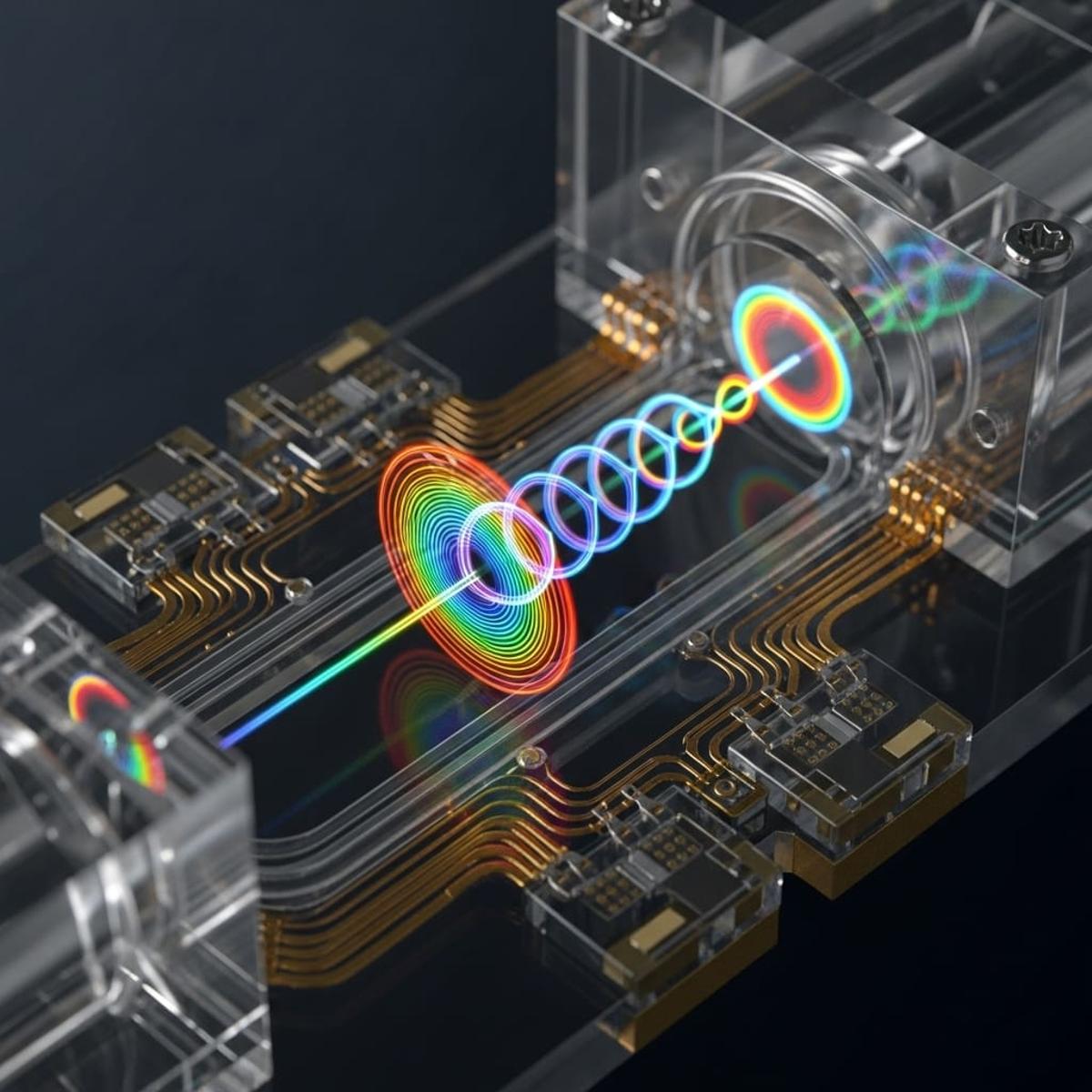
Orbital angular momentum has emerged as a promising degree of freedom for multiplexing data streams, but practical deployment has been hampered by the lack of compact, efficient detectors. Traditional OAM receivers rely on bulky diffractive elements or specialty two‑dimensional materials, which increase cost and limit integration with existing silicon photonics platforms. The new silicon photodetector sidesteps these constraints by converting the helical phase of vortex beams into surface plasmon polaritons that are then electrically read out, offering a truly on‑chip solution.
The core of the device is a momentum‑matched plasmonic coupler that translates each OAM state into a distinct SPP propagation angle. A surface dielectric lens sharpens the spatial separation of these modes, while a split‑electrode layout captures the resulting photocurrents and distinguishes clockwise from counter‑clockwise vortices. This architecture delivers an unprecedented average responsivity of 226 nA W⁻¹ and a noise‑equivalent OAM resolution of 0.05 Hz⁻¹⁄², outperforming all prior OAM detectors and supporting reliable operation even in noisy environments.
For the communications industry, the ability to detect up to 19 orthogonal OAM channels on a silicon chip translates into dramatically higher data throughput without expanding fiber count. In quantum information processing, chirality discrimination enables encoding of qubits in OAM states, facilitating more robust quantum networks. Because the detector is fabricated with standard CMOS‑compatible processes, it can be mass‑produced and integrated with existing transceiver modules, accelerating the rollout of next‑generation high‑capacity optical links and sensing platforms.
Electrical Detection Achieves Direct Readout of Optical Orbital Angular Momentum
0
Comments
Want to join the conversation?
Loading comments...