Fracton Orders Advance 3D Hypergraph Product Codes and Stabilizer Code Design
•January 20, 2026
0
Why It Matters
Fragmented excitations and non‑Abelian defects broaden the toolbox for fault‑tolerant quantum memories, potentially enabling self‑correcting quantum computers.
Key Takeaways
- •Generalized HGP codes host fracton topological order.
- •3‑D orthoplex models show non‑monotonic ground‑state degeneracy.
- •4‑D models reveal fragmented excitations linking points to loops.
- •Non‑Abelian lattice defects enable exotic braiding statistics.
- •Platform offers analytically tractable route to self‑correcting codes.
Pulse Analysis
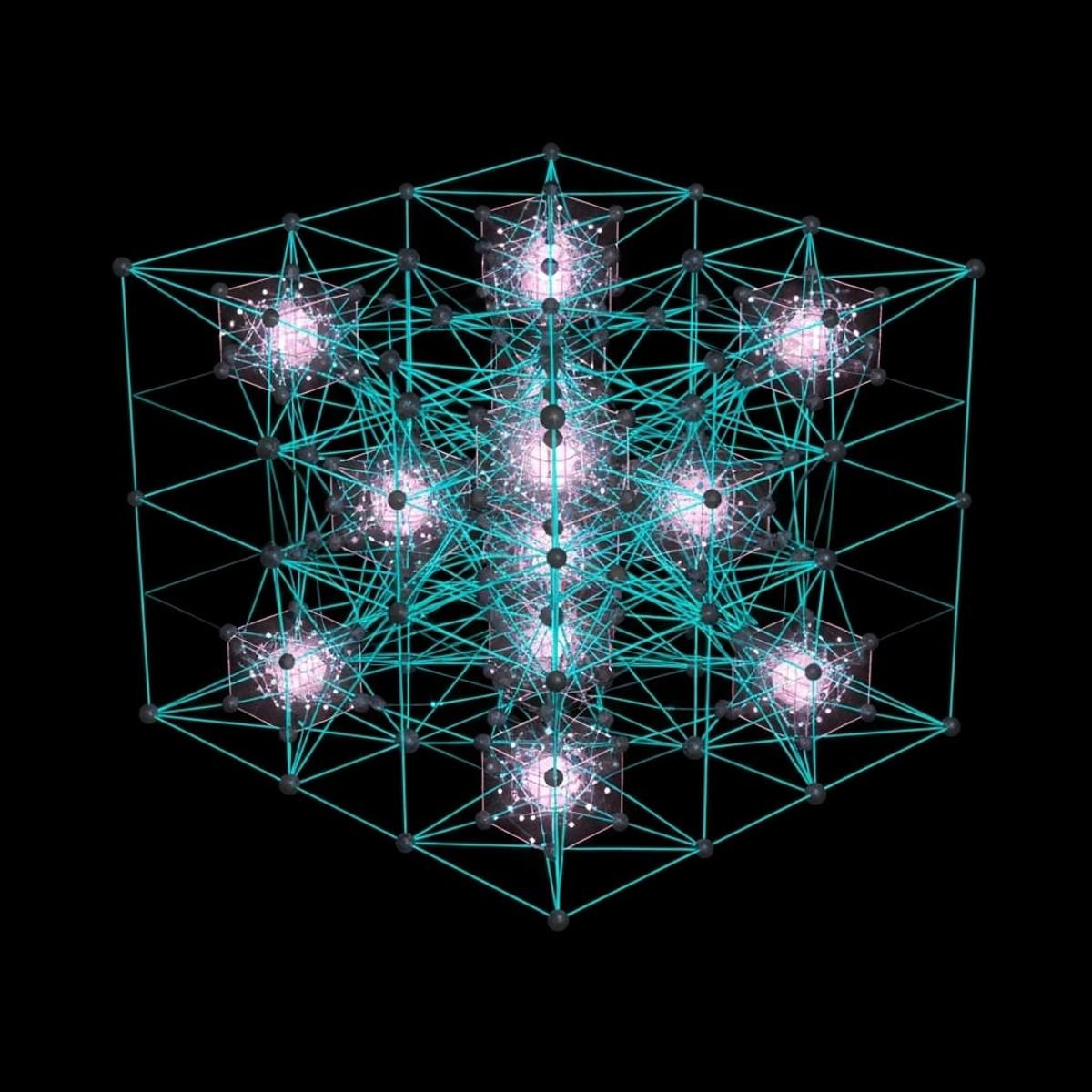
Product‑code constructions have long been a cornerstone of quantum error correction, but their conventional forms struggle to capture the exotic physics of fracton phases. The generalized hypergraph product (HGP) introduced by Li and Wu extends the homological toolkit, allowing each direct‑sum component of a chain complex to be treated independently. This flexibility yields orthoplex models—exactly solvable spin systems whose geometry mirrors high‑dimensional octahedra—providing a rare analytical window into long‑range entangled states that were previously accessible only through numerics or field‑theoretic approximations.
In the three‑dimensional incarnation, the orthoplex models exhibit a striking non‑monotonic ground‑state degeneracy, meaning the number of logical qubits does not simply scale with system size. Coupled with non‑Abelian lattice defects that alter excitation properties upon braiding, these features signal a rich interplay between topology and lattice geometry. The four‑dimensional extension pushes the frontier further by revealing fragmented excitations: quasiparticles that appear isolated in real space yet form continuous loops when projected onto two‑dimensional planes. This intermediate class blurs the line between point‑like and extended excitations, challenging traditional classifications of topological order.
For the quantum‑computing community, these discoveries suggest new pathways toward self‑correcting quantum memories. Fragmented excitations could enable error syndromes that are intrinsically non‑local, reducing the overhead of active error correction. Moreover, the analytical tractability of generalized HGP codes makes them an attractive testbed for exploring fault‑tolerant protocols that leverage non‑Abelian braiding. Future work will likely probe alternative input codes, higher‑dimensional generalizations, and experimental realizations in superconducting or trapped‑ion platforms, accelerating the march toward scalable, resilient quantum processors.
Fracton Orders Advance 3D Hypergraph Product Codes and Stabilizer Code Design
0
Comments
Want to join the conversation?
Loading comments...