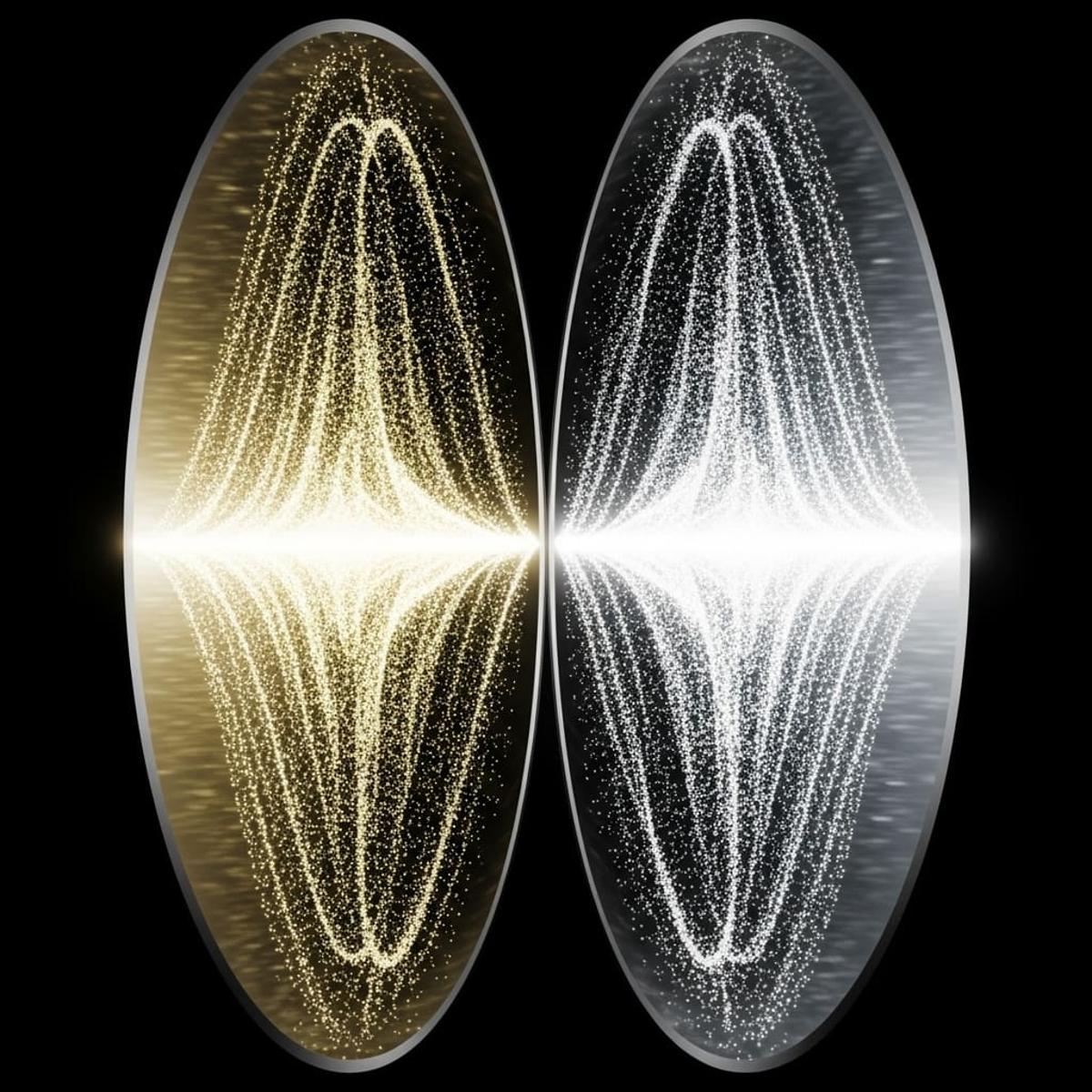
Giant Quantum States with 180 Photons Achieved Via Principles of Optics in Fock Space
•January 19, 2026
0
Key Takeaways
- •Fock‑space optics treats photon number as synthetic dimension.
- •Demonstrated propagation, refraction, interference with 180 photons.
- •Superconducting resonator enables classical‑like optics in quantum regime.
- •Links Schrödinger evolution to paraxial wave equation.
- •Opens path to bosonic processors with thousands of photons.
Summary
Researchers at Tsinghua University introduced “Fock‑space optics,” a framework that applies classical wave‑optics principles to the photon‑number dimension of quantum states. Using a superconducting microwave resonator, they experimentally reproduced propagation, refraction, lensing and interference with up to 180 photons, establishing a direct link between Schrödinger evolution and paraxial wave behavior. This approach bypasses the exponential complexity of traditional Hilbert‑space calculations, offering a scalable route to manipulate giant quantum states. The work paves the way for bosonic quantum information processing that could eventually handle thousands of photons.
Pulse Analysis
The field of quantum optics has long grappled with the exponential scaling of Hilbert spaces as photon numbers increase, limiting experimental progress to few‑photon regimes. Fock‑space optics reframes this challenge by treating photon number as an additional, controllable dimension, allowing researchers to import the well‑established toolbox of geometric ray tracing and wave interference. This conceptual shift reduces computational overhead and provides an intuitive design language for engineering complex quantum states, bridging a gap that has persisted between theoretical elegance and experimental feasibility.
In the laboratory, the Tsinghua team leveraged a superconducting microwave resonator to emulate classic optical phenomena—propagation, refraction, lensing, dispersion, and interference—using coherent states populated with up to 180 photons. By calibrating qubit frequencies to resolve photon‑number‑splitting peaks, they effectively built a “Fock‑space camera” that visualizes the evolution of massive quantum excitations. Crucially, the experiment demonstrated that the Schrödinger equation for a single bosonic mode maps onto the paraxial wave equation, confirming that centuries‑old optics theory remains valid when extended into the quantum regime.
The implications extend far beyond a single demonstration. Scalable control of large‑photon‑number states unlocks new architectures for bosonic quantum computing, where information is encoded in harmonic oscillator modes rather than discrete qubits, potentially simplifying error correction and gate implementation. Moreover, the ability to manipulate thousands of photons could enhance quantum communication channels, sensing platforms, and simulation of many‑body physics. Industry players eyeing quantum advantage now have a concrete pathway to integrate existing photonic infrastructure with emerging quantum hardware, accelerating the transition from laboratory prototypes to commercial quantum technologies.
Comments
Want to join the conversation?