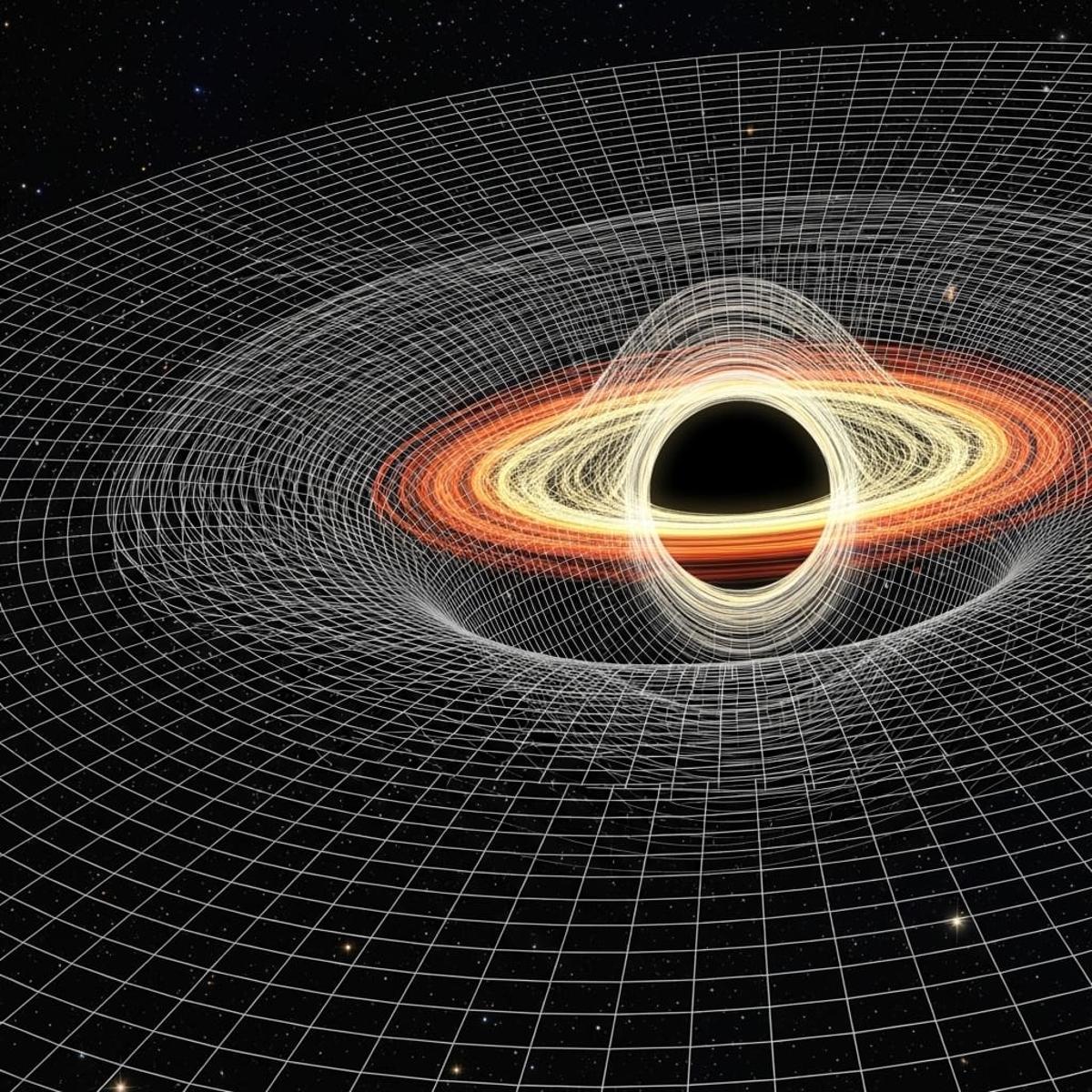
Hawking Radiation Destroys Quantum Links in Three-Part Systems, Study Reveals
•February 5, 2026
0
Why It Matters
Understanding how Hawking radiation reshapes quantum steering bridges quantum information science and gravitation, offering a potential experimental probe of black‑hole physics and informing future quantum communication protocols in extreme environments.
Key Takeaways
- •Hawking radiation disrupts steering with three accessible modes
- •Two-mode access yields mixed enhancement and suppression of steering
- •Single-mode access strongly amplifies quantum steering
- •Steering asymmetry defines a critical phase boundary
- •Findings suggest observable Hawking signatures via quantum steering
Pulse Analysis
Quantum steering, a directional form of entanglement, has become a cornerstone for secure communication and quantum networks. When such correlations are placed in the warped spacetime of a Schwarzschild black hole, the ubiquitous Hawking radiation—thermal particles emitted from the event horizon—interacts with the quantum fields, reshaping their informational properties. This study leverages the Dirac equation in curved spacetime to model how the radiation influences steering among three observers, revealing a nuanced dependence on how many quantum channels remain accessible to measurement. The analysis moves beyond simple decoherence, showing that Hawking particles can both erode and, paradoxically, boost steering depending on the observational configuration.
The authors’ systematic classification of six steering pathways uncovers a phase transition marked by maximal steering asymmetry when all three modes are available. In the two‑mode scenario, the radiation’s dual nature creates a competitive landscape: certain directional steerings are reinforced while others weaken, leading to a net gain for specific configurations. Remarkably, with only a single mode reachable, Hawking radiation acts as a catalyst, intensifying steering beyond its flat‑spacetime baseline. These findings suggest that precise steering measurements could serve as indirect detectors of Hawking flux, a prospect that aligns with emerging analogue‑gravity platforms where laboratory‑scale horizons mimic astrophysical black holes.
Beyond fundamental physics, the results carry practical implications for future quantum technologies operating in relativistic settings, such as satellite‑based quantum links or deep‑space communication networks. By mapping how extreme gravity reshapes quantum correlations, engineers can anticipate performance limits and devise error‑mitigation strategies tailored to curved‑spacetime environments. The study also opens avenues for cross‑disciplinary research, inviting experimentalists to test the predictions with superconducting circuits, optical analogues, or ultra‑cold atom setups that emulate Hawking radiation. As the quest to unify quantum mechanics and general relativity intensifies, insights from quantum steering near black holes could become a pivotal piece of the puzzle.
Hawking Radiation Destroys Quantum Links in Three-Part Systems, Study Reveals
0
Comments
Want to join the conversation?
Loading comments...