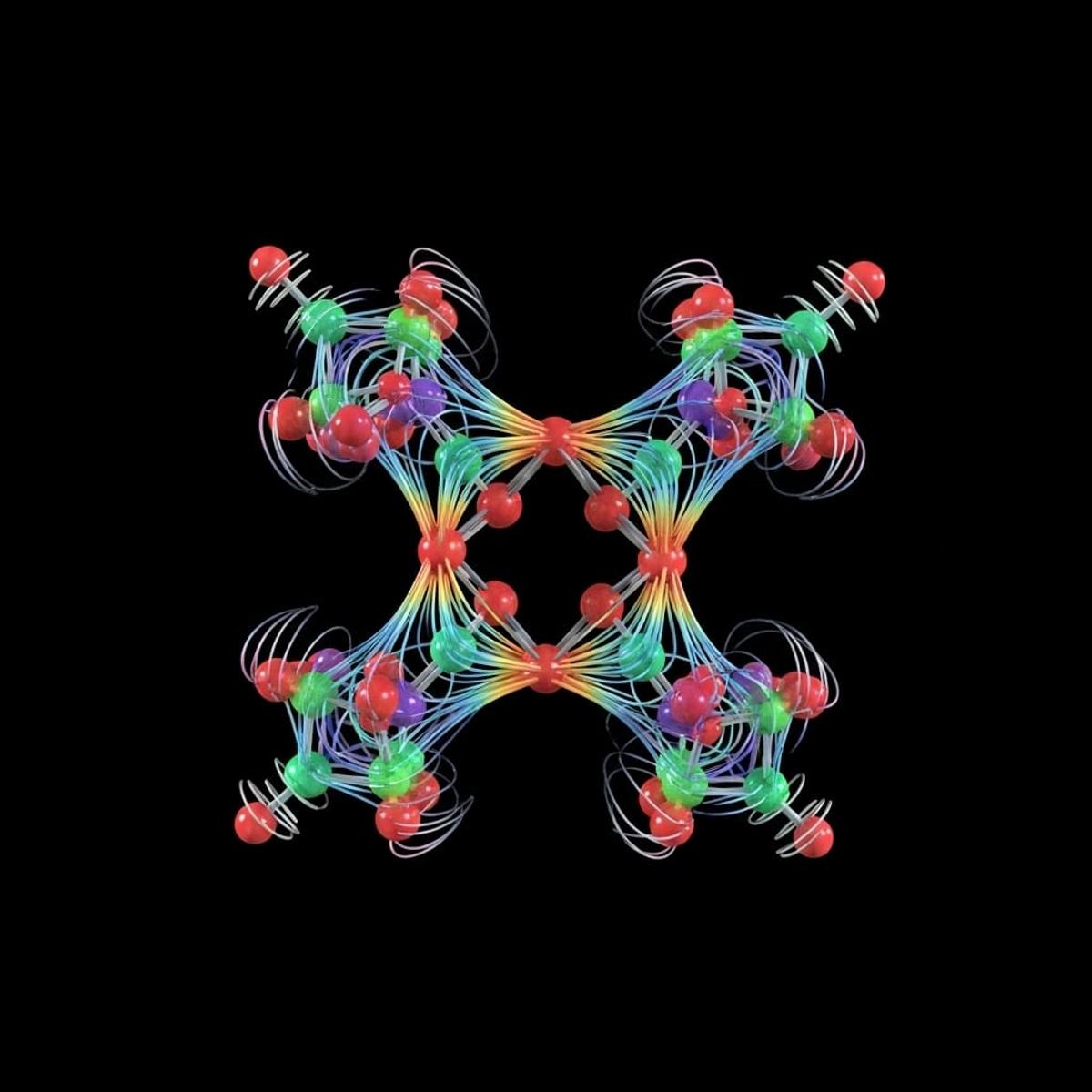
Heom-2dvs Achieves Accurate Simulation of Molecular Vibrations Beyond Thermal Excitation
•January 30, 2026
0
Why It Matters
Accurate quantum simulation of vibrational dynamics unlocks deeper insight into ultrafast chemical processes, accelerating experimental design and material discovery. The open‑source framework lowers barriers for researchers to exploit high‑resolution 2DVS data.
Key Takeaways
- •HEOM‑2DVS merges HEOM with 2D vibrational spectroscopy
- •Simulates non‑Markovian, quantum vibrational dynamics beyond thermal limits
- •Handles three‑mode anharmianic interactions and dephasing mechanisms
- •Open‑source C++ code enables reproducibility and extension
- •Improves 2DVS interpretation for chemistry, biophysics, materials
Pulse Analysis
Hierarchical equations of motion (HEOM) have long been a benchmark for modeling open quantum systems, yet their application to multidimensional spectroscopy remained limited. By integrating HEOM with two‑dimensional vibrational spectroscopy (2DVS), the new HEOM‑2DVS framework bridges this gap, delivering a rigorous treatment of system‑bath entanglement and non‑Markovian effects. This synergy captures quantum coherence and energy‑transfer pathways that classical molecular‑dynamics simulations miss, especially when vibrational excitations surpass thermal populations. The result is a more faithful representation of ultrafast phenomena that drive chemical reactivity in condensed phases.
The implementation, written in high‑performance C++, extends the traditional HEOM approach to a three‑mode anharmonic Brownian model, enabling non‑perturbative and nonlinear interaction analysis. Validation against water’s OH‑stretching vibration demonstrates precise reproduction of linear absorption and 2D correlation IR spectra, confirming the method’s ability to resolve line‑shape origins and dephasing mechanisms. By providing the source code as supplementary material, the authors ensure reproducibility and invite community‑driven enhancements, positioning HEOM‑2DVS as a versatile tool for both theoretical prediction and experimental interpretation.
Beyond immediate scientific value, HEOM‑2DVS could reshape research pipelines in solution‑phase chemistry, biophysical spectroscopy, and materials design. Accurate quantum simulations reduce reliance on costly trial‑and‑error experiments, shortening development cycles for novel catalysts, pharmaceuticals, and functional materials. Future work aims to embed machine‑learning models that translate molecular‑dynamics trajectories into refined HEOM parameters, further automating the analysis of complex 2DVS datasets. As the community adopts this framework, it is poised to become a cornerstone for next‑generation quantum‑aware spectroscopy and computational chemistry.
Heom-2dvs Achieves Accurate Simulation of Molecular Vibrations Beyond Thermal Excitation
0
Comments
Want to join the conversation?
Loading comments...