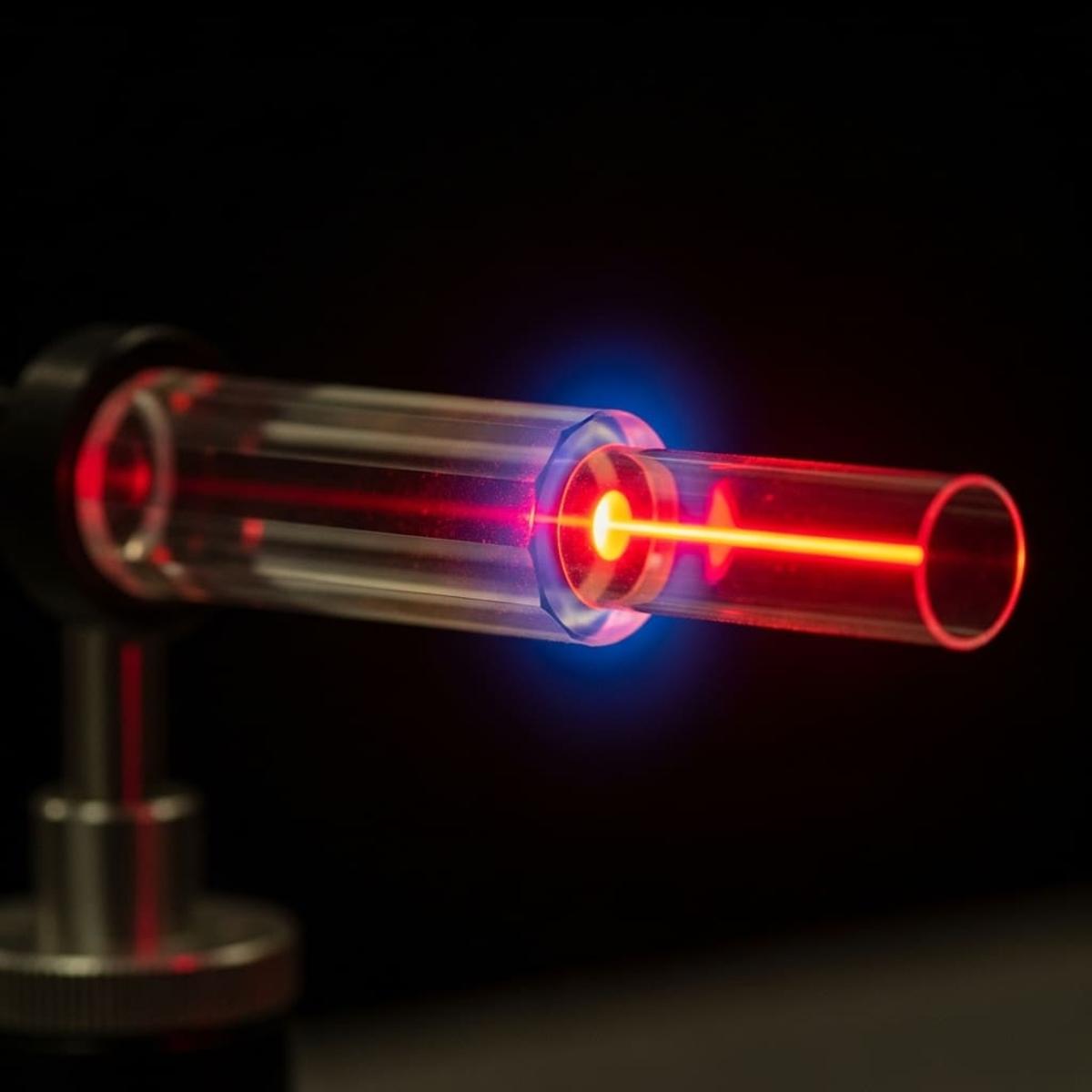
High-Power 2.1-Μm Lasers Achieved Using Innovative Ho3+-Doped CALGO Crystals
•January 24, 2026
0
Why It Matters
The breakthrough lowers cost and complexity for high‑power 2‑µm lasers, unlocking new commercial and scientific opportunities in the short‑wave infrared market.
Key Takeaways
- •52 W average power at 2.1 µm achieved
- •Ho:CALGO offers high gain and thermal conductivity
- •Enables compact SWIR/MIR sources replacing complex OPA systems
- •Supports nonlinear conversion to XUV and soft‑X‑ray
- •π‑polarization yields strongest stimulated‑emission cross‑section
Pulse Analysis
The 2.1 µm wavelength sits at the heart of the short‑wave infrared (SWIR) window, a region prized for its atmospheric transmission and material interaction characteristics. Traditional sources rely on optical parametric amplification, which demands high‑energy pump lasers and intricate alignment. Ho‑doped CALGO crystals combine exceptional thermal conductivity with a broad, disorder‑induced gain bandwidth, allowing direct amplification of ultrashort pulses. This intrinsic material advantage reduces system footprint and operational overhead, making high‑power SWIR lasers more accessible to industrial and research labs.
Spectroscopic measurements reported lifetimes of 5.27 ms and 0.237 ms for the 5I7 and 5I6 manifolds, respectively, confirming efficient energy storage even at modest doping levels. The π‑polarized stimulated‑emission cross‑section peaks at 0.94 × 10⁻²⁰ cm² near 2076 nm, outperforming many holmium‑based hosts. Such strong, polarization‑selective gain enables stable, high‑repetition‑rate operation without the thermal lensing issues that plague conventional crystal lasers. Compared with competing holmium‑doped fluoride or oxide media, Ho:CALGO delivers higher average powers while maintaining ultrashort pulse durations, positioning it as the leading candidate for next‑generation mid‑infrared ultrafast sources.
Beyond raw performance, the ability of Ho:CALGO‑driven lasers to serve as efficient drivers for nonlinear processes expands their utility. Frequency conversion to the extreme ultraviolet (XUV) and soft‑X‑ray domains becomes feasible, supporting time‑resolved studies of electron dynamics. Simultaneously, down‑conversion to the mid‑infrared enhances molecular fingerprinting for environmental monitoring and chemical sensing. Ongoing research into thin‑disk geometries, cryogenic cooling, and optimized doping promises to push average powers toward the hundred‑watt regime, further cementing Ho:CALGO’s role in shaping the future of high‑power ultrafast laser technology.
High-Power 2.1-Μm Lasers Achieved Using Innovative Ho3+-Doped CALGO Crystals
0
Comments
Want to join the conversation?
Loading comments...