High-Temperature Operation Advances Lithium Niobate Waveguide Power Thresholds
•January 27, 2026
0
Why It Matters
The breakthrough enables reliable nonlinear optics in lithium‑niobate platforms where heating is impractical, raising power thresholds for quantum processors and satellite systems. It accelerates deployment of integrated photonics in energy‑constrained environments.
Key Takeaways
- •Auxiliary 532 nm laser restores phase‑matching spectra
- •Technique works from room temperature down to 7 K
- •Enables high‑power operation without high‑temperature heating
- •Reduces pyroelectric effects, improving device stability
- •Potential for space‑borne and quantum photonic platforms
Pulse Analysis
Lithium niobate waveguides are a workhorse for nonlinear optics, but photorefractive damage—light‑induced refractive index changes—has long limited their power handling and spectral fidelity. Conventional mitigation relies on heating the crystal to increase charge‑carrier mobility, a solution that clashes with emerging cryogenic quantum‑photonics and space‑borne systems where thermal budgets are tight. The trade‑off between temperature control and device performance has created a bottleneck for scaling integrated photonic circuits that demand precise phase‑matching and high‑peak powers.
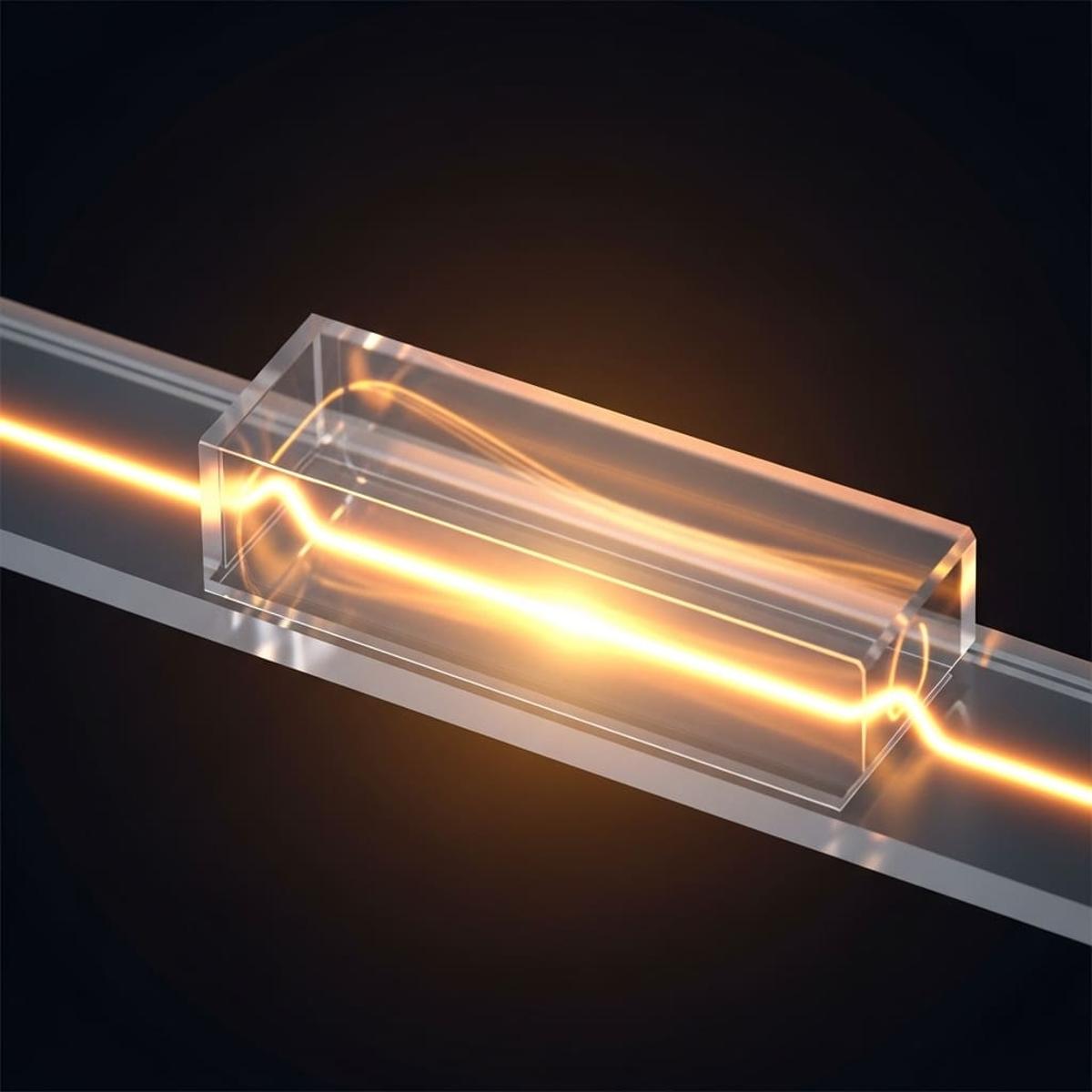
The Paderborn team introduced an "optical cleaning" strategy: coupling a continuous‑wave 532 nm auxiliary beam alongside the pump light within the same Ti:PPLN waveguide. This auxiliary illumination neutralizes trapped charge carriers, effectively suppressing photorefraction and dampening pyroelectric fluctuations. Experimental data showed that at 7 K, where photorefraction normally appears at low continuous‑wave powers, the auxiliary light restored the sum‑frequency generation spectrum to its room‑temperature shape and permitted stable operation at significantly higher powers. The same technique proved effective at elevated temperatures, demonstrating a versatile, temperature‑agnostic solution.
Beyond the laboratory, the method promises tangible benefits for industries targeting low‑energy, high‑precision photonic platforms. Satellite payloads can now exploit lithium‑niobate nonlinear devices without bulky heaters, conserving power and mass. Quantum computing modules operating at millikelvin temperatures gain a reliable source of frequency conversion, essential for interfacing disparate qubit technologies. Future work will likely refine auxiliary‑laser parameters, explore pulsed schemes, and integrate electric‑field biasing to further enhance charge‑relaxation dynamics, cementing this approach as a cornerstone of next‑generation integrated photonics.
High-Temperature Operation Advances Lithium Niobate Waveguide Power Thresholds
0
Comments
Want to join the conversation?
Loading comments...