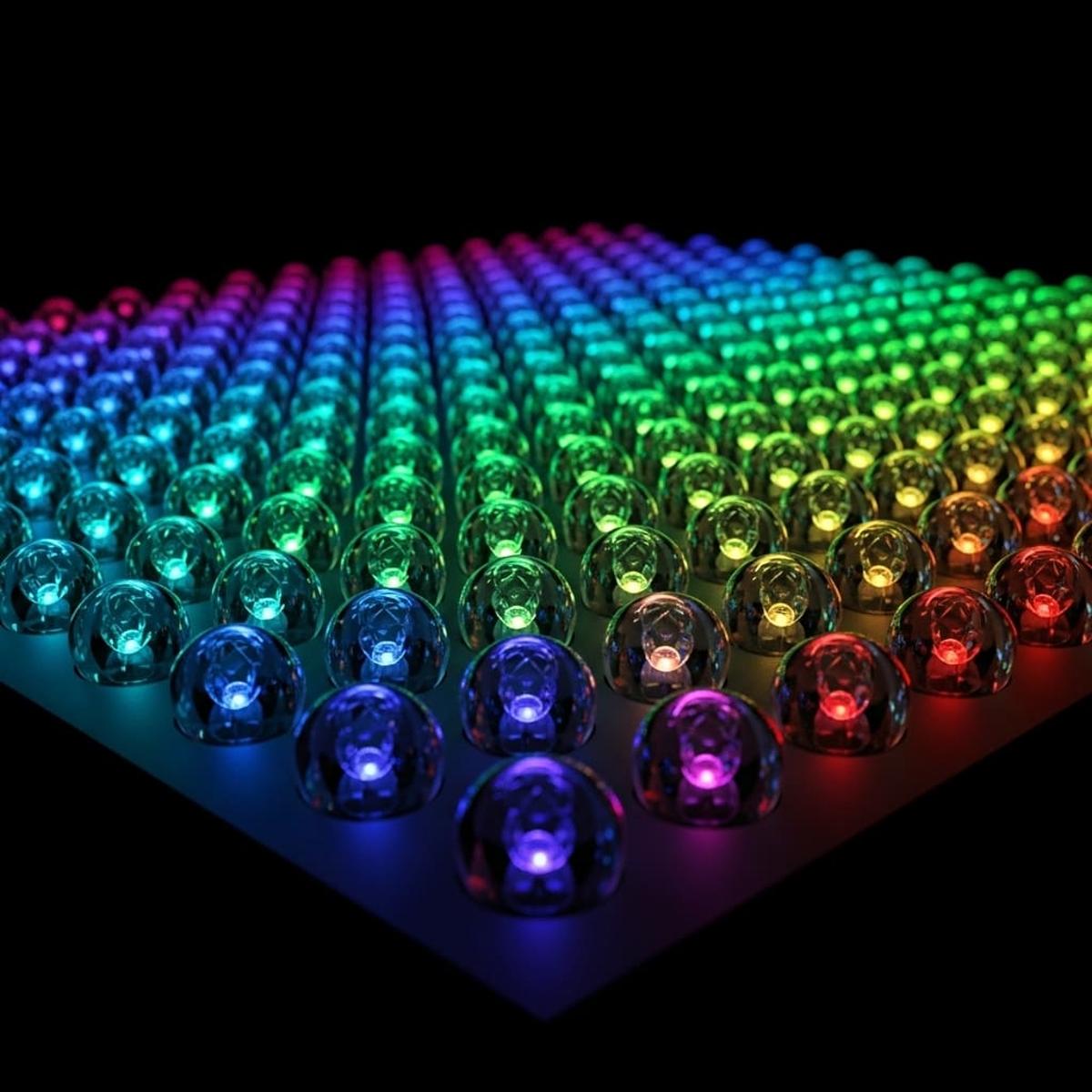
Hundreds of Miniature Light Traps Built for Future Quantum Technologies
•February 9, 2026
0
Why It Matters
The breakthrough provides a scalable, high‑cooperativity interface for neutral‑atom quantum processors, accelerating the development of fast, large‑scale quantum computing and networking.
Key Takeaways
- •603 cavities achieved with average finesse 114
- •Single‑atom cooperativity exceeds ten across array
- •537 cavities degenerate within readout linewidth
- •Field‑of‑view radius limited to 140 µm
- •Path to tens‑thousands cavities via denser microlens arrays
Pulse Analysis
The race to build practical quantum processors has long been constrained by the difficulty of coupling large numbers of atoms to a common photonic mode. Traditional Fabry‑Perot resonators offer high cooperativity but scale poorly, while integrated photonic chips struggle with uniformity and atom‑access. The Stanford team’s cavity‑array microscope sidesteps these trade‑offs by arranging more than six hundred micro‑cavities in a two‑dimensional lattice, each with wavelength‑scale waists and a shared optical axis. This architecture delivers the uniform, high‑finesse environment required for deterministic atom‑photon interactions across an extensive field of view.
Experimentally the array reaches an average finesse of 114 ± 17, translating to a single‑atom peak cooperativity above ten—a benchmark for strong coupling. Remarkably, 537 cavities remain mutually degenerate within the readout‑optimized linewidth, enabling simultaneous interrogation of hundreds of qubits. The researchers mapped stability regions by displacing aspheric lenses in 18 µm steps, revealing a radial hierarchy that informs optimal alignment. A detailed loss budget attributes the remaining 5 % round‑trip loss to coating imperfections, surface roughness and clipping, providing a clear roadmap for incremental improvements.
From a systems perspective, the ability to parallelize readout and entanglement generation could push neutral‑atom processors toward gigahertz‑scale gate rates, a regime currently out of reach. Scaling the microlens density and adopting wide‑field microscope objectives are projected to lift the cavity count into the tens of thousands without sacrificing cooperativity or atom‑surface distance. If realized, such dense, high‑cooperativity arrays would support complex hybrid Hamiltonians, error‑corrected architectures, and distributed quantum networks, positioning cavity‑array microscopes as a cornerstone technology for the next generation of quantum information platforms.
Hundreds of Miniature Light Traps Built for Future Quantum Technologies
0
Comments
Want to join the conversation?
Loading comments...