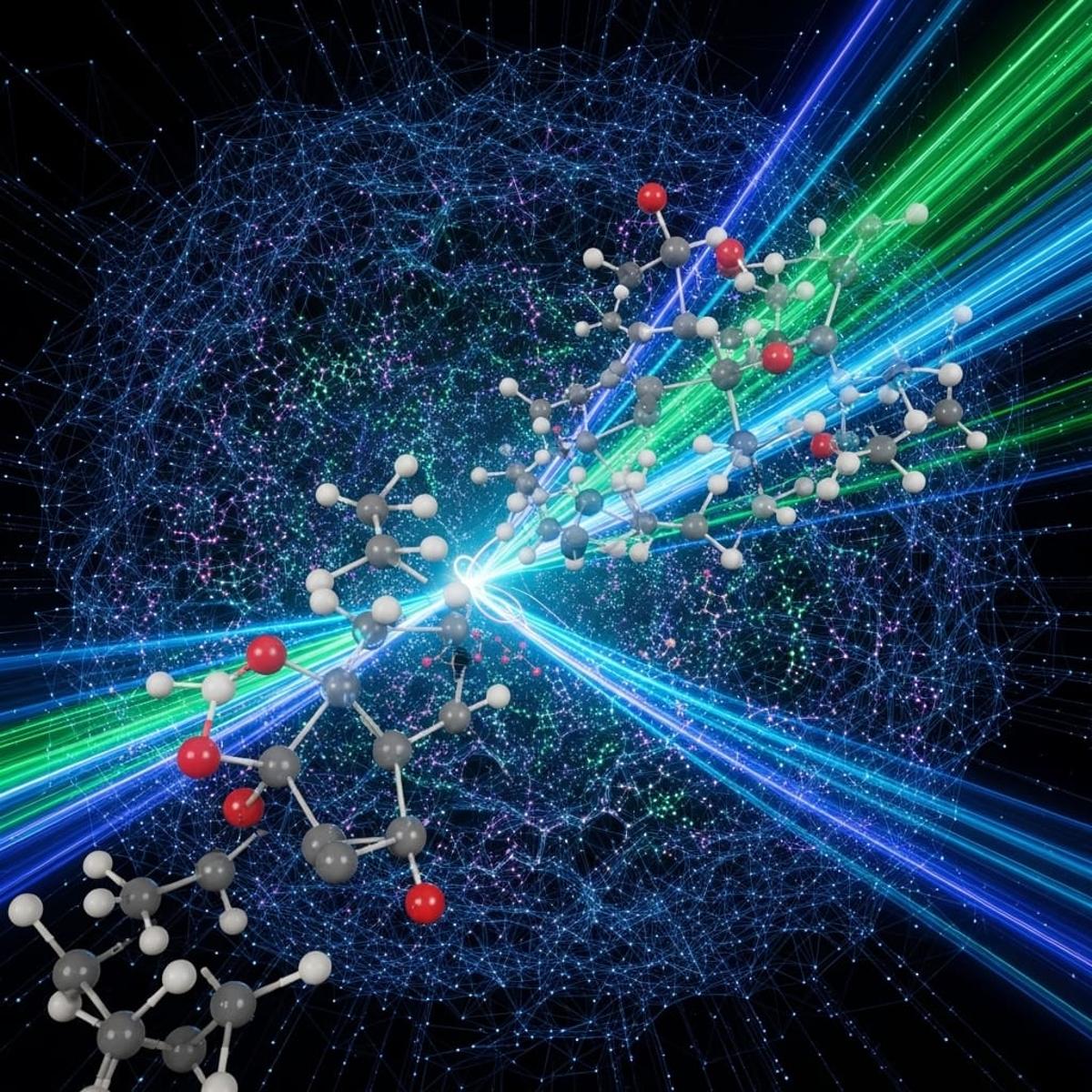
Molecular Language Model Achieves 100x Faster Quantum Hamiltonian Prediction
•January 28, 2026
0
Why It Matters
MGAHam removes the costly geometry bottleneck, accelerating quantum‑chemical workflows and expanding AI‑driven material discovery to larger, data‑limited domains.
Key Takeaways
- •MAE ≈ 7×10⁻⁵ on Hamiltonian elements.
- •Delivers ~100× faster predictions than DFT.
- •Removes dependence on explicit 3‑D molecular geometries.
- •Modality compensation injects spatial information into SMILES embeddings.
- •Validated on MD17, QH9, QH‑BM, and high‑temp datasets.
Pulse Analysis
The emergence of MGAHam marks a shift in computational chemistry, where language models—traditionally confined to property prediction—now tackle the core quantum problem of Hamiltonian estimation. By treating SMILES strings as a linguistic proxy for molecular structure, the model sidesteps the expensive generation of 3‑D coordinates, a step that has long limited the scalability of graph‑neural‑network approaches. This multimodal alignment, coupled with a learnable affine transformation, effectively embeds spatial cues within the token representations, preserving the physics needed for accurate matrix construction while keeping the data pipeline lightweight.
Speed is a decisive factor for high‑throughput screening in drug discovery, catalyst design, and battery materials. MGAHam’s reported 100‑fold acceleration relative to density‑functional theory translates to hours of computation becoming minutes, opening the door to exhaustive virtual libraries that were previously infeasible. The weakly supervised fine‑tuning further reduces the dependence on large Hamiltonian datasets, allowing researchers to leverage sparse or partially labeled data without sacrificing predictive fidelity. This efficiency gain is already evident in a case study on lithium‑metal electrolytes, where the model correctly identified the stabilizing effect of the –CF₃ group, guiding electrolyte formulation decisions.
Looking ahead, the model’s limitation with highly complex systems suggests a hybrid future where geometry‑aware modules intervene only when necessary, preserving speed for the majority of compounds. Extending modality compensation to incorporate experimental spectroscopy or electron density maps could enrich the representation space, enhancing transferability across chemical domains. As AI continues to blur the line between symbolic chemistry and quantum mechanics, MGAHam exemplifies how multimodal learning can democratize access to high‑accuracy quantum predictions, accelerating innovation across the entire materials ecosystem.
Molecular Language Model Achieves 100x Faster Quantum Hamiltonian Prediction
0
Comments
Want to join the conversation?
Loading comments...