Non-Invertible Nielsen Circuits Advance 3d Ising Gravity Understanding with Fusion Graphs
•January 19, 2026
0
Key Takeaways
- •Non‑invertible gates added to Nielsen complexity.
- •Fusion operations become completely positive trace‑preserving channels.
- •Optimization reduces to shortest‑path on fusion graph.
- •Transitions map to shock‑like defects in AdS₃.
- •Provides new discrete tool for holographic complexity.
Summary
Researchers extend Nielsen's circuit‑complexity framework by incorporating intrinsically non‑invertible gates derived from fusion with topological defects. These gates act as completely positive, trace‑preserving channels between superselection sectors, enabling transitions across distinct conformal families in two‑dimensional CFTs. The optimisation problem shifts from a continuous geodesic calculation to a discrete shortest‑path search on a fusion graph. The authors demonstrate the approach with rational CFT examples and interpret the resulting boundary stress‑tensor changes as shock‑like defects in AdS₃ spacetime.
Pulse Analysis
Nielsen’s original circuit‑complexity proposal treats quantum gates as invertible operations on a continuous group manifold, forcing the optimisation into a geodesic problem. By introducing non‑invertible gates—realised through fusion with topological defect operators—the authors break this constraint, allowing circuits to jump between superselection sectors. This shift mirrors recent interest in non‑invertible symmetries, where categorical data replace conventional group structures, and it equips theorists with a richer toolbox for modelling state preparation in conformal field theories.
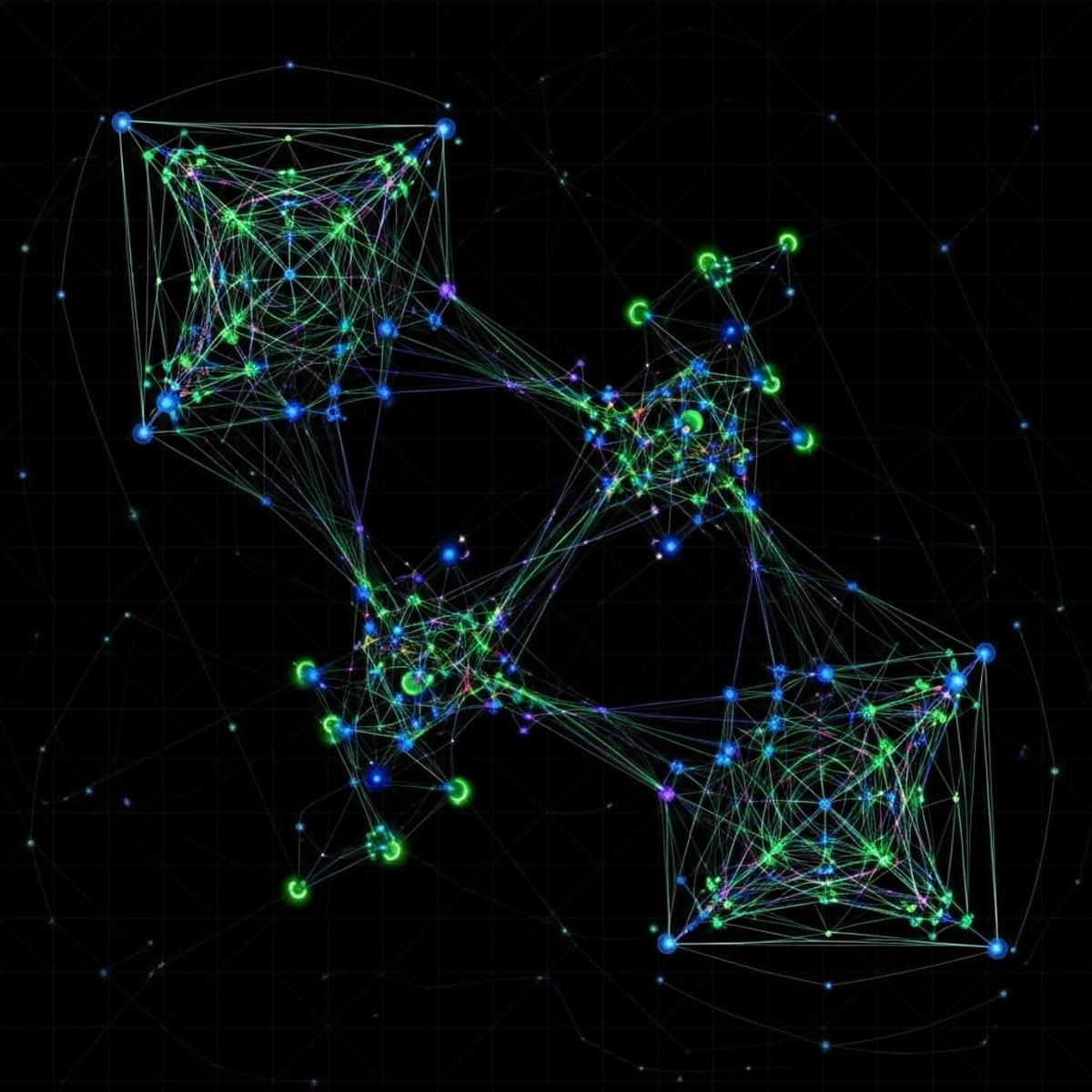
The key technical advance lies in recasting the cost‑minimisation as a shortest‑path problem on a fusion graph. Each node represents a superselection sector, and edges encode fusion rules derived from a unitary modular tensor category. Because rational CFTs possess finite, well‑catalogued fusion data, the graph is tractable, enabling exact calculations of circuit depth and cost. Moreover, the discrete transitions correspond to abrupt changes in the boundary stress‑tensor, which the authors interpret as shock‑like defects in the bulk AdS₃ geometry, linking quantum information measures to concrete gravitational observables.
Beyond the immediate formalism, this framework reshapes discussions of holographic complexity and three‑dimensional gravity. By providing a concrete, discrete analogue of the complexity‑action conjecture, it offers a testbed for exploring how non‑invertible operations affect bulk dynamics, information scrambling, and black‑hole physics. The approach also suggests cross‑fertilisation with topological quantum computation, where fusion processes are already central. Future work will need to address higher‑dimensional extensions and the role of infinite‑dimensional sectors, but the present results mark a significant step toward unifying categorical quantum symmetries with gravitational holography.
Comments
Want to join the conversation?