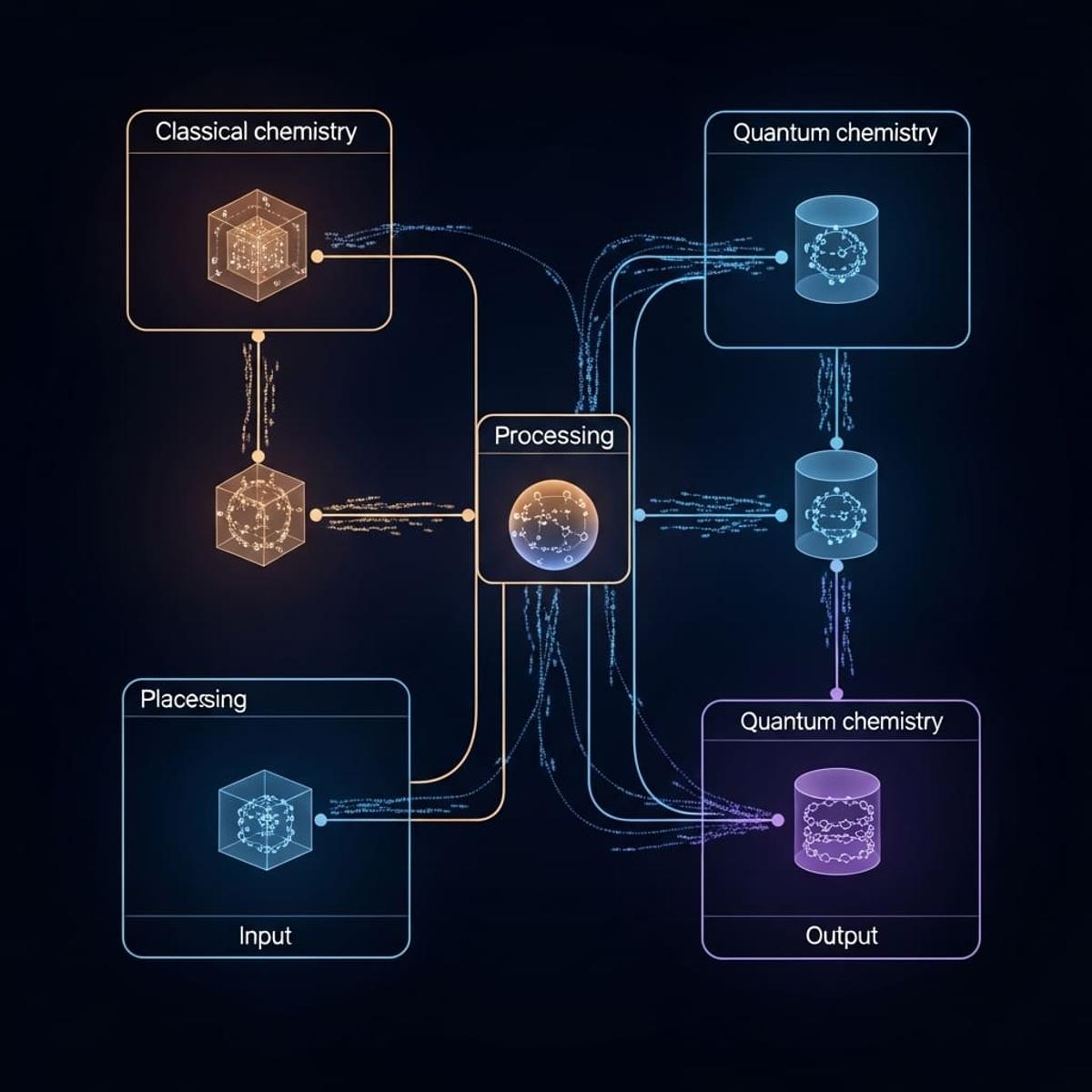
Qdk/Chemistry Advances Modular Workflows, Connecting Classical & Quantum Chemistry Calculations
•January 23, 2026
0
Why It Matters
The framework cuts development time and enhances reproducibility, accelerating material and drug discovery efforts that rely on quantum chemistry simulations.
Key Takeaways
- •Modular design separates data from algorithms.
- •Plugin system integrates existing chemistry packages.
- •Immutable data classes ensure reproducibility and checkpointing.
- •Easy swapping of active‑space selectors and qubit mappings.
- •Accelerates quantum chemistry simulations on near‑term hardware.
Pulse Analysis
Quantum chemistry has long suffered from fragmented toolchains that force researchers to juggle disparate data formats and rewrite code for each new algorithm or hardware target. QDK/Chemistry tackles this bottleneck by establishing a clear separation between immutable data objects and stateless algorithm classes. This architecture not only simplifies provenance tracking but also enables checkpointing, allowing long‑running simulations to be paused and resumed without loss of fidelity. By providing a unified interface, the toolkit reduces the friction that traditionally hampers the adoption of emerging quantum algorithms.
The platform’s extensible plugin system is a game‑changer for workflow flexibility. Developers can plug in established open‑source packages—such as PySCF or Psi4—for tasks like self‑consistent field calculations, orbital localization, and active‑space selection, while the core framework supplies native implementations of qubit Hamiltonian construction, state preparation, and quantum phase estimation. Factory‑based registries make it trivial to swap out components, meaning a researcher can benchmark multiple qubit mappings or error‑mitigation strategies with a few configuration changes. This modularity fosters reproducible experiments and encourages community contributions, extending the toolkit’s lifespan as quantum hardware evolves.
For industry, the implications are immediate. Faster, more reliable quantum‑classical pipelines lower the barrier to exploring strongly correlated electronic systems, speeding the discovery of novel materials and pharmaceuticals. By standardizing data handling and promoting reusable components, QDK/Chemistry shortens the time from hypothesis to simulation results, making near‑term quantum computers a practical asset rather than a theoretical curiosity. As hardware improves, the toolkit’s plug‑and‑play design ensures that new algorithms can be integrated seamlessly, positioning it as a foundational layer for the next generation of quantum chemistry research.
Qdk/chemistry Advances Modular Workflows, Connecting Classical & Quantum Chemistry Calculations
0
Comments
Want to join the conversation?
Loading comments...