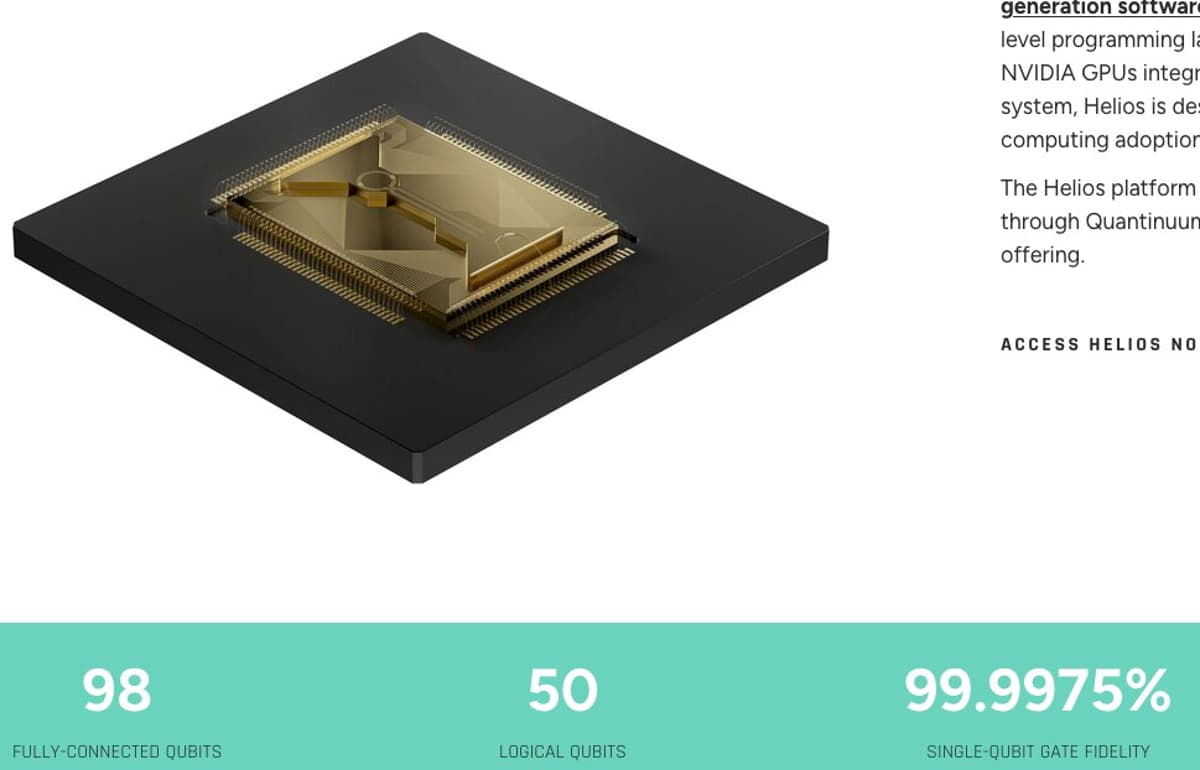
Quantinuum Helios With 98 Physical Qubits and 50 Logical Qubits

Key Takeaways
- •Helios offers 98 physical qubits, 50 fully error‑corrected logical qubits
- •Logical qubits use Iceberg code with ~2 ancilla per logical block
- •Physical‑to‑logical ratio of ~2:1 is industry‑leading efficiency
- •System accessible via Quantinuum cloud and on‑premises deployment
- •Helios sets new benchmark for logical qubit count on trapped‑ion hardware
Pulse Analysis
The quantum computing landscape has long been constrained by the gap between noisy physical qubits and the fault‑tolerant logical qubits required for real‑world algorithms. Quantinuum’s Helios platform narrows this divide by leveraging trapped‑ion technology, which naturally offers long coherence times, and pairing it with an aggressive error‑correction scheme. The result is a system that can sustain a fully entangled GHZ state across 98 physical qubits while delivering 50 logical qubits that operate with dramatically reduced error probabilities. This leap in logical qubit density marks a pivotal step toward scalable quantum workloads.
At the heart of Helios’s performance is the proprietary Iceberg code, a surface‑code‑inspired architecture that encodes each logical qubit using only about two ancilla qubits. This ultra‑efficient ~2:1 physical‑to‑logical ratio outperforms competing platforms, which often require three or more physical qubits per logical unit. The low ancilla overhead not only conserves hardware resources but also shortens the error‑correction cycle, translating into faster gate operations and higher overall throughput. Compared with peers such as QuEra, Helios’s logical qubit count and encoding efficiency set a new industry benchmark for trapped‑ion systems.
Beyond the technical merits, Helios’s dual‑delivery model—cloud access and on‑premises installations—lowers the barrier for enterprises to experiment with quantum algorithms without massive upfront capital expenditures. Companies in finance, materials science, and logistics can now prototype quantum‑enhanced solutions on a platform that offers near‑term fault tolerance. As logical qubit counts continue to rise, the ecosystem of quantum software, compilers, and talent will expand, positioning Quantinuum as a central player in the emerging quantum‑first computing era.
Quantinuum Helios With 98 Physical Qubits and 50 Logical Qubits
Comments
Want to join the conversation?