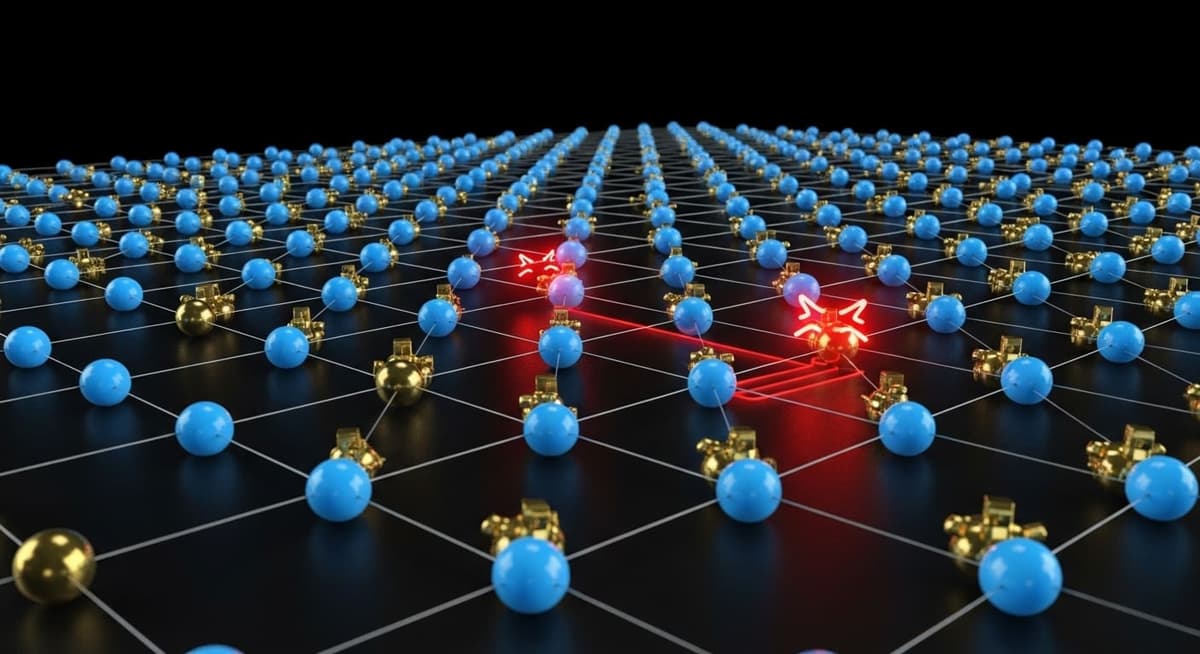
Quantum Computers Edge Closer with Universal Noise Reduction Technique

Key Takeaways
- •Ancilla qubit in GKP code cuts Gaussian noise from σ to O(σ²)
- •Fidelity of non‑Gaussian cat and Fock states improves from 0.54 to 0.9986
- •Technique enables universal hybrid gates, including non‑Gaussian operations
- •Researchers aim to extend method to other noise types and scale up
Pulse Analysis
Hybrid quantum computing blends continuous‑variable (CV) photonic modes with discrete‑variable (DV) qubits, promising computational power beyond classical limits. Yet, CV systems are plagued by Gaussian displacement noise, and existing GKP‑stabilizer codes only mitigate this for Gaussian gates. This asymmetry forces architects to restrict algorithms to a narrow gate set, stalling progress toward truly universal machines. The new ancilla‑augmented GKP approach reshapes that landscape by providing a unified error‑correction layer that works across the entire gate repertoire, effectively turning a previously linear error term into a quadratic one.
The experimental validation demonstrated a striking fidelity boost for non‑Gaussian resources. Preparing a cat state—a delicate superposition of coherent light—saw infidelity drop from 0.46 to 1.4×10⁻³, while Fock states achieved comparable accuracy. These states are essential for quantum key distribution, sensing, and many algorithmic primitives. By reducing the noise’s standard deviation from σ to σ², the ancilla qubit acts as a buffer that absorbs displacement errors without adding significant overhead, a balance that has eluded prior schemes. The result is a more reliable platform for complex quantum protocols that demand high‑precision state preparation.
The broader impact reaches beyond academia. Industries eyeing quantum advantage—pharmaceuticals, materials science, finance—require fault‑tolerant hardware to run deep optimization and simulation workloads. A universal error‑correction framework accelerates the roadmap toward scalable, commercial‑grade quantum processors. Future work will likely expand the ancilla technique to combat other error channels such as photon loss and dephasing, while engineering larger code distances for scalability. As these advances converge, the prospect of practical, fault‑tolerant hybrid quantum computers becomes increasingly tangible.
Quantum Computers Edge Closer with Universal Noise Reduction Technique
Comments
Want to join the conversation?