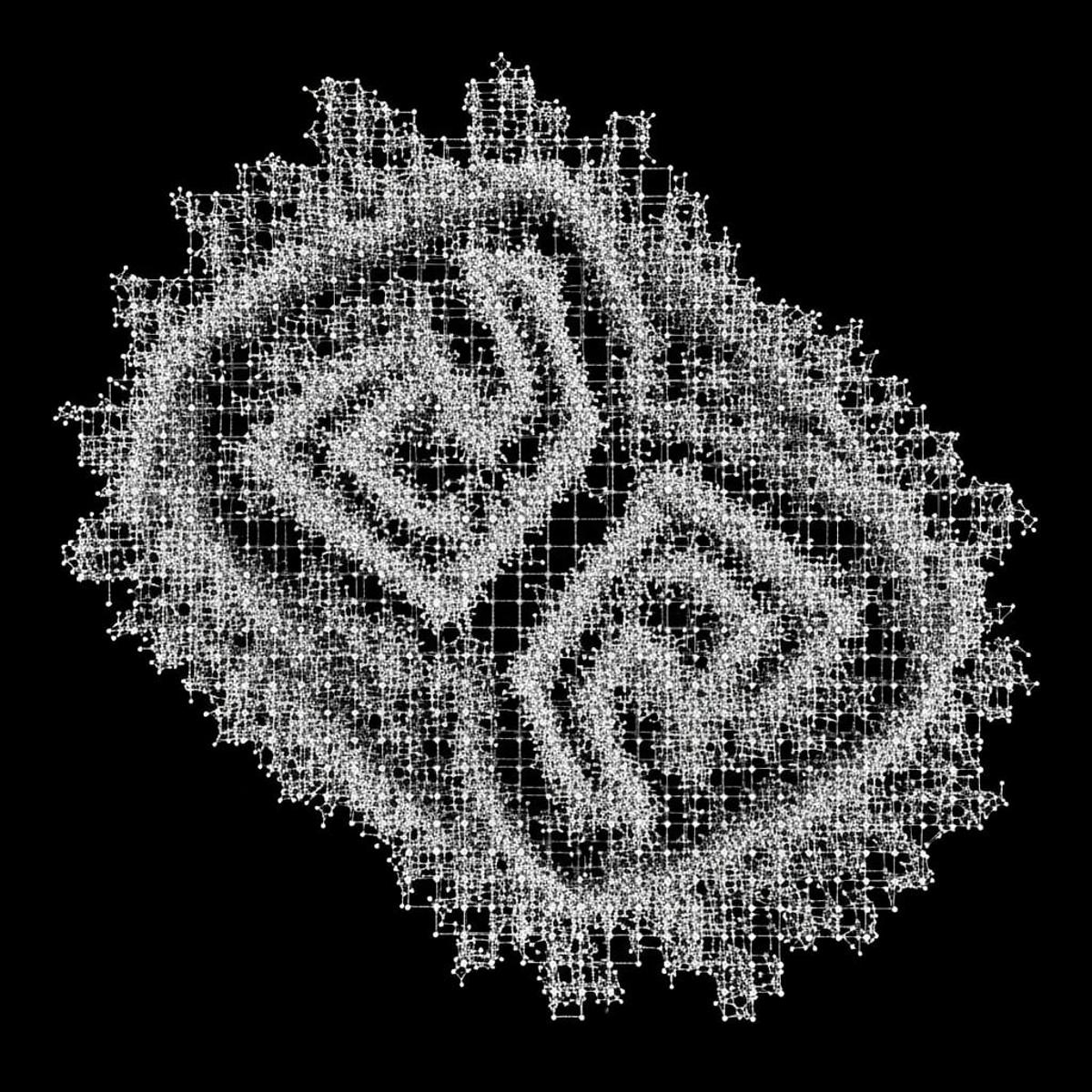
Quantum Dimer Model Achieves Continuous Phase Transition at Critical Value 0
•January 26, 2026
0
Why It Matters
The result offers a rare analytical window into topological quantum phase transitions, informing the design of quantum materials and platforms that rely on robust Z₂ order.
Key Takeaways
- •Exact continuous transition at α = 3 on triangular lattice
- •Z2 spin liquid ↔ columnar order linked via edge‑weighted dimers
- •Correlation length diverges as 1/|α‑3|
- •Visons switch from exponential decay to constant at criticality
- •Critical exponents match 2‑D Ising universality class
Pulse Analysis
Quantum dimer models have long served as a theoretical laboratory for exploring strongly correlated phases, yet exact solutions of their phase transitions are scarce. The new work builds on the Rokhsar‑Kivelson framework, extending it with tunable edge‑weighted superpositions that preserve solvability on a non‑bipartite triangular lattice. By engineering a 2 × 1 periodic weight pattern, the authors isolate a single control parameter α, enabling precise analytical control over the ground‑state wavefunction and its excitations. This methodological advance demonstrates how classical dimer statistics can be directly mapped onto quantum many‑body states, offering a clear pathway to study topological order without resorting to numerics.
At the critical value α = 3 the system undergoes a continuous quantum phase transition. Both dimer‑dimer and vison correlators reveal a correlation length that scales inversely with the distance from criticality, while exactly at α = 3 the decay becomes algebraic, a hallmark of criticality. Finite‑size scaling of the vison correlator yields critical exponents identical to those of the two‑dimensional Ising model, confirming that the transition falls within a well‑understood universality class despite its topological nature. This alignment bridges the gap between topological quantum matter and conventional statistical‑mechanics frameworks, providing a benchmark for future theoretical and computational studies.
The broader impact lies in the model’s experimental relevance. Its exact solvability makes it an attractive target for quantum simulators such as Rydberg atom arrays or superconducting qubit lattices, where programmable interactions can mimic the engineered edge weights. Realizing the Z₂ spin‑liquid to columnar transition in the lab would offer a controllable testbed for topological quantum computation and for probing exotic excitations like visons. Moreover, the construction technique can be generalized to other lattices and weight patterns, opening a fertile research avenue toward designer quantum phases with predictable critical behaviour.
Quantum Dimer Model Achieves Continuous Phase Transition at Critical Value 0
0
Comments
Want to join the conversation?
Loading comments...