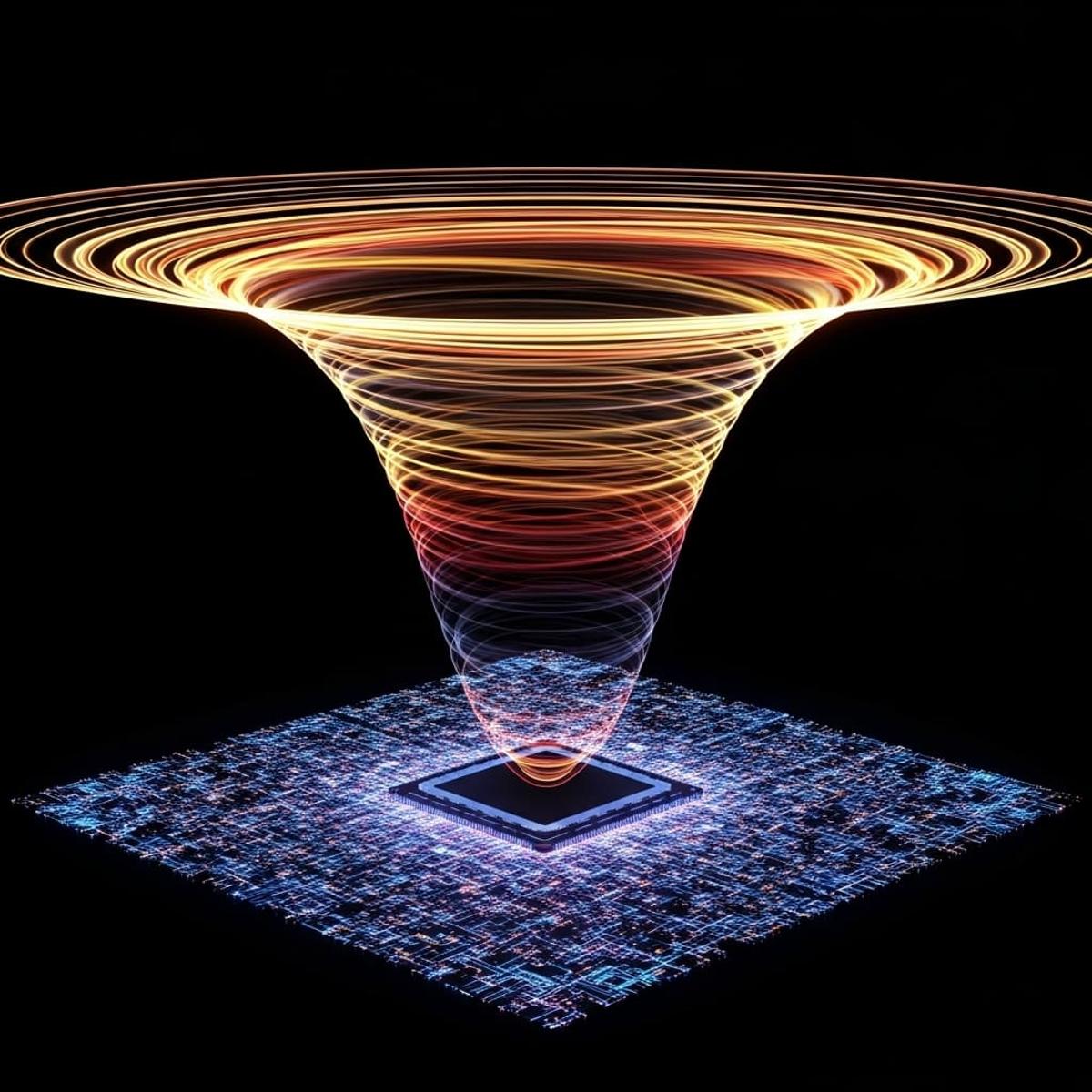
Quantum Simulation Reveals Curved Spacetime on 80 Qubits
•February 26, 2026
0
Why It Matters
These results prove quantum computers can emulate relativistic spacetime effects, providing a controllable testbed for theories that are otherwise inaccessible. This capability could accelerate research in quantum gravity, cosmology, and novel quantum algorithms.
Key Takeaways
- •80 superconducting qubits engineered to mimic warped spacetime.
- •Curved light‑cone propagation observed after quantum quench.
- •Ballistic quasiparticles persisted through 20 Trotter steps.
- •Effective metric created via spatially varying XXZ couplings.
- •Demonstrates quantum processors as testbeds for quantum‑gravity research.
Pulse Analysis
The ability to emulate relativistic phenomena on a digital quantum processor marks a turning point for both physics and computing. IBM’s Heron chip, equipped with 80 high‑coherence superconducting qubits, provides the raw scale needed to encode a spin‑½ XXZ chain whose low‑energy description mirrors an inhomogeneous Tomonaga‑Luttinger liquid. By programming spatially varying couplings, the researchers turned a purely abstract metric into a set of gate parameters, effectively turning the processor into a laboratory for synthetic spacetime. This level of control was previously limited to analog cold‑atom platforms.
After initializing the chain in Néel or few‑spin‑flip states, the team performed a sudden quench and tracked correlation functions across all 80 sites. The resulting data revealed a pronounced curvature of the light cone, matching geodesics derived from the engineered metric, and a freezing of magnetization near the simulated Rindler horizons. Despite the strong spatial inhomogeneity, quasiparticles propagated ballistically with velocities set by the local deformation profile v(x), and clear signatures survived up to twenty Suzuki‑Trotter steps. These observations confirm that digital error‑mitigation and pulse‑level optimization can sustain non‑trivial many‑body dynamics on near‑term hardware.
The experiment opens a practical pathway for probing quantum‑gravity questions that have long been confined to theory. Synthetic curved spacetimes can be used to study Hawking‑like radiation, entanglement entropy across horizons, and the information paradox within a controllable quantum device. Moreover, the techniques demonstrated—metric engineering, adaptive Trotterization, and robust error mitigation—are directly transferable to other quantum‑algorithm domains, potentially accelerating the development of fault‑tolerant processors. As qubit counts and coherence improve, larger and more intricate geometries will become accessible, positioning digital quantum simulators as indispensable tools for both fundamental physics and next‑generation computing.
Quantum Simulation Reveals Curved Spacetime on 80 Qubits
0
Comments
Want to join the conversation?
Loading comments...