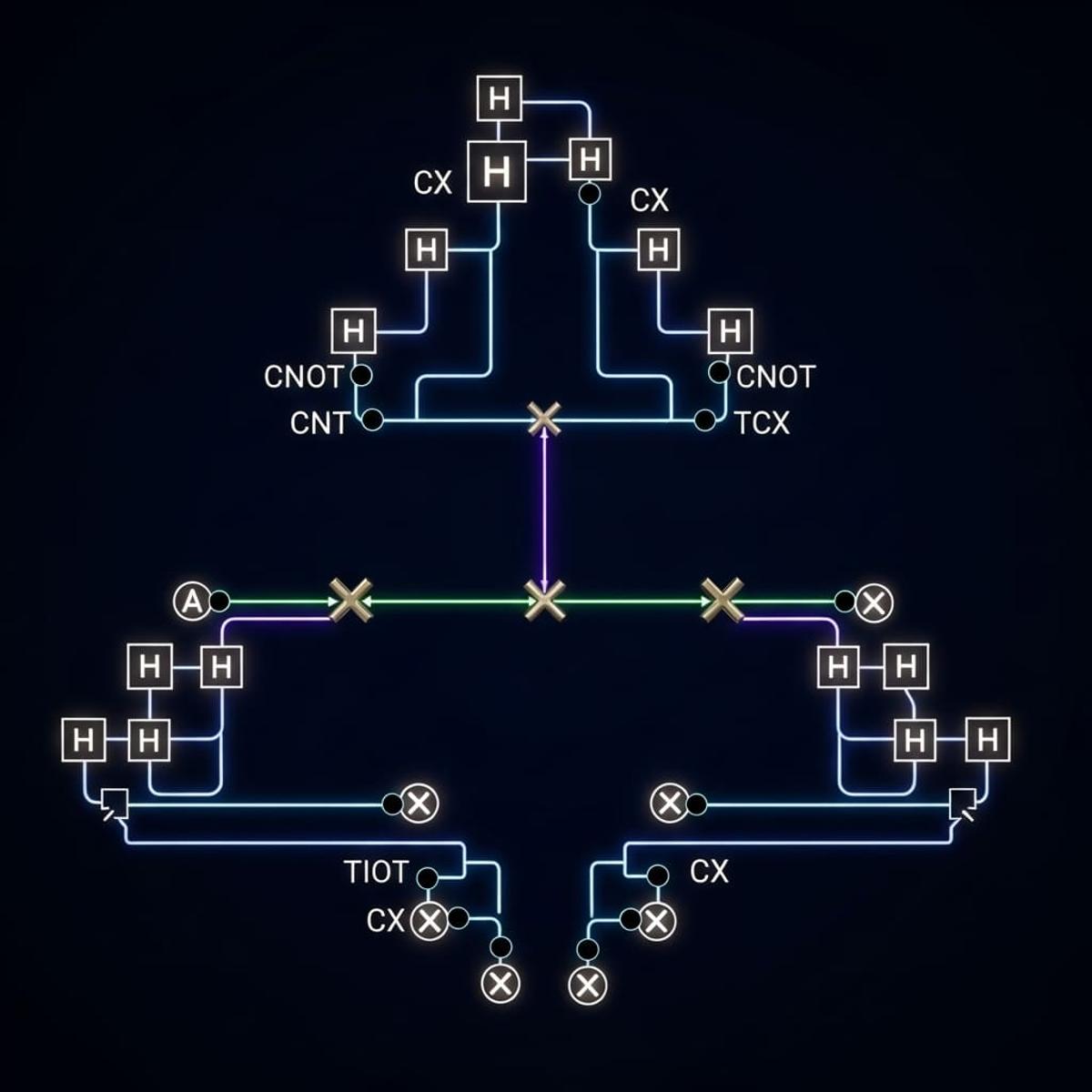
Quantum State Preparation Achieves 97% CNOT Reduction for 14 Qubit Systems
•February 2, 2026
0
Why It Matters
The breakthrough cuts circuit depth on real hardware, directly boosting the feasibility of near‑term quantum simulations in chemistry and materials science.
Key Takeaways
- •Co-ADAPT-VQE reduces CNOT gates up to 97% for 12-14 qubits
- •Works under linear nearest-neighbor connectivity constraints
- •Outperforms original ADAPT even with all-to-all connectivity
- •Customizable penalty balances circuit depth and hardware error rates
- •Enables near-term quantum chemistry simulations with chemical accuracy
Pulse Analysis
Quantum hardware today is limited by qubit connectivity, short coherence times, and variable gate errors, making two‑qubit operations the primary bottleneck. The CNOT gate, in particular, dominates circuit depth and error accumulation, so any reduction translates into higher fidelity results. Traditional ADAPT‑VQE algorithms generate problem‑tailored ansätze without considering these hardware realities, often requiring extensive transpilation that inflates gate counts. Co‑ADAPT‑VQE flips this paradigm by co‑designing the algorithm with the device, integrating a penalty function that discourages circuit elements likely to incur large overhead on linear nearest‑neighbor (LNN) processors. This hardware‑aware selection yields compact circuits that are intrinsically suited to the target architecture.
The authors validated their approach on linear H₆ and H₇ molecular models, demonstrating up to a 97 % cut in CNOT gates for 12‑ to 14‑qubit systems. Compared with standard all‑to‑all ADAPT‑VQE, Co‑ADAPT‑VQE still outperforms even when the latter enjoys unrestricted connectivity, delivering more than a 70 % reduction in two‑qubit operations. The custom penalty can be tuned to prioritize depth, post‑transpilation gate count, or device‑specific error rates, offering flexibility across diverse NISQ platforms. By preserving chemical accuracy while slashing gate overhead, the method proves scalable for larger, more correlated quantum chemistry problems.
For industry, the impact is immediate. Reduced gate counts lower error budgets, enabling reliable simulations of molecular ground states that underpin drug discovery and materials design. Hardware‑aware algorithms like Co‑ADAPT‑VQE accelerate the transition from theoretical quantum advantage to practical, near‑term applications, aligning with the roadmap of quantum‑ready enterprises. As quantum processors evolve toward higher qubit counts and improved connectivity, the co‑design philosophy will remain essential, ensuring that algorithmic advances keep pace with hardware capabilities and deliver tangible business value.
Quantum State Preparation Achieves 97% CNOT Reduction for 14 Qubit Systems
0
Comments
Want to join the conversation?
Loading comments...