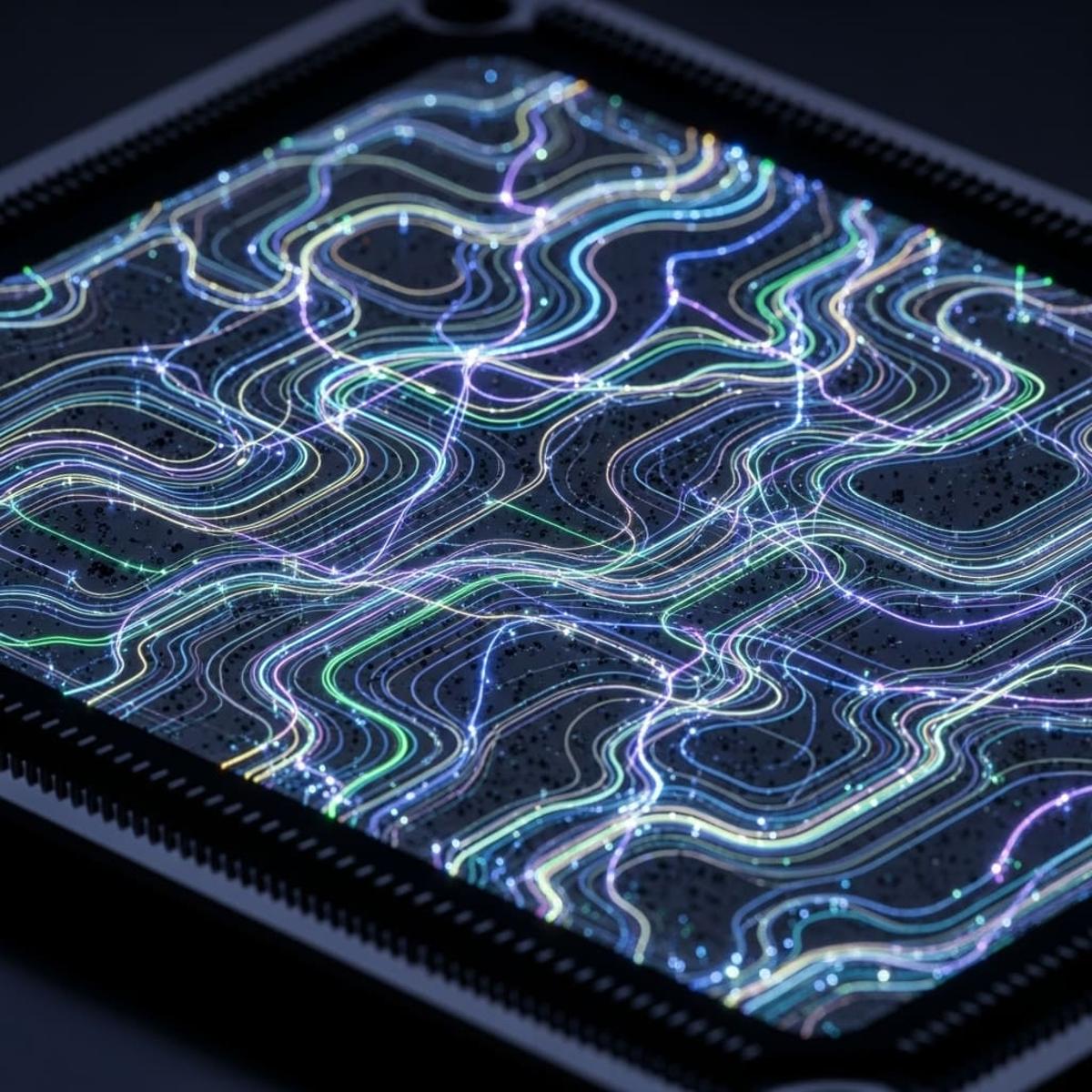
Quantum Walks on Photonic Processors Advance Universal Quantum Computation
•January 22, 2026
0
Why It Matters
Precise control of decoherence via absorbing boundaries expands photonic quantum processors’ capability to simulate realistic open‑system dynamics, accelerating robust quantum algorithm development and quantum‑enhanced modeling of materials and biological processes.
Key Takeaways
- •Leaking quantum walks realized on integrated photonic processor.
- •Absorbing boundaries tune decoherence and transport dynamics.
- •Experiments match theoretical DTQW simulations across loss strengths.
- •Platform mimics energy transfer in biological complexes like FMO.
- •Future work aims at time‑varying or random losses.
Pulse Analysis
Photonic integrated circuits have emerged as a leading substrate for implementing quantum walks, offering unparalleled phase stability, low loss, and the prospect of large‑scale integration. In the recent study from Quix Quantum, a universal photonic processor was programmed to execute discrete‑time coined quantum walks while embedding a tunable absorbing boundary. This hardware‑level control surpasses previous bulk‑optics demonstrations, allowing thousands of steps to be simulated on a chip‑scale platform. The ability to manipulate single‑photon paths with nanometer precision positions photonic processors as a practical route toward universal quantum computation.
The introduction of controlled loss—effectively an absorbing boundary—transforms the walk from a closed, unitary evolution into an open quantum system that can emulate realistic environmental interactions. Experimental data reveal that the probability distribution of the walker reshapes proportionally to the loss strength, mirroring theoretical predictions for energy transport in complex networks such as the Fenna‑Matthews‑Olson (FMO) complex. By reproducing both coherent and noise‑assisted transport regimes, the platform provides a testbed for exploring decoherence‑enhanced algorithms, quantum biology simulations, and optimized material‑design strategies that rely on balanced coherence and dissipation.
Looking ahead, the demonstrated control over boundary‑induced decoherence opens several commercial pathways. Quantum‑enhanced sensing devices could exploit tailored loss to improve signal‑to‑noise ratios, while quantum‑machine‑learning frameworks may incorporate leaking walks to encode probabilistic inference. Moreover, the scalability of integrated photonics suggests that future processors could implement time‑dependent or stochastic loss profiles, bringing simulations of real‑world noisy environments within reach. As industry invests in photonic quantum hardware, the ability to model open‑system dynamics on‑chip will likely accelerate the transition from laboratory prototypes to deployable quantum technologies.
Quantum Walks on Photonic Processors Advance Universal Quantum Computation
0
Comments
Want to join the conversation?
Loading comments...