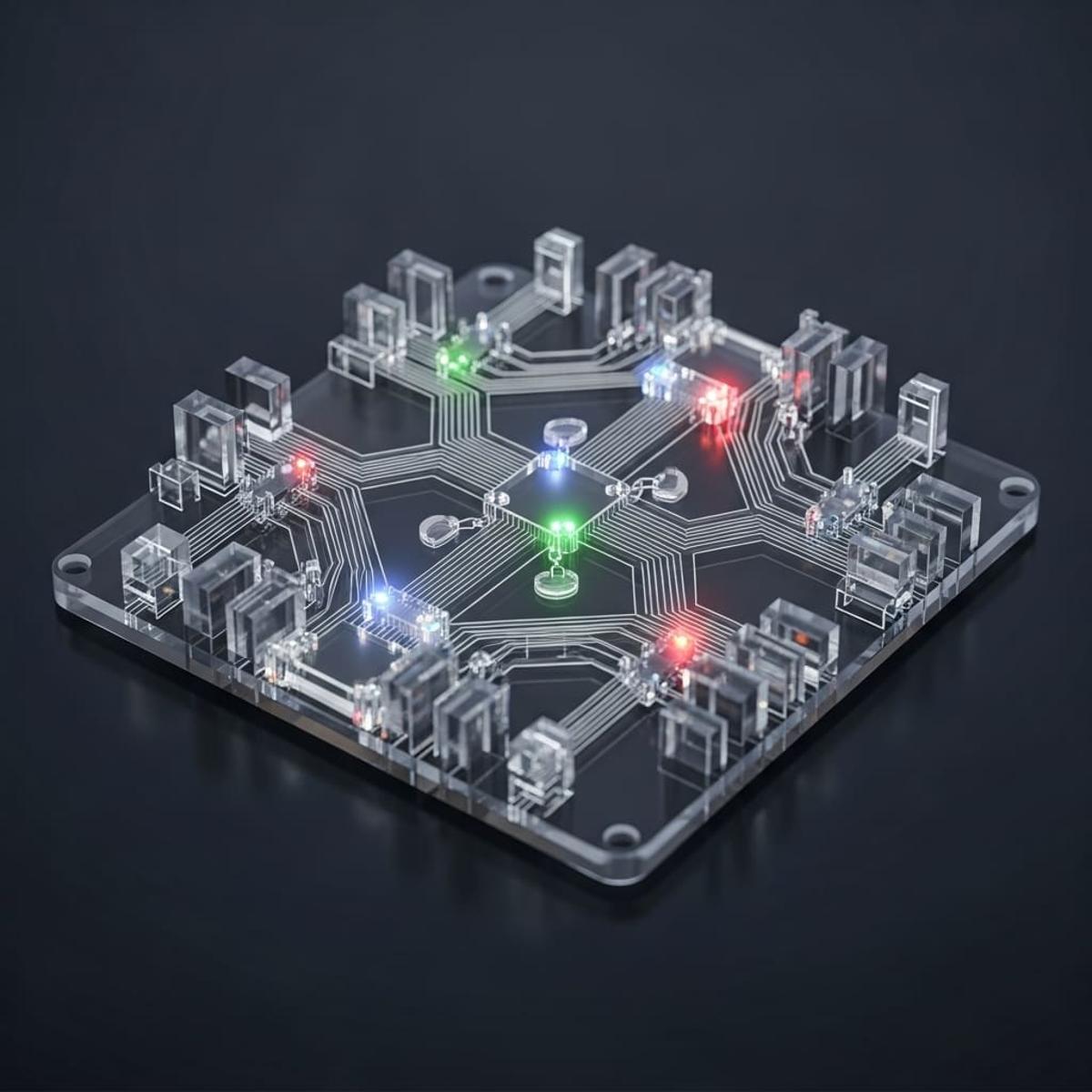
Quantum ‘Walls’ Halt Information Spread, Revealing New Rules for Causality
•February 9, 2026
0
Why It Matters
The framework provides a new tool for engineering non‑ergodic quantum systems that protect information and offers a measurable spectral fingerprint to distinguish causal constraints from quantum chaos, impacting quantum computing and simulation.
Key Takeaways
- •Wall unitaries create permanent light‑cone barriers in circuits
- •Invariant sub‑algebra splits operator space into commuting sectors
- •Entanglement obeys area‑law under causal constraints
- •Spectral form factor reveals distinct non‑chaotic signature
- •72‑qubit processor validates algebraic predictions experimentally
Pulse Analysis
The discovery of ‘wall’ unitaries reshapes our understanding of information flow in many‑body quantum systems. In conventional circuit models, local operators spread ballistically, forming a light cone that eventually entangles the entire device. By inserting a tri‑partite gate that acts as an impenetrable barrier, the authors demonstrate that the evolution can be partitioned into causally independent regions, a property rooted in an invariant sub‑algebra of the operator algebra. This algebraic perspective bridges quantum information theory with the mathematical structure of von‑Neumann algebras, offering a rigorous language for describing constrained dynamics.
The paper leverages representation theory of finite matrix algebras to derive the general form of wall gates as unitary automorphisms, revealing a set of local conserved quantities that enforce the barrier. These constraints give rise to an entanglement area‑law, in stark contrast to the volume‑law typical of chaotic systems, and remain robust under projective measurements. Spectral analysis of random ensembles respecting causal independence shows a polynomial scaling of the spectral form factor, providing a clear diagnostic that separates these systems from the universal chaotic ensemble.
Experimental validation on a 72‑qubit superconducting processor confirms the theoretical predictions, with measured operator spreading halted at the engineered walls and the expected spectral signatures observed. This capability to deliberately restrict information propagation opens new pathways for designing non‑ergodic quantum hardware that can protect logical states from thermalization and error proliferation. Moreover, the framework may inform quantum field theory models of spacelike separation and inspire measurement‑induced phase‑transition studies, positioning causal‑constrained circuits as a versatile platform for next‑generation quantum technologies.
Quantum ‘walls’ Halt Information Spread, Revealing New Rules for Causality
0
Comments
Want to join the conversation?
Loading comments...