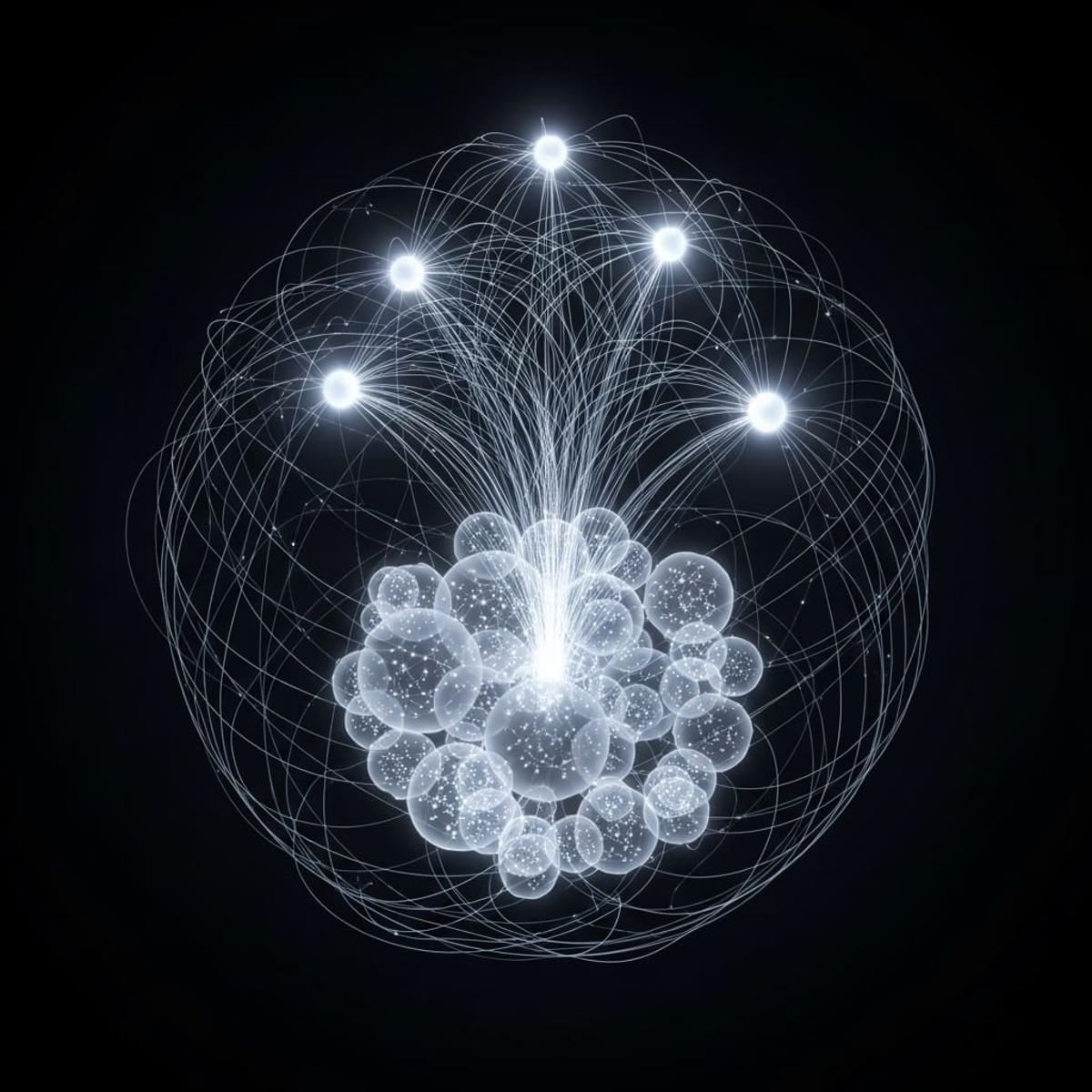
Qubit-Qudit Entanglement Transfer Achieves High-Spin Nuclear Memory with Arbitrary Dimension
•January 29, 2026
0
Why It Matters
The method offers a hardware‑efficient path to high‑dimensional quantum memory, extending coherence times and enabling deterministic entanglement distribution crucial for a future quantum internet and error‑corrected computing.
Key Takeaways
- •Entanglement transferred from electron qubits to high‑spin nuclear qudits
- •Deterministic maximal entanglement when dimension d is power two
- •Scheme operates without continuous driving, using hyperfine Ising interaction
- •Applicable to ^73Ge, ^51V, group‑V donors, and rare‑earth ions
- •Supports scalable networks and fault‑tolerant logical qubits
Pulse Analysis
Quantum networking today faces a bottleneck: preserving entanglement over long distances while maintaining high fidelity. High‑spin nuclei embedded in defect centers—such as germanium‑vacancy or silicon‑vacancy sites—provide a large Hilbert space and intrinsically long coherence times, making them ideal candidates for quantum memory. By shifting the entanglement burden from fragile electron spins to these robust nuclear spins, the new protocol addresses both storage capacity and decoherence challenges that have limited earlier spin‑qubit architectures.
The core of the scheme exploits the naturally occurring Ising term of the hyperfine interaction, enabling a driving‑free transfer of entanglement. When the qudit dimension d aligns with a power of two, the protocol deterministically produces maximally entangled states; for other dimensions, engineered variations raise the success probability from the baseline 1/d to competitive levels. Crucially, the process requires no continuous microwave control, reducing operational overhead and error sources. Experimental validation across ^73Ge (I = 9/2), ^51V (I = 7/2), and group‑V donors demonstrates the versatility of the approach across material platforms.
Industry implications are significant. Deterministic high‑dimensional entanglement paves the way for fault‑tolerant logical qubits and measurement‑based quantum computing, while the hardware‑efficient encoding eases scaling to multi‑node networks. As quantum repeaters and distributed processors move toward commercialization, the ability to store and relay entanglement without active driving could lower system complexity and power consumption. Future work will likely focus on integrating this protocol into larger quantum internet prototypes and tailoring cluster‑state generation for high‑dimensional MBQC applications.
Qubit-Qudit Entanglement Transfer Achieves High-Spin Nuclear Memory with Arbitrary Dimension
0
Comments
Want to join the conversation?
Loading comments...