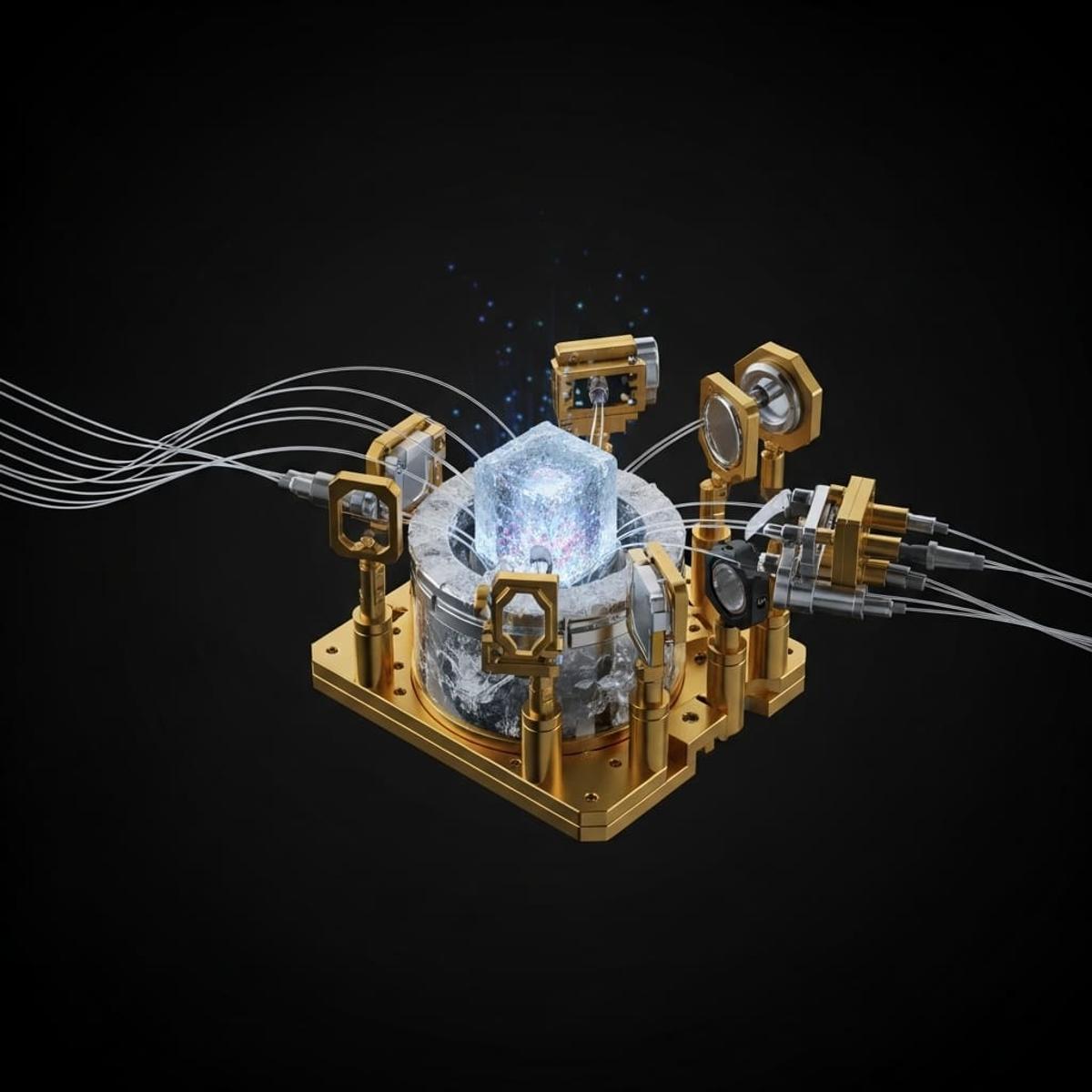
Researchers Achieve 35ms Qubit Memory Certification Via Device-Independent Quantum Tests
•January 22, 2026
0
Why It Matters
The ability to certify memory performance without trusting the device boosts confidence in quantum hardware, accelerating deployment of quantum computers and networks. It provides a universal metric that can be applied across platforms.
Key Takeaways
- •Device‑independent test certifies 35 ms qubit memory
- •Method uses temporal correlations, not spatial Bell tests
- •Violations of causal inequalities prove quantum behavior
- •Approach requires no assumptions about hardware calibration
- •Scalable to gates, algorithms, future quantum networks
Pulse Analysis
Quantum memories are essential for scaling quantum computers, enabling error‑corrected computation, long‑distance entanglement distribution, and secure communication. Yet characterising their performance has traditionally relied on detailed knowledge of the underlying hardware, leaving room for hidden systematic errors. The recent device‑independent certification protocol sidesteps this limitation by treating the memory as a black box and probing it only at two distinct times. By focusing on the statistical relationship between the input and output states, the technique delivers a trustworthy performance metric that is agnostic to the specific physical implementation.
The core of the approach lies in temporal correlations, which are compared against predictions from classical causal models expressed as Bayesian networks. When the measured two‑time statistics breach established causal inequalities, the data cannot be reproduced by any classical explanation, confirming genuine quantum behavior. Unlike conventional Bell tests that require spatially separated parties, this time‑domain test can be applied locally to individual modules such as trapped‑ion or superconducting memories. The experiment demonstrated a clear decay of the quantum violation with storage time, matching a simple dephasing‑fidelity model and validating the method’s sensitivity.
By providing a hardware‑agnostic benchmark, device‑independent certification can streamline quality control across heterogeneous quantum platforms, reducing the time and cost of integration into larger architectures. Industry players developing quantum repeaters, fault‑tolerant processors, and cloud‑based quantum services stand to benefit from a universally comparable metric. Future work aims to extend the protocol to multi‑qubit memories, complex gate sequences, and longer coherence times, potentially establishing a new standard for quantum device validation. As quantum technologies move toward commercial deployment, such rigorous, assumption‑free testing will be pivotal for building trust with investors and end‑users.
Researchers Achieve 35ms Qubit Memory Certification Via Device-Independent Quantum Tests
0
Comments
Want to join the conversation?
Loading comments...