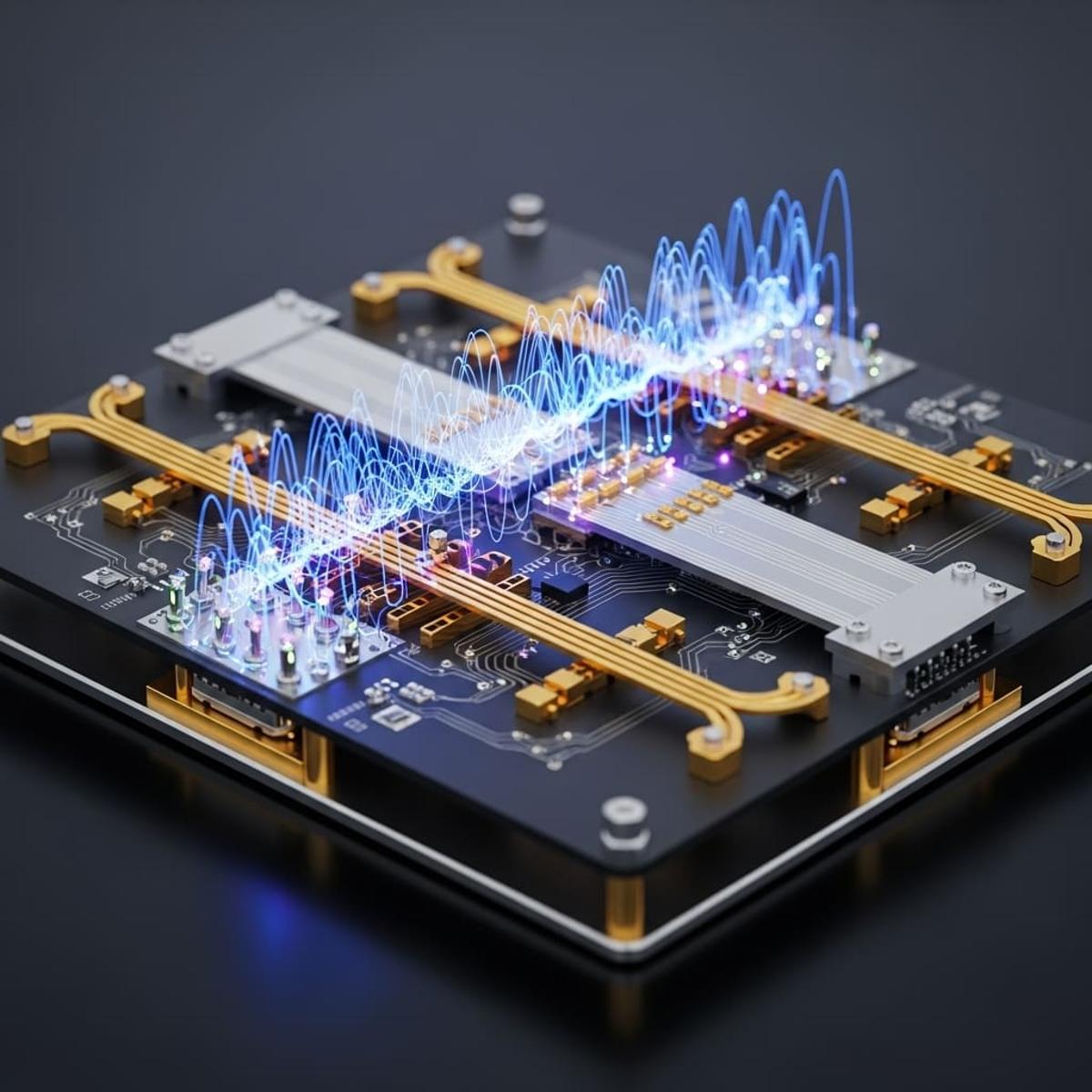
Researchers Achieve Ns-Scale Quantum Dynamics with Novel Computer-Aided Design Framework
•February 2, 2026
0
Why It Matters
By leveraging quantum hardware for design simulations, the framework cuts computational expense and accelerates development cycles for next‑generation quantum devices, giving manufacturers a competitive edge in the rapidly evolving quantum market.
Key Takeaways
- •Framework simulates ns-scale spin dynamics on quantum hardware
- •Integrates electronic, nuclear spins and phonon interactions
- •Uses sQKFF algorithm to cut circuit depth dramatically
- •Accurately models NV‑center parameters like zero‑field splitting
- •Enables faster, cost‑effective quantum device prototyping
Pulse Analysis
The design of solid‑state quantum hardware has long been hampered by the exponential cost of classical simulations, especially when modeling intricate spin‑phonon couplings. This new computer‑aided framework flips the paradigm by running the simulations directly on quantum processors, allowing researchers to explore nanosecond‑scale dynamics that were previously out of reach. By automating Hamiltonian construction from experimental or computational data, the tool bridges the gap between theory and laboratory, delivering realistic predictions without sacrificing accuracy.
At the core of the platform lies the sQKFF algorithm, which, when combined with qubit‑wise commuting aggregation, reorganizes quantum gates for parallel execution. This reduces circuit depth and mitigates decoherence, enabling the inclusion of both electronic and nuclear spin degrees of freedom alongside vibrational modes. The framework successfully reproduced key NV‑center characteristics—such as a 2.87 GHz zero‑field splitting and a –2.16 MHz axial hyperfine coupling—while generating autocorrelation functions and microwave absorption spectra essential for device benchmarking.
The broader impact extends beyond academic curiosity. Faster, lower‑cost simulation cycles empower companies to iterate quantum sensor and processor designs more rapidly, shortening time‑to‑market and lowering R&D budgets. As experimental validation catches up, the methodology could become a standard component of quantum hardware pipelines, fostering a more agile ecosystem where hardware and algorithm development co‑evolve. This synergy is poised to accelerate the commercialization of quantum technologies across communications, computing, and precision metrology.
Researchers Achieve Ns-Scale Quantum Dynamics with Novel Computer-Aided Design Framework
0
Comments
Want to join the conversation?
Loading comments...