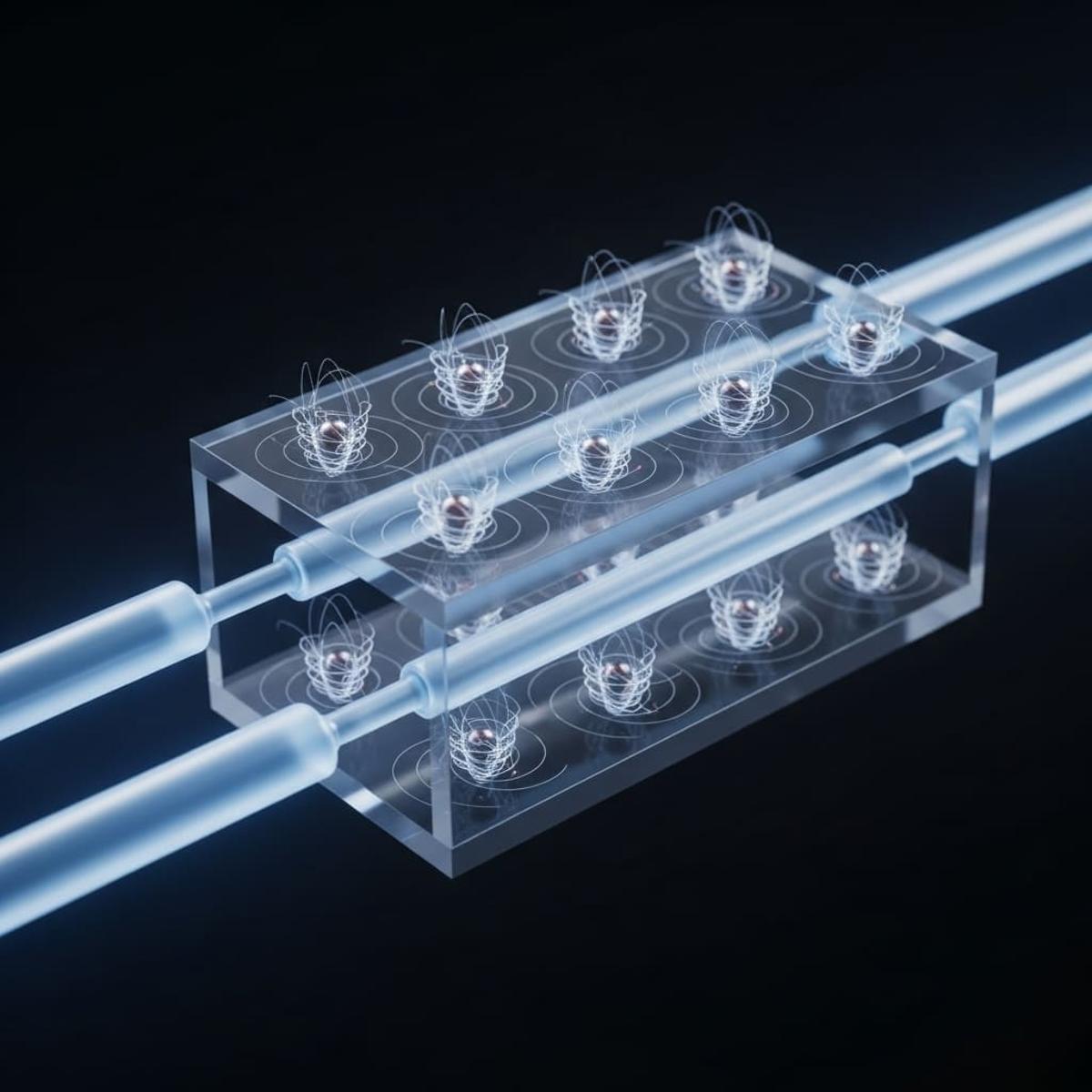
Researchers Achieve Polarity-Tunable Josephson Diode Effect with 3DTI Vortex Control
•January 26, 2026
0
Key Takeaways
- •Vortex parity flips Josephson diode polarity in 3DTI Corbino junction
- •In‑vacuo fabrication preserves pristine topological surface states
- •Control devices show no polarity switching, confirming topological origin
- •Findings suggest non‑Abelian anyons reside in vortex cores
- •Enables potential Majorana braiding for fault‑tolerant quantum computing
Summary
Researchers demonstrated a vortex‑parity‑controlled Josephson diode effect in a Corbino‑geometry junction built from the bulk‑insulating 3D topological insulator Bi₁.₁Sb₀.₉Te₂S. The diode polarity flips each time the number of trapped vortices changes between even and odd, a behavior absent in non‑topological control devices. In‑vacuo fabrication preserved pristine surface states, enabling clear observation of the effect. The result provides experimental evidence for non‑Abelian anyons and a new route toward Majorana‑based quantum circuitry.
Pulse Analysis
The Josephson diode effect (JDE) has emerged as a hallmark of non‑reciprocal superconductivity, yet most implementations rely on material asymmetries or external bias. By exploiting a closed‑loop Corbino geometry on a bulk‑insulating three‑dimensional topological insulator, the new study leverages the intrinsic phase winding of superconducting vortices to dictate current direction. This design eliminates edge‑related complications and directly couples the diode polarity to the parity of trapped magnetic flux quanta, delivering a clean, tunable platform that stands apart from conventional linear junctions.
A key technical advance lies in the fully in‑vacuo fabrication process. Sn‑doped Bi₁.₁Sb₀.₉Te₂S crystals were exfoliated, capped, and patterned without exposure to air, preserving the Dirac surface states that host proximitized superconductivity. Niobium contacts form a 2 µm‑diameter Corbino ring, while a calibrated out‑of‑plane magnetic field injects a precise number of vortices. The experimental data reveal a strict even‑odd alternation of diode polarity, a signature reproduced only in the topological device and absent in graphene or linear‑junction controls, confirming the topological origin of the phenomenon.
Beyond fundamental physics, the ability to toggle supercurrent flow by simply adjusting vortex count opens a practical pathway to manipulate Majorana bound states. Each vortex is predicted to host a non‑Abelian anyon; controlling their parity and position could enable braiding operations essential for topological quantum computers. Future work will focus on single‑vortex addressability, coherent braiding protocols, and integration with scalable qubit architectures, positioning vortex‑parity‑controlled Josephson diodes as a cornerstone of next‑generation quantum technologies.
Comments
Want to join the conversation?