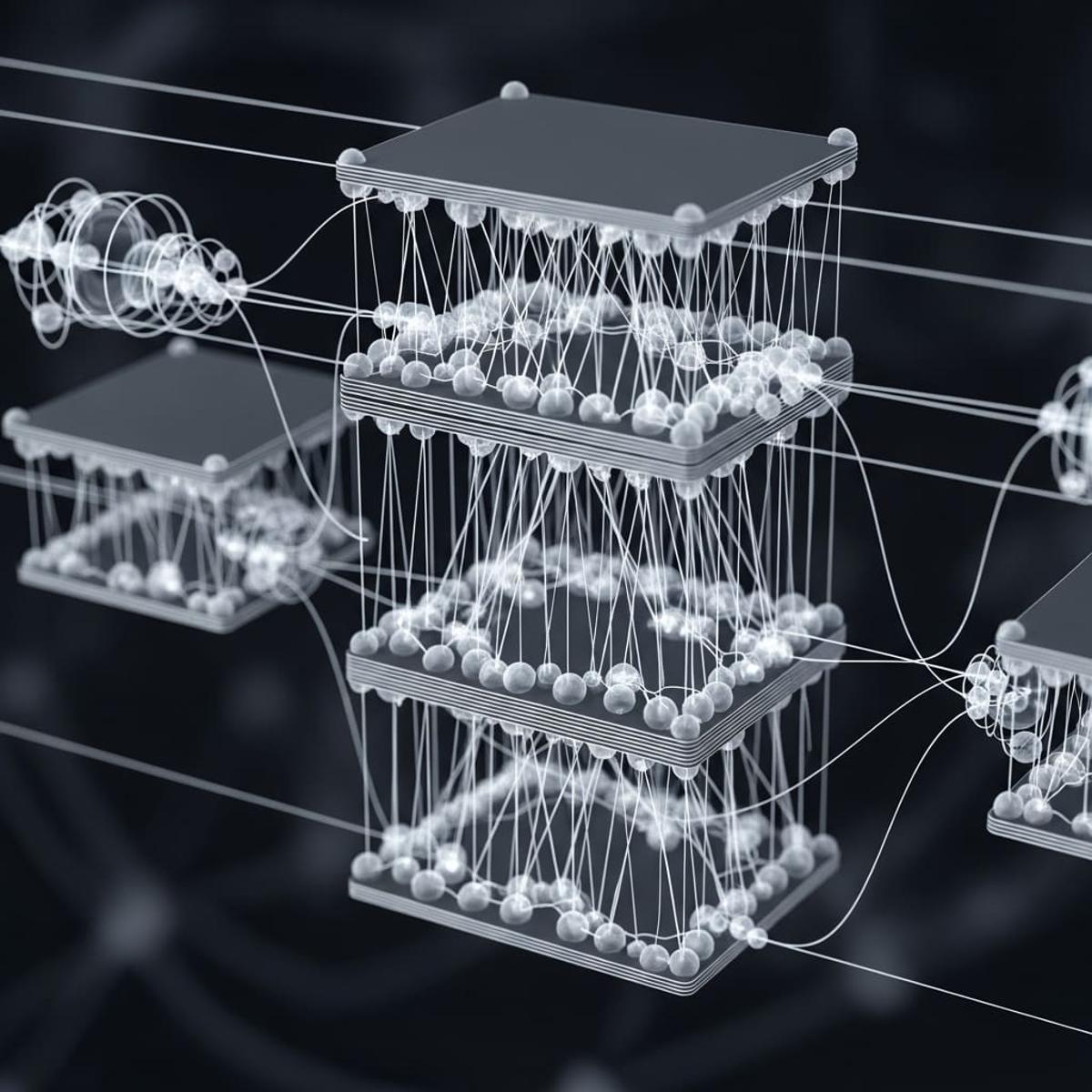
Researchers Factor 551 Using Novel Feedback Quantum Control with 9 Qubits
•January 26, 2026
0
Why It Matters
FALQON provides a scalable, hardware‑efficient pathway for prime factorization, reducing classical overhead and enhancing error tolerance on near‑term quantum devices. Its success could accelerate quantum‑ready cryptanalysis and optimization applications.
Key Takeaways
- •FALQON factors 551 using three‑qubit NMR register
- •Feedback loop eliminates pre‑computed control fields
- •Simulations extend to 9‑qubit factorization of 2,106,287
- •Method shows robustness to RF amplitude errors
Pulse Analysis
The emergence of feedback‑driven quantum algorithms marks a shift from gate‑heavy circuits toward measurement‑centric control. FALQON’s Lyapunov‑inspired iteration uses real‑time observables to adjust drive parameters, sidestepping the massive classical optimization required by traditional Hamiltonian‑based schemes. By embedding the problem Hamiltonian directly into the quantum evolution and letting the system self‑correct, the approach aligns with the constraints of noisy intermediate‑scale quantum (NISQ) hardware, where gate fidelity and coherence time remain limited.
Scalability is a critical test for any quantum factoring method. While Shor’s algorithm demands deep circuits and error‑corrected qubits, FALQON demonstrated experimental success on a three‑qubit NMR platform and, through digital‑analog simulations, projected capability up to nine qubits for factoring numbers as large as 2,106,287. The use of digital‑analog quantum computing (DAQC) efficiently harnesses natural Ising interactions, reducing circuit depth and preserving fidelity, which is essential for extending the technique to larger biprimes without prohibitive resource overhead.
Beyond cryptography, the broader implications of measurement‑based feedback extend to optimization problems such as graph partitioning and eigenvalue estimation, where rapid convergence and resilience to noise are prized. FALQON’s ability to converge from thermal states and its reduced sensitivity to initial conditions suggest a versatile tool for NISQ‑era applications. As quantum hardware matures, algorithms that minimize classical preprocessing while exploiting real‑time quantum feedback will likely dominate the roadmap toward practical quantum advantage.
Researchers Factor 551 Using Novel Feedback Quantum Control with 9 Qubits
0
Comments
Want to join the conversation?
Loading comments...