Resonant Cavity Transducer Achieves Percent-Level Microwave to Telecom Photon Conversion
•January 23, 2026
0
Why It Matters
Achieving efficient, room‑temperature microwave‑optical conversion removes a key bottleneck for linking superconducting quantum processors to fiber networks, accelerating quantum communication and sensing deployments.
Key Takeaways
- •Percent-level photon conversion achieved at room temperature
- •All-dielectric design eliminates metal electrode losses
- •Triply resonant operation boosts conversion efficiency
- •Single-photon EO coupling rate measured at 1.5 Hz
- •Platform enables quantum microwave‑optical networking
Pulse Analysis
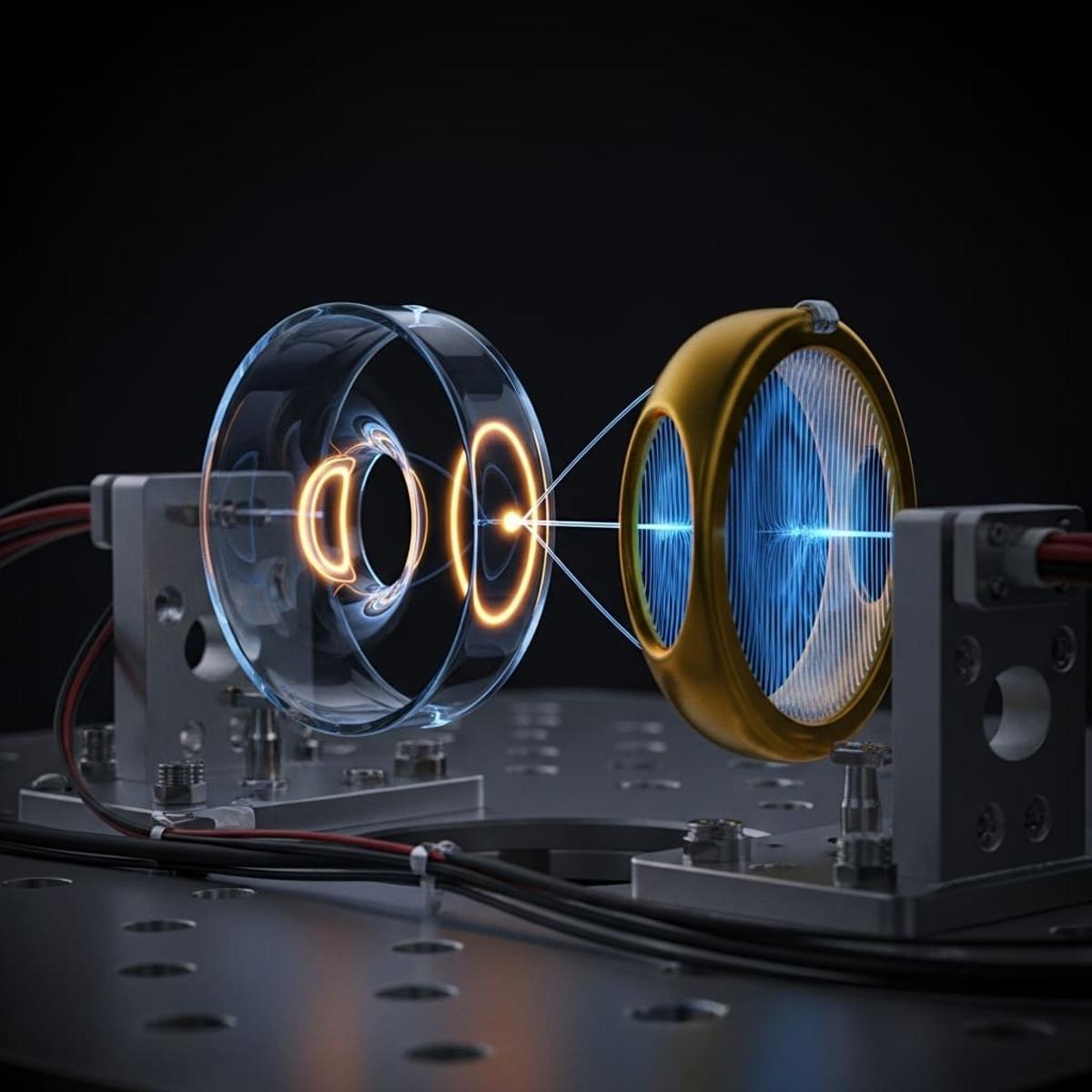
Microwave‑to‑optical photon conversion has long been a stumbling block for quantum networking because traditional metal‑electrode devices introduce loss and thermal noise. Lithium niobate, with its high dielectric constant and strong electro‑optic coefficient, offers a compelling alternative. By shaping a bulk LN slab into a wavelength‑scale microwave resonator and embedding it within a high‑finesse Fabry‑Perot cavity, researchers create a platform where the microwave field directly modulates the optical refractive index, generating sidebands that carry the quantum information across vastly different frequencies.
The breakthrough lies in achieving triple resonance—simultaneous alignment of a microwave mode, an optical pump, and the up‑converted optical signal—within high‑Q electromagnetic modes. This condition maximizes the overlap of the fields, driving a photon‑number conversion efficiency into the percent range, comparable to the best room‑temperature systems. Key performance metrics include an intrinsic microwave quality factor of 1.3×10³ at 9 GHz, a single‑photon electro‑optic coupling rate of 1.5 ± 0.3 Hz, and a cooperativity near 1.7×10⁻². The all‑dielectric architecture also tolerates higher optical powers, reducing heating and preserving signal fidelity.
Beyond the laboratory, this technology could become the linchpin for scalable quantum interconnects. Efficient, low‑noise transduction enables superconducting qubits to communicate over existing fiber‑optic infrastructure without cryogenic links, simplifying network architectures and lowering deployment costs. Future work targeting cryogenic operation promises further gains in cooperativity and the prospect of single‑photon‑level conversion, essential for error‑corrected quantum repeaters and high‑precision sensing. As industry pushes toward quantum‑ready communications, lithium‑niobate resonant transducers are poised to play a central role.
Resonant Cavity Transducer Achieves Percent-Level Microwave to Telecom Photon Conversion
0
Comments
Want to join the conversation?
Loading comments...