Secondary Autler-Townes Splitting Achieved Via Four-Level Quantum Frequency Mixing
•January 30, 2026
0
Why It Matters
Independent control of two quantum‑interference pathways gives unprecedented spectral engineering, boosting coherent‑control capabilities for quantum sensors and communication. It enables phase‑sensitive microwave detection without dependence on specific atomic transitions.
Key Takeaways
- •Secondary Autler‑Townes splitting observed via four‑level quantum mixing.
- •Floquet‑channel and loop interference can be tuned independently.
- •Phase of drive controls peak spacing and linewidth asymmetry.
- •Enables broadband AC‑field sensing without specific atomic transitions.
- •Provides new method for precise microwave phase extraction.
Pulse Analysis
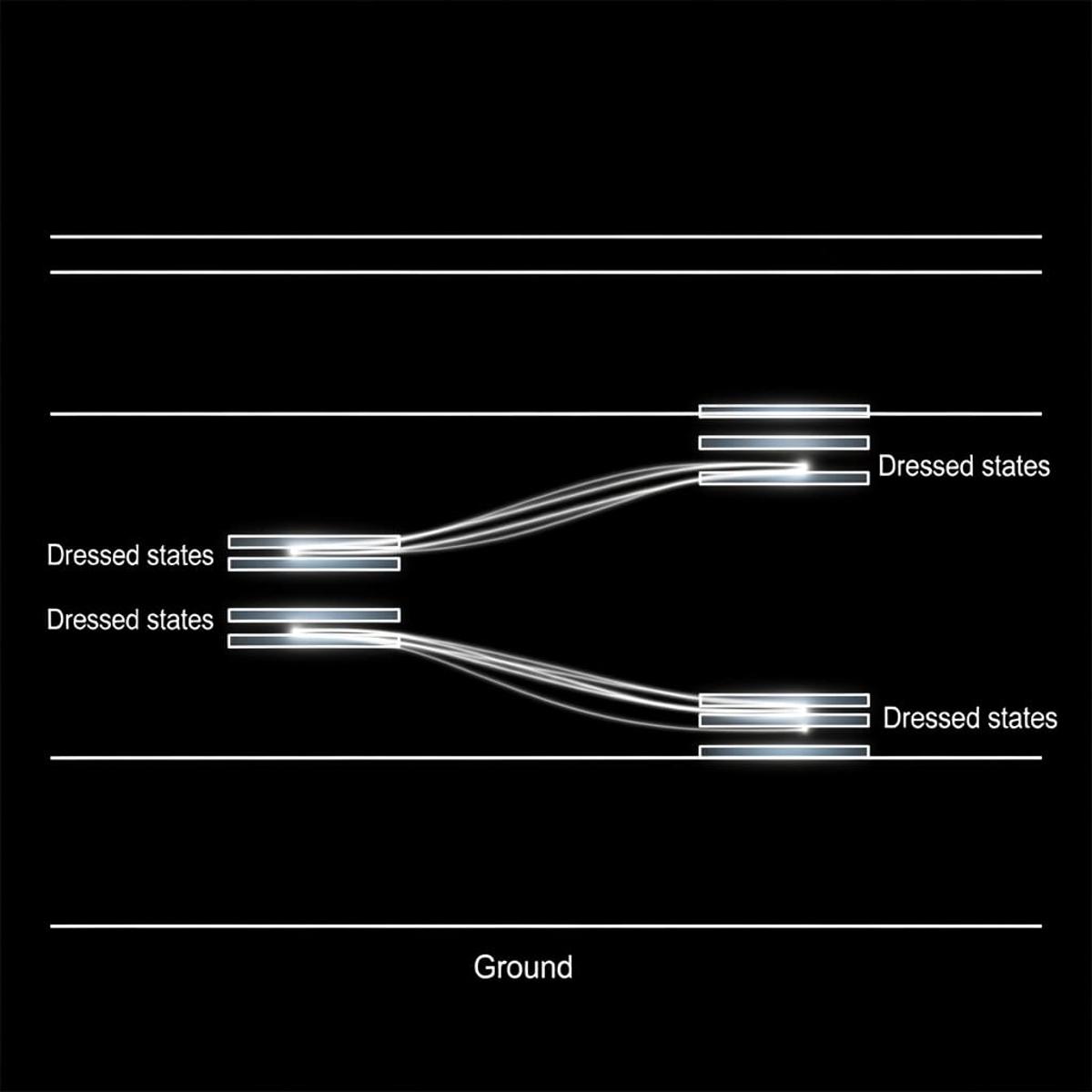
Electromagnetically induced transparency (EIT) has long been a cornerstone for manipulating light‑matter interactions, yet traditional three‑level schemes limit the flexibility of spectral shaping. The recent four‑level ladder configuration expands the toolbox by introducing quantum frequency mixing, which generates dressed states that behave like additional energy levels without physically adding atoms. This theoretical advance leverages multi‑mode Floquet theory to predict how periodic driving reshapes the transparency window, offering a richer landscape for controlling photon propagation in quantum media.
At the heart of the breakthrough are two distinct interference mechanisms: Floquet‑channel interference, which modulates the effective coupling strength and thus the Autler‑Townes peak separation, and loop interference, arising from a closed coherent pathway that sculpts the lineshape. Both mechanisms respond to the phase of a single external drive, providing two independent “knobs” for engineers. By adjusting the drive strength, researchers can switch Floquet‑channel effects on or off, while the phase continuously tunes linewidth symmetry, delivering a level of spectral precision previously unattainable in atomic platforms.
The practical implications extend to quantum sensing and communication. Phase‑tunable linewidths enable direct extraction of microwave electric‑field phases, bypassing the need for resonant atomic transitions and allowing broadband operation across a wide frequency range. This could accelerate the development of compact, high‑resolution quantum sensors for navigation, spectroscopy, and secure communication. Future work will focus on experimental validation and exploring time‑varying drive waveforms, potentially unlocking dynamic sensing protocols and more complex quantum network architectures.
Secondary Autler-Townes Splitting Achieved Via Four-Level Quantum Frequency Mixing
0
Comments
Want to join the conversation?
Loading comments...