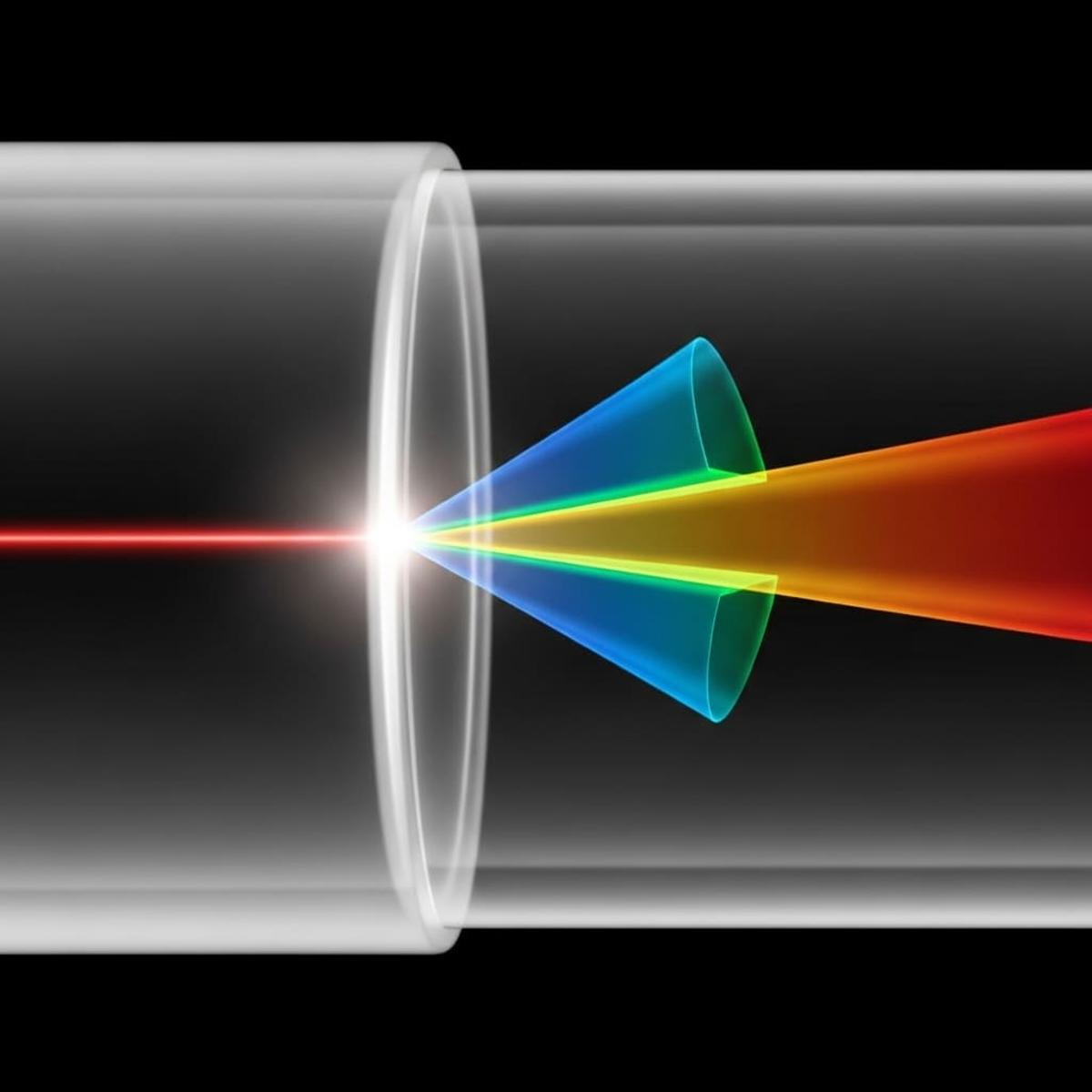
Shows Direct Spontaneous Four-Wave Mixing Dominates in Thin Layers for Photon Pairs
•February 4, 2026
0
Why It Matters
Direct SFWM provides a more efficient, single‑step method for on‑chip entangled photon generation, accelerating the deployment of integrated quantum communication and computing hardware.
Key Takeaways
- •Direct SFWM dominates over cascaded SHG‑SPDC in 10 µm LN
- •Quadratic pump‑power scaling confirms four‑wave mixing origin
- •Thin‑film phase‑matching reduces wave‑vector mismatch
- •Photon‑pair rates exceed cascaded process by ~20×
- •Enables compact, integrated quantum light sources on LN platforms
Pulse Analysis
Integrated photonic circuits rely on reliable sources of entangled photons, traditionally generated through spontaneous parametric down‑conversion (SPDC) in bulk nonlinear crystals. While lithium‑niobate (LN) excels in second‑order processes, its thin‑film incarnation has attracted attention for on‑chip applications because it combines high electro‑optic coefficients with a planar fabrication workflow. The emergence of thin‑film LN platforms has prompted researchers to revisit third‑order effects, particularly spontaneous four‑wave mixing, as a potentially more scalable route to quantum light generation.
In the recent study, a 10 µm‑thick x‑cut LN layer was pumped with 210‑fs, 1030 nm pulses at a 1 MHz repetition rate. The experiment revealed a clear quadratic dependence of coincidence counts on pump power, a hallmark of SFWM, and measured second‑order correlation values exceeding two, confirming genuine photon‑pair correlations. By contrast, the cascaded SHG‑then‑SPDC pathway produced only about 5 % of the observed pairs, a consequence of reduced wave‑vector mismatch for the third‑order interaction in the ultrathin geometry. These quantitative findings underscore that phase‑matching constraints, which typically favor second‑order processes in bulk media, are inverted in the thin‑film regime, allowing SFWM to dominate.
The implications for the quantum‑technology market are significant. A single‑step SFWM source eliminates the need for intermediate frequency conversion stages, simplifying device architecture and reducing loss. This efficiency boost paves the way for densely integrated quantum photonic chips that can generate, manipulate, and detect entangled photons on the same substrate. As telecom‑compatible wavelengths are readily accessed, manufacturers can envision scalable quantum key distribution modules and photonic processors built around thin‑film LN, accelerating the transition from laboratory prototypes to commercial quantum networks.
Shows Direct Spontaneous Four-Wave Mixing Dominates in Thin Layers for Photon Pairs
0
Comments
Want to join the conversation?
Loading comments...