Silicon Quantum Computing Achieves 99% Spin Initialisation with 10THz Photons
•January 31, 2026
0
Why It Matters
This breakthrough dramatically reduces qubit preparation time and thermal requirements, accelerating the path toward scalable silicon quantum processors. Faster, higher‑temperature operation also lowers energy costs and simplifies hardware integration for quantum computing and related industries.
Key Takeaways
- •10 THz photons initialise boron spin in 250 ps.
- •Operation possible above 3 K, not millikelvin.
- •99% spin polarisation achieved, 1000× faster.
- •Technique uses optical pumping with circular polarisation.
- •Applicable to other THz-active solid‑state qubits.
Pulse Analysis
Silicon remains the most promising platform for large‑scale quantum computers, yet the bottleneck of spin initialisation has limited its practicality. Traditional methods rely on thermal equilibration at sub‑2 K temperatures, demanding complex dilution refrigerators and microsecond‑long preparation cycles. The new THz‑driven optical pumping approach sidesteps these constraints by directly populating the desired spin state, offering a clear path to more compact and cost‑effective quantum hardware.
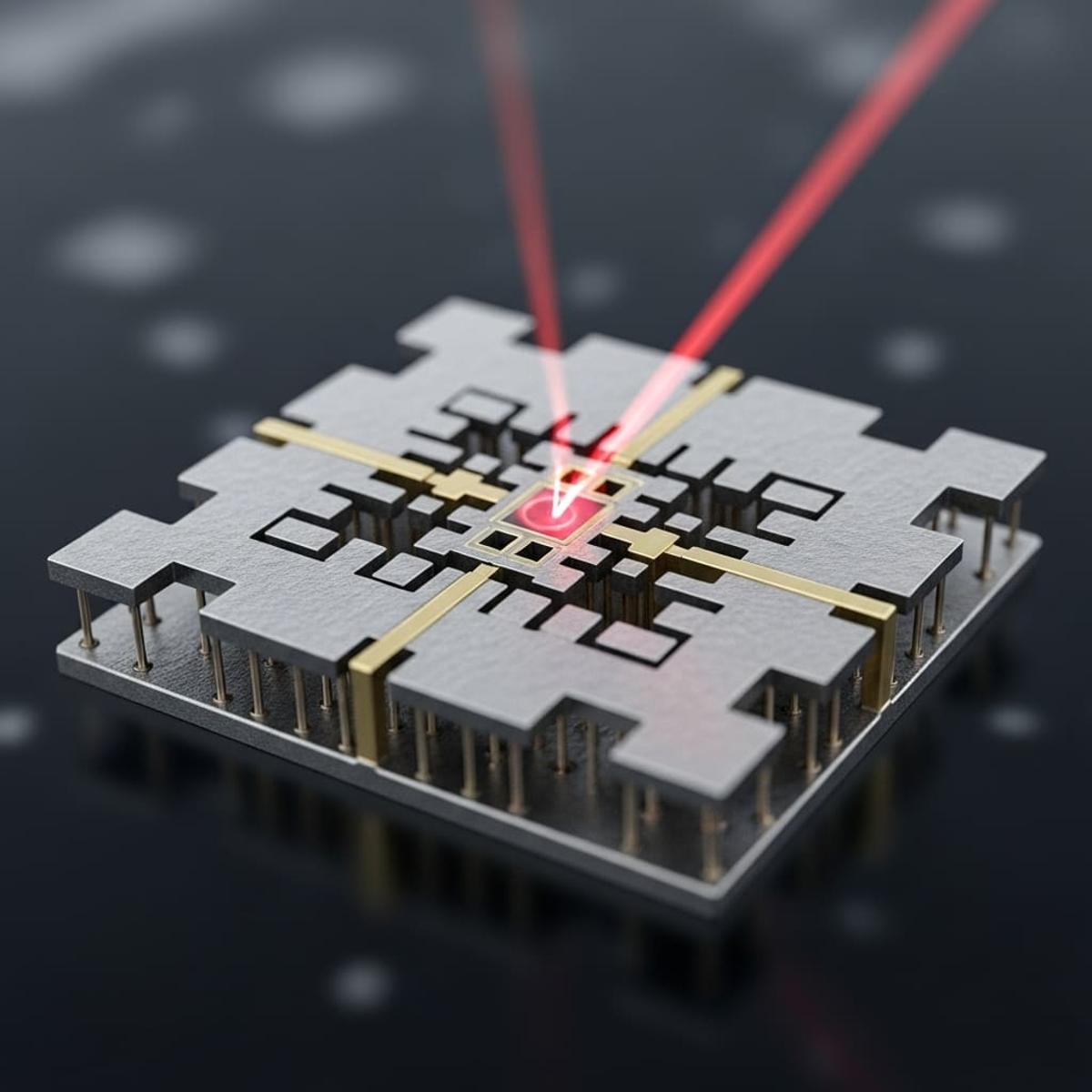
The experiment leverages a free‑electron laser to generate ~10 THz, 9‑ps pulses with precise circular polarisation. When these photons excite boron‑bound holes from the 1s‑like ground state to higher hydrogenic orbitals, rapid phonon cascades relax the system into a targeted spin eigenstate. Measured results show 99 % polarisation within 250 ps at 3 K, translating to a three‑order‑of‑magnitude improvement over microwave‑based techniques. This speedup not only accelerates computation cycles but also enables real‑time qubit readout, a critical requirement for error‑corrected quantum algorithms.
Beyond silicon, the methodology opens a broader research frontier for any solid‑state qubit possessing THz‑active transitions, such as rare‑earth dopants or color‑center defects. By demonstrating that THz photons can efficiently control spin populations without external magnetic fields, the work paves the way for hybrid quantum architectures that combine photonic, phononic, and electronic resources. Industry players focused on quantum‑ready chips, cryptography, and materials simulation stand to benefit from reduced cooling overhead and faster gate operations, hastening the transition from laboratory prototypes to commercial quantum processors.
Silicon Quantum Computing Achieves 99% Spin Initialisation with 10THz Photons
0
Comments
Want to join the conversation?
Loading comments...