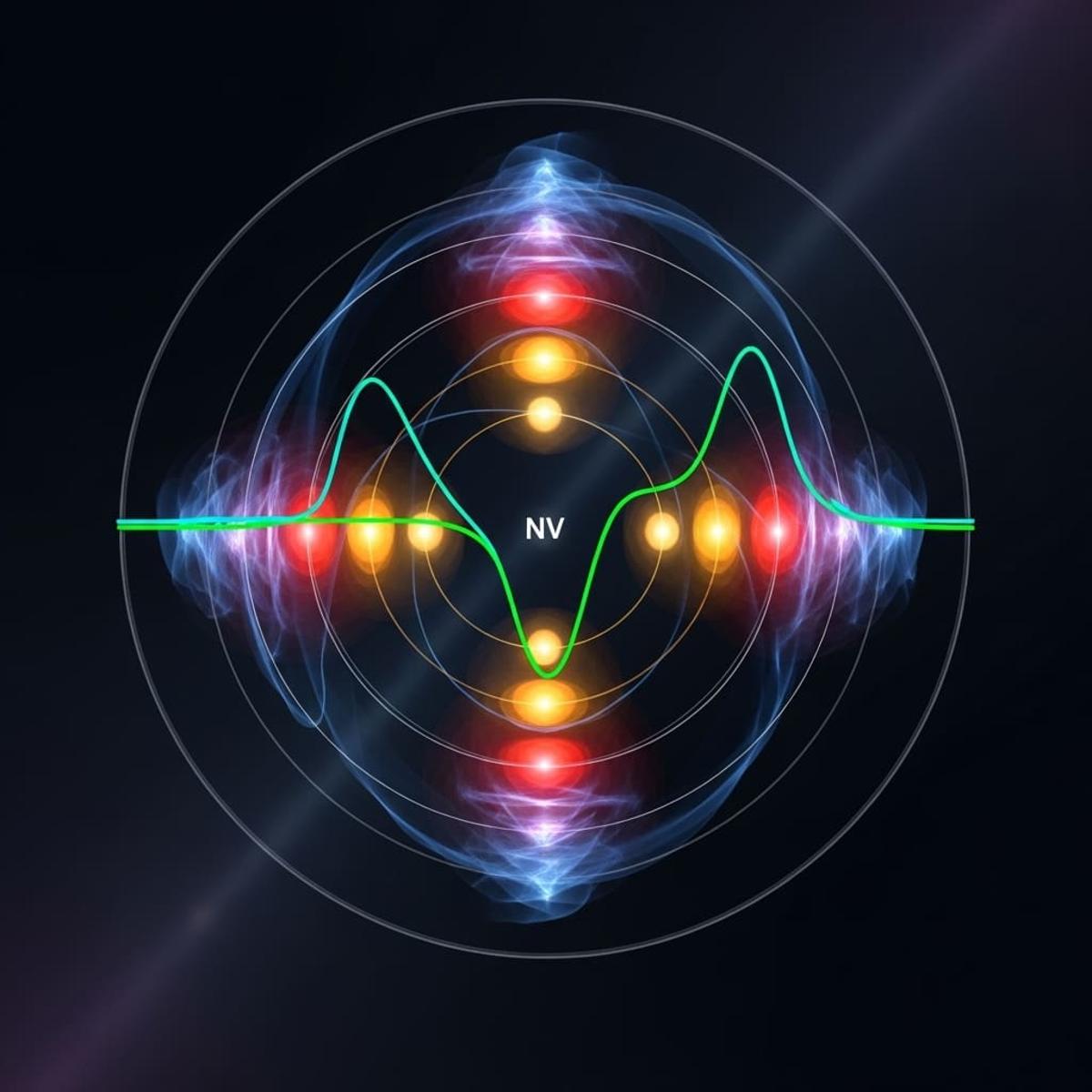
Simulation Toolkit Advances Realistic Noise Modelling for Seven-Level Nv-Center Magnetometry
•January 23, 2026
0
Why It Matters
Accurate noise modeling boosts sensor sensitivity and reliability, essential for deploying quantum magnetometers in healthcare, electronics, and field diagnostics. The toolkit also serves as a rapid testbed for AI‑driven signal processing, shortening development cycles.
Key Takeaways
- •QDsiM simulates realistic noise for NV‑center ODMR.
- •Includes laser, microwave, temperature fluctuations.
- •Improves contrast‑to‑linewidth ratio predictions.
- •Enables data‑driven magnetic field reconstruction.
- •Supports design of field‑deployable quantum magnetometers.
Pulse Analysis
NV‑center diamond magnetometers have emerged as a leading platform for nanoscale magnetic imaging, yet their performance is often limited by real‑world noise such as laser intensity drift, microwave power instability, and temperature variations. Traditional simulations assume ideal conditions, leaving a gap between theoretical predictions and experimental outcomes. By providing a comprehensive digital twin that mirrors these imperfections, QDsiM equips researchers with a realistic sandbox to explore how each noise source degrades ODMR contrast and linewidth, thereby informing more robust sensor designs.
The core of QDsiM is a seven‑level quantum model that faithfully represents the NV‑center’s ground, excited, and singlet states, enabling precise calculation of optical pumping, intersystem crossing, and spin‑dependent fluorescence. Modular noise modules translate experimental knobs—laser power, beam waist, microwave amplitude, integration time—into quantitative perturbations, allowing users to reproduce both the shape and the subtle features of measured spectra. Validation against published data shows the toolkit can predict contrast‑to‑linewidth ratios within experimental uncertainty, making it a reliable predictor for sensor optimization and a valuable source of synthetic training data for machine‑learning‑based magnetic‑field reconstruction.
Beyond immediate research benefits, QDsiM positions NV‑based magnetometry for commercial deployment across sectors such as biomedical diagnostics, semiconductor failure analysis, and geophysical surveying. Accurate simulation reduces costly trial‑and‑error hardware iterations and accelerates the development of portable, field‑ready devices. Future extensions that incorporate strain, electric‑field effects, and pulsed ODMR protocols will further broaden its applicability, while integration with AI pipelines promises automated noise mitigation and real‑time performance tuning, heralding a new era of quantum sensor engineering.
Simulation Toolkit Advances Realistic Noise Modelling for Seven-Level Nv-Center Magnetometry
0
Comments
Want to join the conversation?
Loading comments...