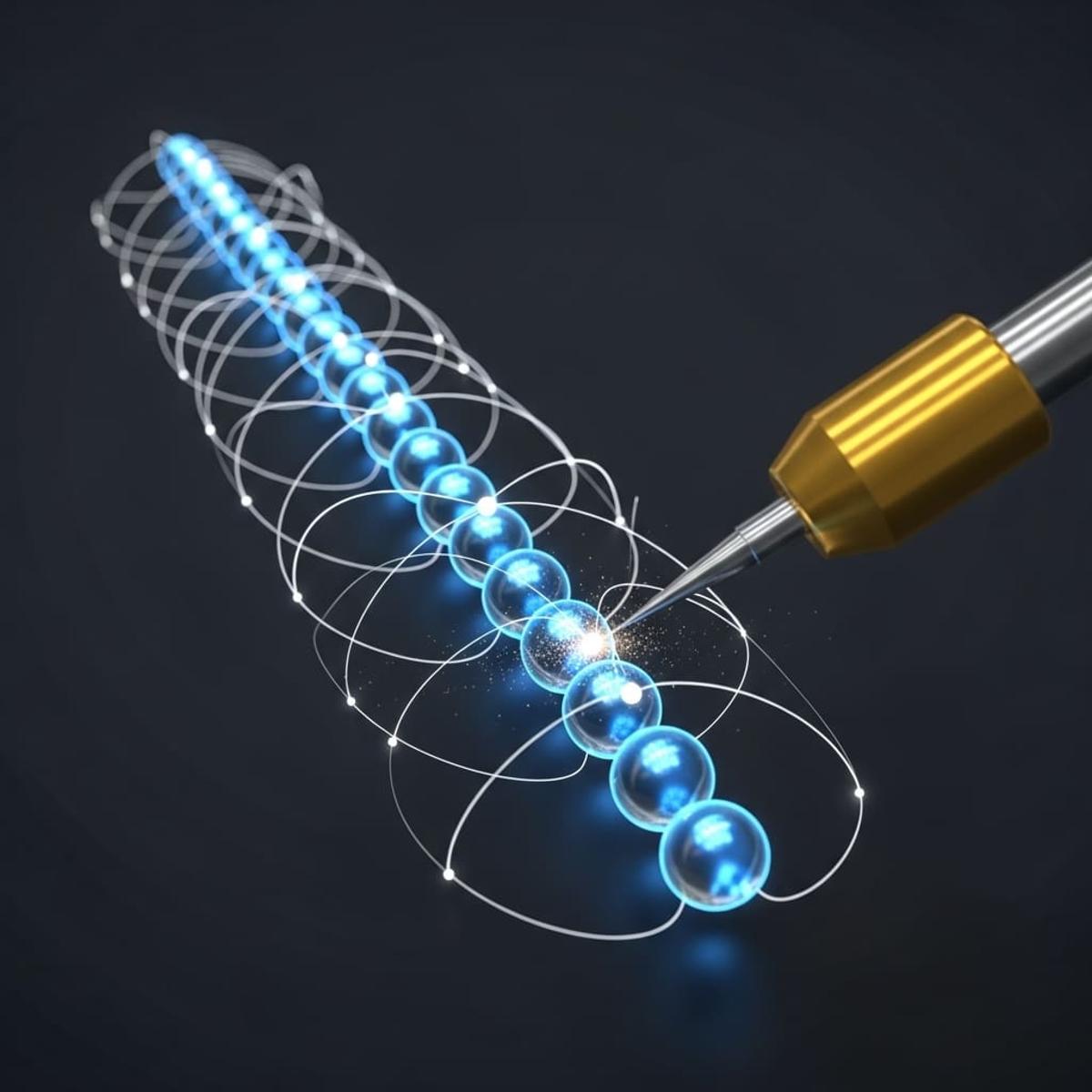
Single Electrons Resolve Qubit Excitations in Coupled Trapped-Ion Quantum Computer
•January 22, 2026
0
Why It Matters
This breakthrough links quantum computing with electron microscopy, allowing unprecedented low‑dose imaging and measurement precision that could transform materials science and biological research.
Key Takeaways
- •Single electrons trigger measurable qubit excitations.
- •Coupling achieved via TEM integrated with ion trap.
- •Bit‑flip probability reaches 0.1–1 for 100 eV–1 keV electrons.
- •Enables low‑dose, quantum‑enhanced electron microscopy.
- •Framework extensible to free‑electron lasers and ion beams.
Pulse Analysis
The convergence of quantum computing and electron microscopy marks a pivotal shift in nanoscale probing. Free electrons, traditionally viewed as invasive particles, are now being harnessed as quantum probes that interact coherently with trapped‑ion qubits. By embedding a transmission electron microscope within a planar surface‑electrode Paul trap, researchers create a hybrid platform where the electron’s wavefunction directly couples to the ion’s motional states, unlocking measurement capabilities that surpass classical scattering limits.
Experimental results reveal that focusing the electron beam to the ion’s harmonic‑oscillator ground state yields strong unitary interactions. For electron energies ranging from 100 eV to 1 keV, the probability of inducing a qubit bit‑flip climbs to 10‑100 %, a level sufficient for practical quantum‑enhanced sensing. The system leverages trap frequencies of 0.5–5 MHz and photonic chip integration to read out qubit states via rapid fluorescence, while the multi‑electron coupling formalism demonstrates scalable entanglement across many qubits, laying groundwork for complex quantum operations.
Beyond proof‑of‑concept, this technology promises transformative applications in low‑dose electron microscopy, where quantum metrology can extract maximal information from each electron, dramatically reducing radiation damage to fragile specimens such as proteins or living cells. The same coupling scheme can be adapted to free‑electron lasers, nanoscale accelerators, and focused ion beams, potentially redefining precision measurement across high‑energy physics and materials characterization. As the platform matures, it could usher in a new era of quantum‑enhanced imaging and sensing, delivering unprecedented resolution with minimal sample perturbation.
Single Electrons Resolve Qubit Excitations in Coupled Trapped-Ion Quantum Computer
0
Comments
Want to join the conversation?
Loading comments...