Key Takeaways
- •Spin‑1/2 chain creates Bell state without photons
- •Engineered XX‑Hamiltonian yields 50% entanglement probability
- •Symmetric coupling constants simplify eigenstate analysis
- •Protocol enables photon‑free quantum teleportation in solid‑state devices
- •Experimental realization faces noise and fabrication challenges
Summary
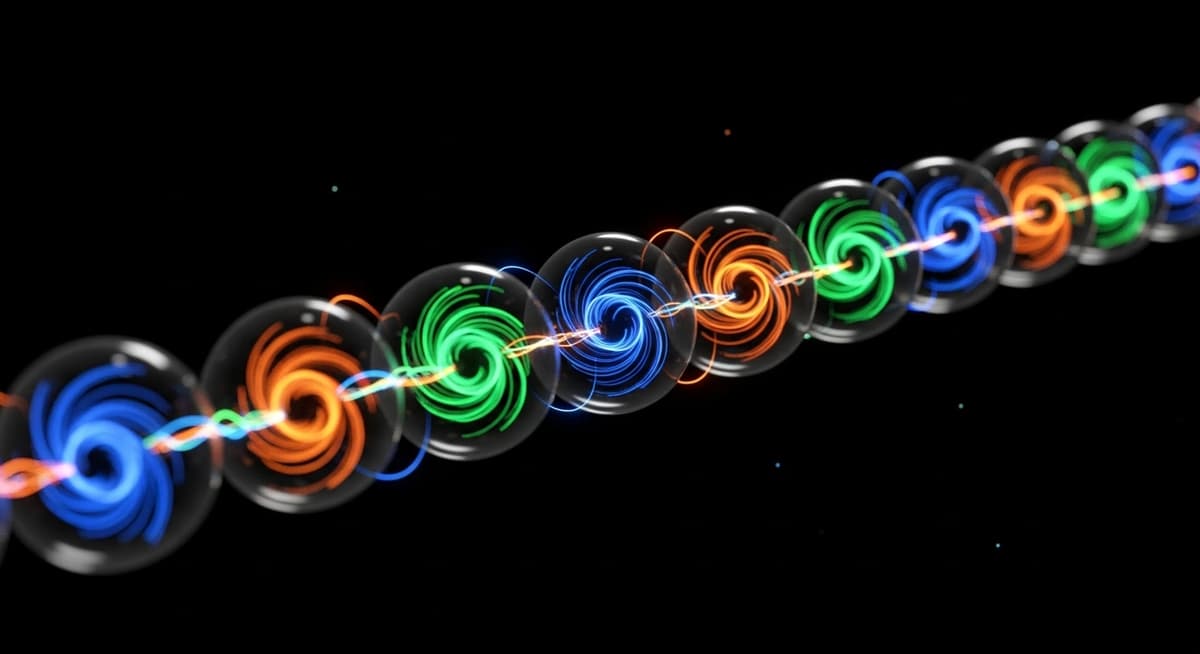
Researchers from Russia propose a photon‑free quantum teleportation protocol using a spin‑1/2 chain governed by an engineered XX‑Hamiltonian. By imposing symmetric coupling constants, the chain can generate a maximally entangled Bell state between its end qubits with a 50 % probability amplitude at a specific time t₀. The method eliminates the need for optical components, offering a potentially simpler architecture for solid‑state quantum devices. Practical implementation will require precise fabrication, noise mitigation, and rapid control operations.
Pulse Analysis
Quantum teleportation has traditionally depended on entangled photons, a strategy that introduces optical complexity and sensitivity to loss. As quantum processors move toward fully integrated solid‑state platforms, researchers are exploring alternatives that keep the entire information flow on-chip. Spin‑1/2 chains—linear arrays of interacting qubits—provide a natural medium for mediating entanglement without external light, aligning with the broader industry push for compact, cryogenic‑compatible architectures.
The new protocol leverages an XX‑Hamiltonian with carefully engineered, centrally‑symmetric coupling constants. By initializing the central spin and allowing the system to evolve, the end qubits reach a Bell state when the probability amplitude reaches one‑half at a precise moment t₀. This timing condition emerges from the reduced eigenvalue problem afforded by the symmetric couplings, enabling analytical control over the entanglement generation. The result is a deterministic, photon‑free teleportation step that can be executed rapidly relative to the Hamiltonian’s natural timescale.
If experimentally realized, this technique could cut the part count and decoherence pathways associated with hybrid photonic‑superconducting systems. However, challenges remain: fabricating long, uniform spin chains, suppressing thermal and magnetic noise, and implementing ultra‑fast gate operations. Ongoing work will focus on material platforms such as silicon‑based quantum dots or diamond nitrogen‑vacancy centers, where spin interactions can be precisely tuned. Success would mark a significant stride toward scalable quantum networks embedded directly within solid‑state chips, a key milestone for the quantum computing industry.
Comments
Want to join the conversation?