Spin Control Advances Kitaev Chain Coherence, Enabling Exponentially Scalable Qubits
•January 23, 2026
0
Why It Matters
By removing magnetic‑field control, the method simplifies wiring and reduces cross‑talk, a major hurdle for building long Kitaev chains. It therefore accelerates the path toward fault‑tolerant topological quantum computers.
Key Takeaways
- •Spin control replaces magnetic flux for Kitaev chain phase tuning
- •Demonstrated three-site chain using InSbAs 2DEG quantum dots
- •Achieved near‑π phase shifts via spin‑polarised quantum dots
- •Flux‑free method enables scalable topological qubit architectures
- •Fast RF reflectometry probes local density of states
Pulse Analysis
The quest for fault‑tolerant quantum computing has placed topological qubits at the forefront of research, with Kitaev chains offering a promising route to host Majorana bound states. Conventional implementations rely on magnetic flux to set the superconducting phase between chain segments, a scheme that introduces bulky control lines and susceptibility to flux noise. As chain length increases, maintaining coherent phase relationships becomes increasingly complex, limiting scalability and eroding the theoretical exponential gain in coherence time that long Kitaev wires promise.
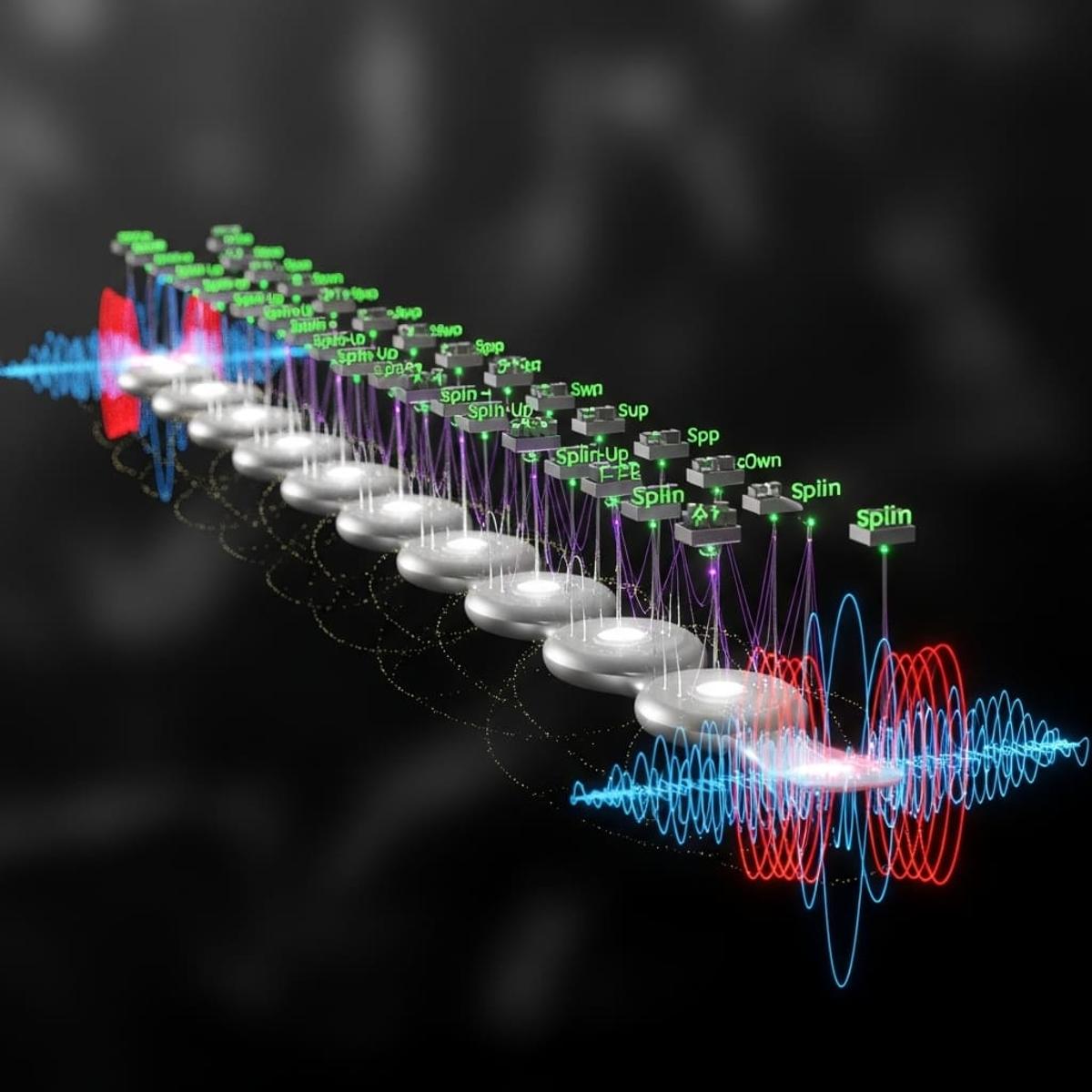
In the new study, a three‑site Kitaev chain was fabricated in an InSbAs two‑dimensional electron gas, integrating quantum dots and Andreev bound states. By polarising the spin of individual dots with an in‑plane magnetic field, the researchers could toggle the sign of the tunnelling and pairing terms, producing phase shifts that approach a π rotation without any external flux. Fast radio‑frequency reflectometry provided real‑time readout of the local density of states, confirming that the spin‑induced phase control is both reproducible and compatible with existing semiconductor‑superconductor platforms.
The flux‑free spin control scheme dramatically simplifies wiring and reduces cross‑talk, paving the way for longer Kitaev chains that can be scaled exponentially. Because the method leverages intrinsic spin‑orbit coupling and gate‑tunable potentials, it can be integrated with conventional superconducting qubit architectures, enabling hybrid processors that combine topological protection with mature circuit technology. Future work will focus on engineering uniform spin‑orbit fields to tighten the π‑shift precision and extending the approach to multi‑chain networks, bringing practical topological quantum computers closer to reality.
Spin Control Advances Kitaev Chain Coherence, Enabling Exponentially Scalable Qubits
0
Comments
Want to join the conversation?
Loading comments...