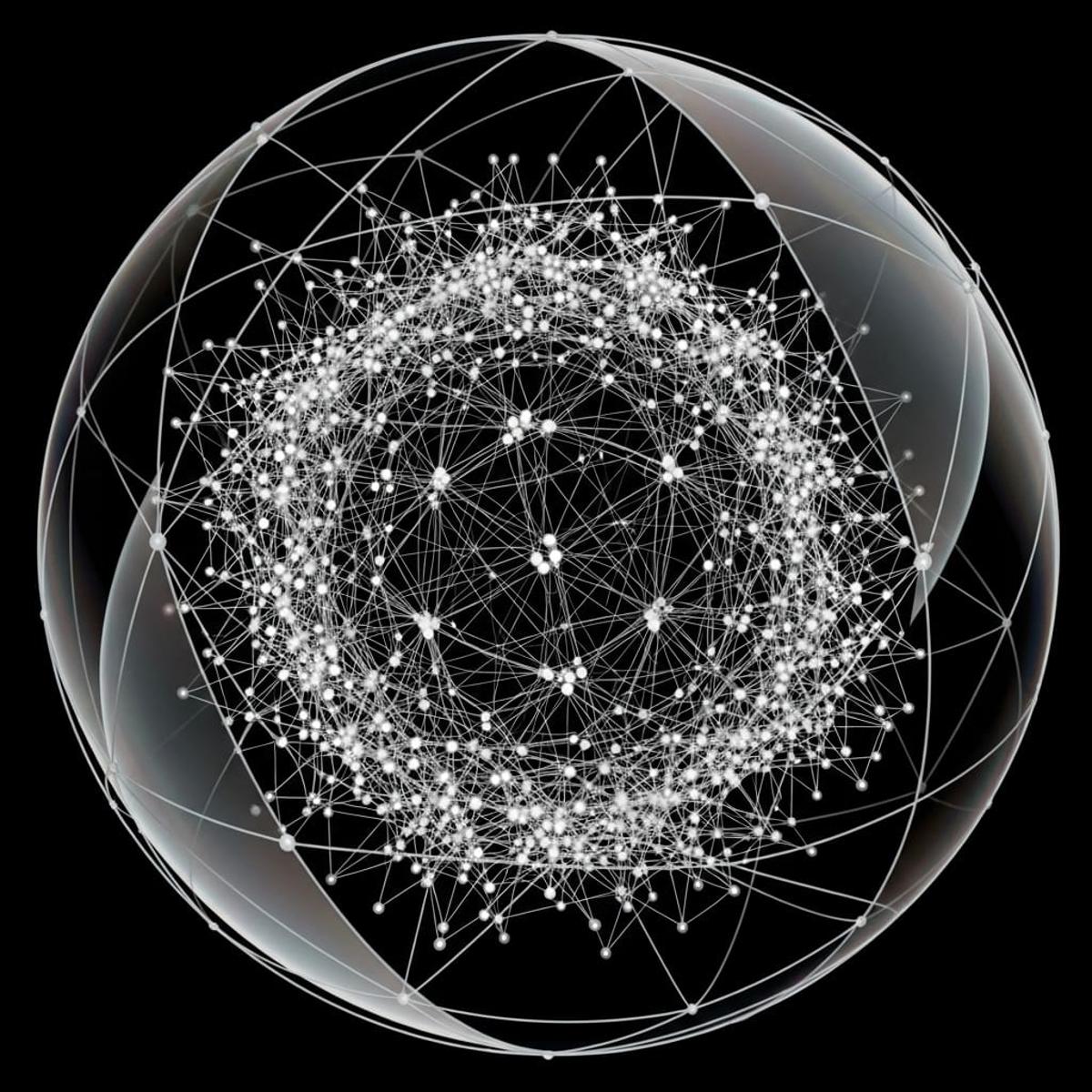
Su(2) Representation Theory Achieves 3-Dimensional Constraints in Graph Quantum Systems
•January 21, 2026
0
Why It Matters
The work demonstrates that spatial dimensionality can arise from pure information‑theoretic constraints, offering a novel foundation for quantum information, discrete geometry, and quantum‑gravity research.
Key Takeaways
- •Graph edges without geometry require qubit (C²) encoding.
- •SU(2) symmetry uniquely yields three-dimensional Euclidean space.
- •Dimensional constraint d=3 remains stable under topology changes.
- •Higher SU(N²) groups conflict with directional-only constraint.
- •Bloch sphere provides canonical map from qubits to ℝ³.
Pulse Analysis
The emergence of space from abstract quantum information has long been a speculative goal in theoretical physics. Recent research on graph‑based quantum systems tackles this problem by stripping away any pre‑assigned geometry and focusing solely on internal edge degrees of freedom. In this minimalist setting, the only viable carrier of directional data is a two‑level quantum state, or qubit, which naturally carries the SU(2) symmetry. By grounding the analysis in representation theory rather than geometric postulates, the study reframes dimensionality as a consequence of algebraic constraints.
Central to the breakthrough is the identification of the Bloch sphere as the unique equivariant map from the qubit Hilbert space to real three‑dimensional space. The authors prove that SU(2)’s three‑dimensional Lie algebra, together with the Killing form, generates a canonical Euclidean metric, making ℝ³ the inevitable target space. Robustness checks demonstrate that this d=3 constraint survives arbitrary changes in graph topology, while attempts to replace SU(2) with larger groups such as SU(N²) inevitably break the directional‑only axiom. Numerical simulations corroborate the analytic results, confirming that the emergent geometry is not a mathematical curiosity but a stable feature of the model.
Beyond its theoretical elegance, the finding has practical ramifications for quantum information science and discrete geometry. It suggests that qubit architectures inherently encode a three‑dimensional relational structure, which could be leveraged in quantum error‑correction schemes or spatially aware quantum algorithms. Moreover, the work provides a concrete pathway for exploring how spacetime dimensionality might arise from purely informational principles, a question at the heart of quantum gravity research. Future investigations will aim to integrate dynamics, explore continuum limits, and identify physical systems that naturally satisfy the non‑embedding hypothesis.
Su(2) Representation Theory Achieves 3-Dimensional Constraints in Graph Quantum Systems
0
Comments
Want to join the conversation?
Loading comments...