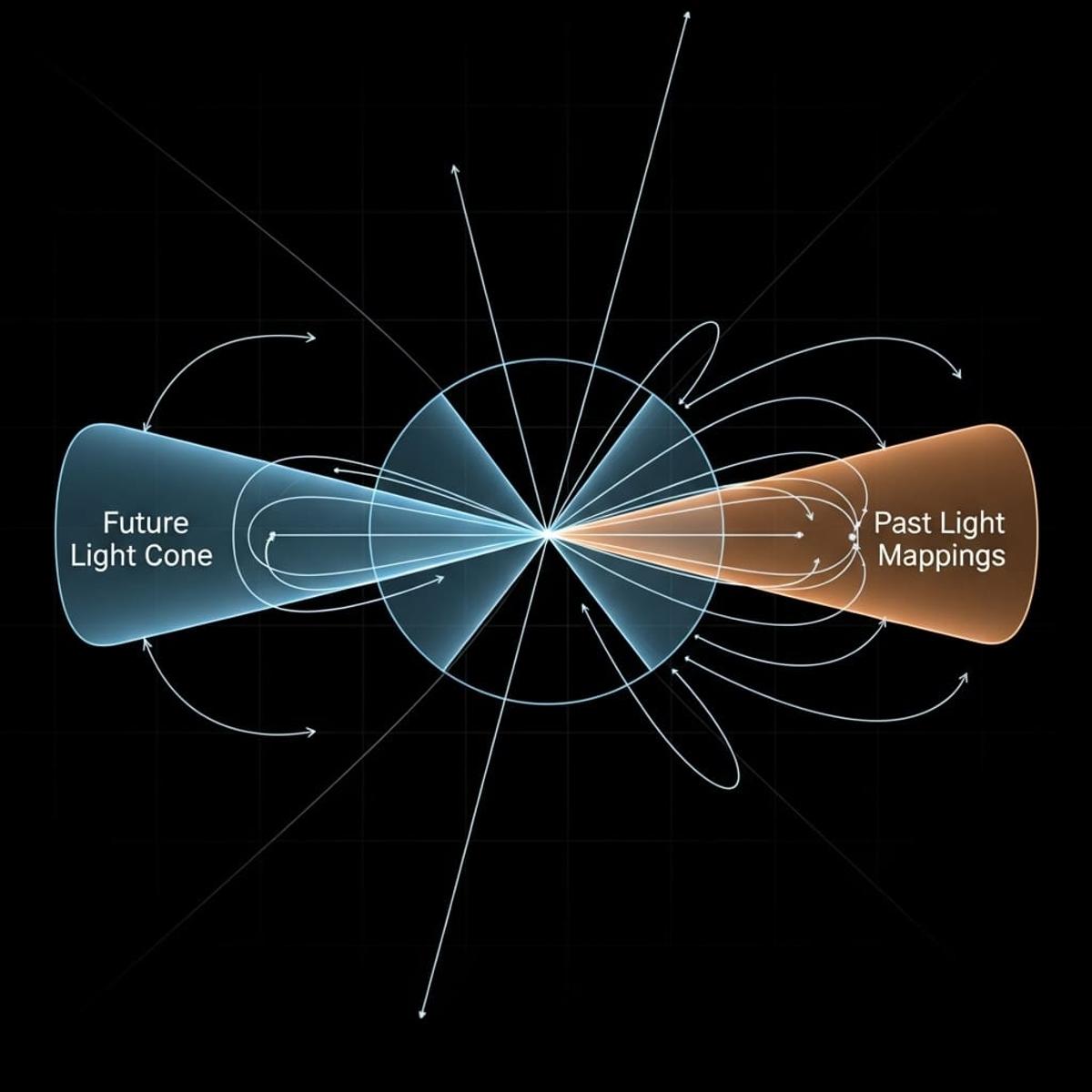
Superluminal Transformations and Finite Limits Incompatible, New No-Go Theorem Achieves Proof
•January 24, 2026
0
Why It Matters
The result forces theorists to reconsider superluminal extensions of relativity as sources of genuine randomness, impacting foundational debates on determinism and information limits in physics.
Key Takeaways
- •Finite superluminal transformations conflict with bounded information.
- •No-go theorem forces deterministic interpretation of superluminal physics.
- •Lorentz symmetry mathematically admits superluminal velocities.
- •Indeterminism stems from epistemic ignorance, not objective randomness.
- •Results hold across different information measure assumptions.
Pulse Analysis
Since Einstein’s formulation of special relativity, the speed of light has been treated as an absolute ceiling, a safeguard against causal paradoxes. Yet the mathematical structure of Lorentz transformations contains solutions that exceed this limit, prompting a niche of theoretical work that explores superluminal scenarios. Proponents have argued that faster‑than‑light signals could reconcile certain quantum puzzles, while critics warn of violations of locality and determinism. This tension has kept the community divided, with experimental searches for superluminal particles yielding null results but leaving the conceptual question open.
The recent paper by Sen, Del Santo and collaborators delivers a decisive blow to the superluminal‑indeterminism hypothesis. By rigorously partitioning observables into manifest (directly measurable) and non‑manifest sectors, the authors construct a ‘bridging theory’ that tests whether quantum probabilities emerge from incomplete knowledge. Their no‑go theorem proves that any transformation allowing superluminal speeds while remaining finite inevitably demands unbounded information content, a condition incompatible with realistic physical systems. Consequently, the apparent randomness associated with such transformations collapses into epistemic uncertainty, reinforcing a deterministic outlook for any theory that respects finite information bounds.
Beyond its philosophical weight, the theorem reshapes practical research agendas in quantum information and high‑energy physics. If superluminal extensions cannot generate intrinsic stochasticity, efforts to harness faster‑than‑light channels for secure communication or computation must pivot toward alternative mechanisms. Moreover, the work invites a re‑examination of Lorentz‑invariant models that embed hidden variables, potentially bridging gaps between deterministic hidden‑state theories and relativistic constraints. Future investigations may relax the information‑measure assumptions or explore non‑linear extensions, but the current result establishes a clear benchmark: any viable superluminal framework must either abandon finiteness or accept determinism.
Superluminal Transformations and Finite Limits Incompatible, New No-Go Theorem Achieves Proof
0
Comments
Want to join the conversation?
Loading comments...