Support Geometry Achieves Fast Entanglement Diagnostics in Qubit Registers
•January 27, 2026
0
Why It Matters
A rapid, geometry‑based entanglement test reduces computational overhead for quantum hardware designers, enabling more efficient circuit optimization and error‑correction strategies. Its scalability is essential as qubit counts grow toward fault‑tolerant quantum computers.
Key Takeaways
- •Boolean‑cube support predicts separability without amplitude data.
- •Diagnostic runs in O(n k) versus exponential tomography.
- •Identifies configurations that guarantee multipartite entanglement.
- •Accelerates quantum circuit optimization and error‑code analysis.
- •Currently limited to pure states; mixed‑state extension pending.
Pulse Analysis
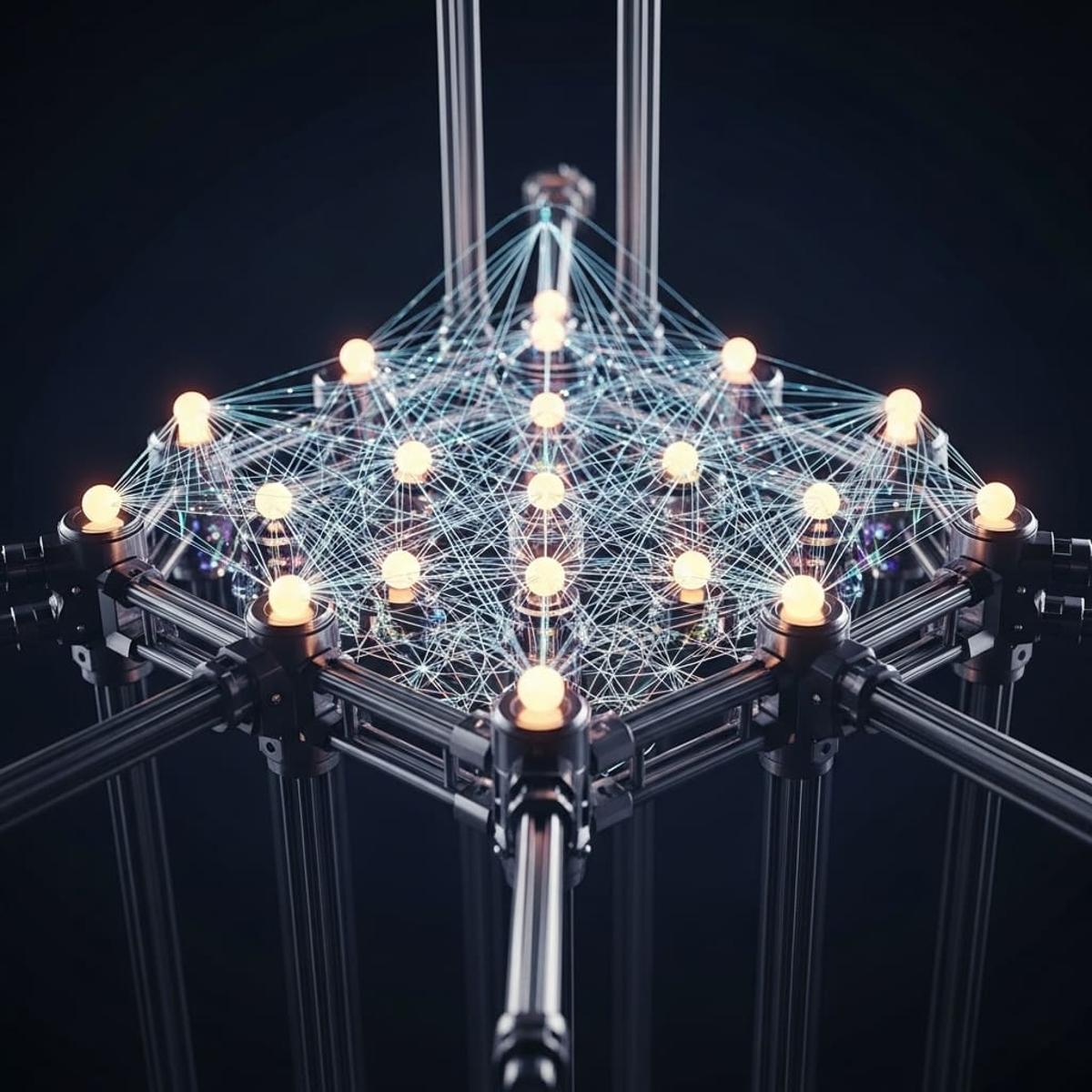
Entanglement verification has long been a bottleneck for scaling quantum processors, with conventional tomography demanding resources that grow exponentially with qubit number. The new Boolean‑cube approach reframes the problem by treating the computational basis as vertices of an n‑dimensional hypercube, allowing researchers to assess separability through the geometry of non‑zero amplitudes—called the support. This shift from amplitude‑heavy calculations to combinatorial analysis dramatically cuts the complexity, offering a diagnostic that scales linearly with both qubit count and support size.
The core contribution lies in closed‑form expressions for support counts and a taxonomy that separates support‑driven separable states from those whose entanglement hinges on specific probability amplitudes. By proving that the number of bipartitions supporting separability follows a 2^{c‑1} rule, the authors provide a clear metric for multipartite entanglement. The resulting O(n k) algorithm outperforms the traditional O(2^{2.5n}) methods, making real‑time entanglement monitoring feasible during circuit compilation and error‑correction code verification. Practitioners can now quickly flag problematic configurations, streamline simulation workloads, and design entanglement‑aware gates with confidence.
Beyond immediate technical gains, this geometry‑centric perspective opens new research avenues. Extending the framework to mixed states and higher‑dimensional qudits could unify entanglement diagnostics across a broader class of quantum systems, directly benefiting quantum‑machine‑learning models and communication protocols. As the industry pushes toward fault‑tolerant architectures, tools that provide rapid, accurate entanglement insight will be indispensable for both hardware manufacturers and algorithm developers, positioning Boolean‑cube support analysis as a foundational component of the quantum technology stack.
Support Geometry Achieves Fast Entanglement Diagnostics in Qubit Registers
0
Comments
Want to join the conversation?
Loading comments...