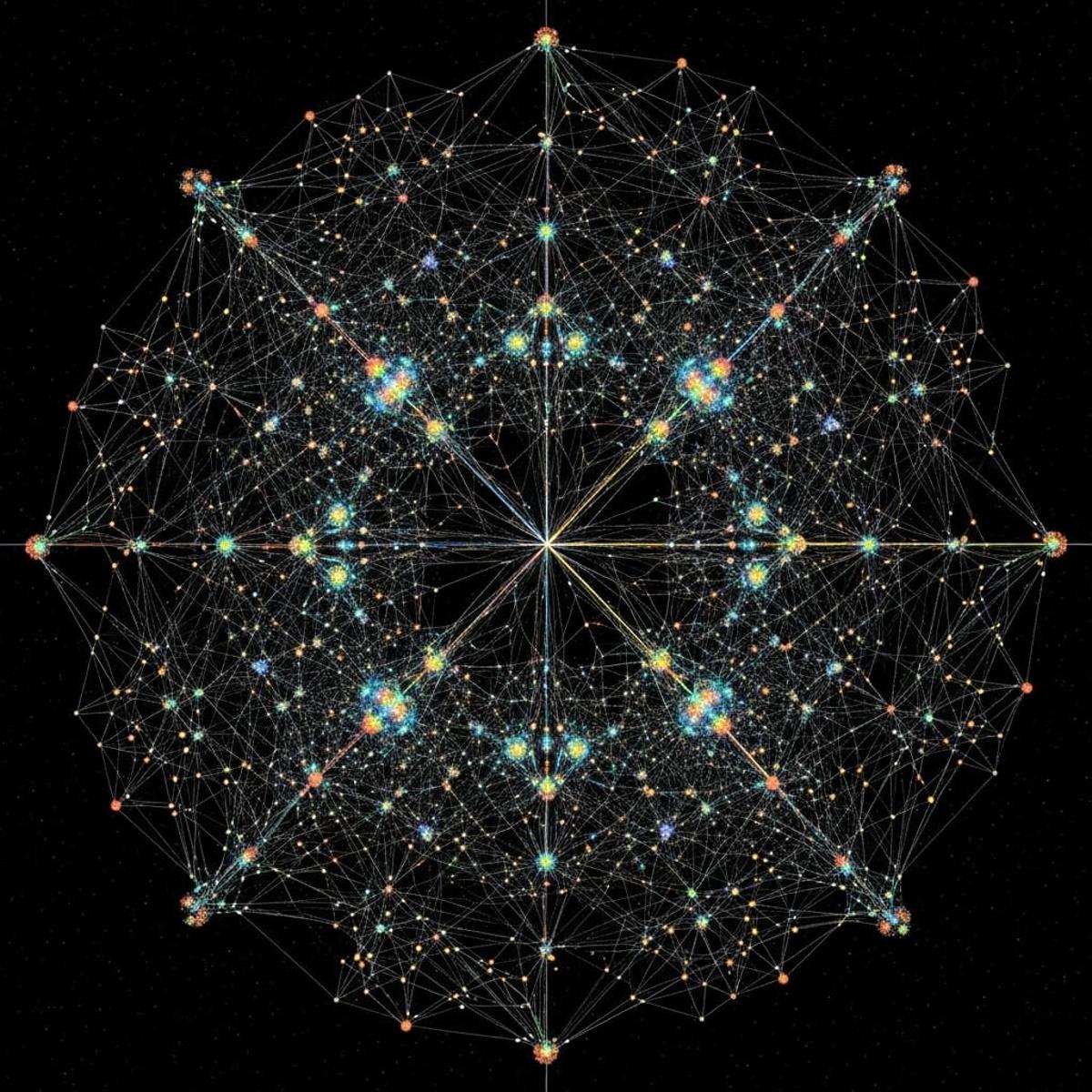
Symmetric Quantum States Achieved Via Complete Graphs and Odd 3-Qudit Systems
•January 29, 2026
0
Why It Matters
Linking graph topology to quantum‑state symmetry offers a systematic way to engineer bosonic or fermionic resources, accelerating quantum algorithm and error‑correction design.
Key Takeaways
- •Complete graphs yield fully symmetric quantum states.
- •Directed complete graphs with odd qudits produce antisymmetric states.
- •Edge orientation determines exchange symmetry in graph‑based constructions.
- •Standard CZ‑gate formalism cannot generate full antisymmetry.
- •Unified graph approach simplifies design of bosonic and fermionic states.
Pulse Analysis
Graph states have become a cornerstone of multipartite quantum information, providing a visual and algebraic toolkit for entanglement generation. The new study clarifies that only complete graphs preserve full permutation symmetry because every edge remains invariant under any particle swap, allowing the commuting CZ gates to act uniformly. This insight resolves a long‑standing ambiguity about which network topologies naturally encode bosonic behavior, and it gives experimentalists a clear design rule for symmetric state preparation.
The authors extend the conventional framework by introducing a non‑commutative two‑qudit gate, denoted GR, and by allowing directed edges with a prescribed vertex ordering. When the directed graph is complete and the system contains an odd number of qudits, the orientation of each edge forces the overall wavefunction into a fully antisymmetric configuration, mimicking fermionic exchange. This construction overcomes the limitation of standard CZ‑based graph states, which cannot produce such antisymmetry, and it demonstrates that edge directionality is the decisive factor for fermionic symmetry.
Beyond theoretical elegance, the unified graph‑theoretic approach has practical ramifications. Designers of measurement‑based quantum computers can now tailor resource states with exact symmetry properties, simplifying the synthesis of fault‑tolerant codes and entanglement‑distribution protocols. Moreover, the method may streamline quantum simulation of many‑body systems where bosonic or fermionic statistics are essential. Future research will likely explore richer graph families, assess scalability on near‑term hardware, and integrate the GR gate into existing stabilizer formalism, potentially broadening the toolbox for quantum technology developers.
Symmetric Quantum States Achieved Via Complete Graphs and Odd 3-Qudit Systems
0
Comments
Want to join the conversation?
Loading comments...