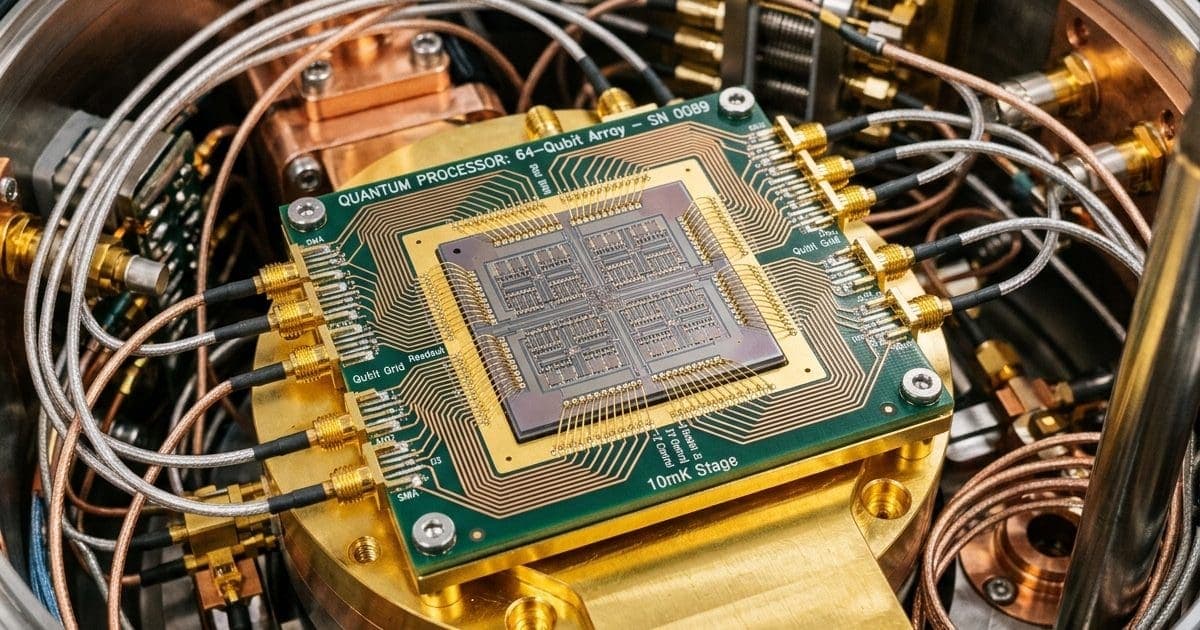
Top Quantum Hardware Companies 2026 By Modality

Key Takeaways
- •Superconducting leads with IBM’s 1,121 physical qubits, highest count
- •Trapped‑ion offers 99.92% fidelity, 48 logical qubits from Quantinuum
- •Neutral‑atom scaling fastest; QuEra demonstrated 96 logical qubits in 2024
- •Photonic firms target fault‑tolerant chips; PsiQuantum raised $1 B
- •Silicon‑spin promises CMOS scalability; Diraq shows 99.85% single‑qubit fidelity
Pulse Analysis
The quantum‑hardware market in 2026 is no longer a niche research arena; it is a multi‑modality industry where each platform competes on distinct performance metrics. Superconducting systems, anchored by IBM and Google, dominate raw qubit volume, making them attractive for near‑term cloud services. Trapped‑ion vendors such as Quantinuum and IonQ differentiate with ultra‑high gate fidelity, positioning themselves for error‑corrected logical qubits. Meanwhile, neutral‑atom firms like QuEra and Infleqtion leverage room‑temperature optics to accelerate scaling, demonstrated by 1,600‑atom arrays and 96 verified logical qubits, a milestone that narrows the gap to practical quantum advantage.
Funding trends underscore the sector’s maturation. PsiQuantum secured a $1 billion Series E round, valuing the company at $7 billion, while Quantinuum closed a $600 million Series C at a $10 billion pre‑money valuation. European neutral‑atom leader Pasqal raised €340 million (approximately $370 million) at a $2 billion valuation, and Infleqtion debuted on the NYSE via a SPAC, becoming the first publicly traded neutral‑atom pure‑play. These capital infusions are fueling aggressive roadmaps: 100‑plus logical qubits by 2027 for trapped‑ion, 1,200‑plus physical qubits for neutral‑atom, and the first fault‑tolerant photonic gate expected within the next two years.
For investors and enterprise strategists, the key takeaway is diversification across modalities. Superconducting offers immediate scale for cloud providers, trapped‑ion provides the highest fidelity for error‑corrected workloads, and neutral‑atom promises rapid hardware growth with lower cryogenic overhead. Silicon‑spin’s CMOS compatibility could eventually unlock mass‑manufacturing economics, while specialty approaches like topological qubits remain high‑risk, high‑reward bets. As IPO pipelines fill—Quantinuum’s confidential S‑1, Infleqtion’s NYSE listing, and upcoming offerings from Pasqal and Xanadu—the sector is poised for a wave of public‑market participation, making 2026 a pivotal year for capital allocation in quantum technologies.
Top Quantum Hardware Companies 2026 By Modality
Comments
Want to join the conversation?