Two Copies of Biseparable States Achieve Genuine Multipartite Entanglement
•January 28, 2026
0
Why It Matters
The breakthrough dramatically lowers resource and experimental overhead for generating GME, accelerating quantum‑network applications that rely on multipartite correlations. It also provides a pathway to stronger nonlocal resources essential for secure multi‑party protocols.
Key Takeaways
- •Two biseparable copies generate genuine multipartite entanglement
- •Protocol works without joint multi‑copy measurements
- •Applicable to arbitrary number of parties
- •Activates genuine nonlocal correlations alongside entanglement
- •Reduces resource overhead compared to three‑qubit schemes
Pulse Analysis
The ability to generate genuine multipartite entanglement (GME) lies at the heart of many quantum‑information tasks, from distributed computing to secure multi‑party communication. Traditionally, activating GME from mixed or biseparable resources has demanded large ensembles of identical states and intricate joint measurements across several copies, inflating experimental complexity and error rates. In three‑qubit settings, for example, researchers often needed dozens of biseparable copies to probabilistically distill a multipartite entangled state, limiting scalability and practical deployment.
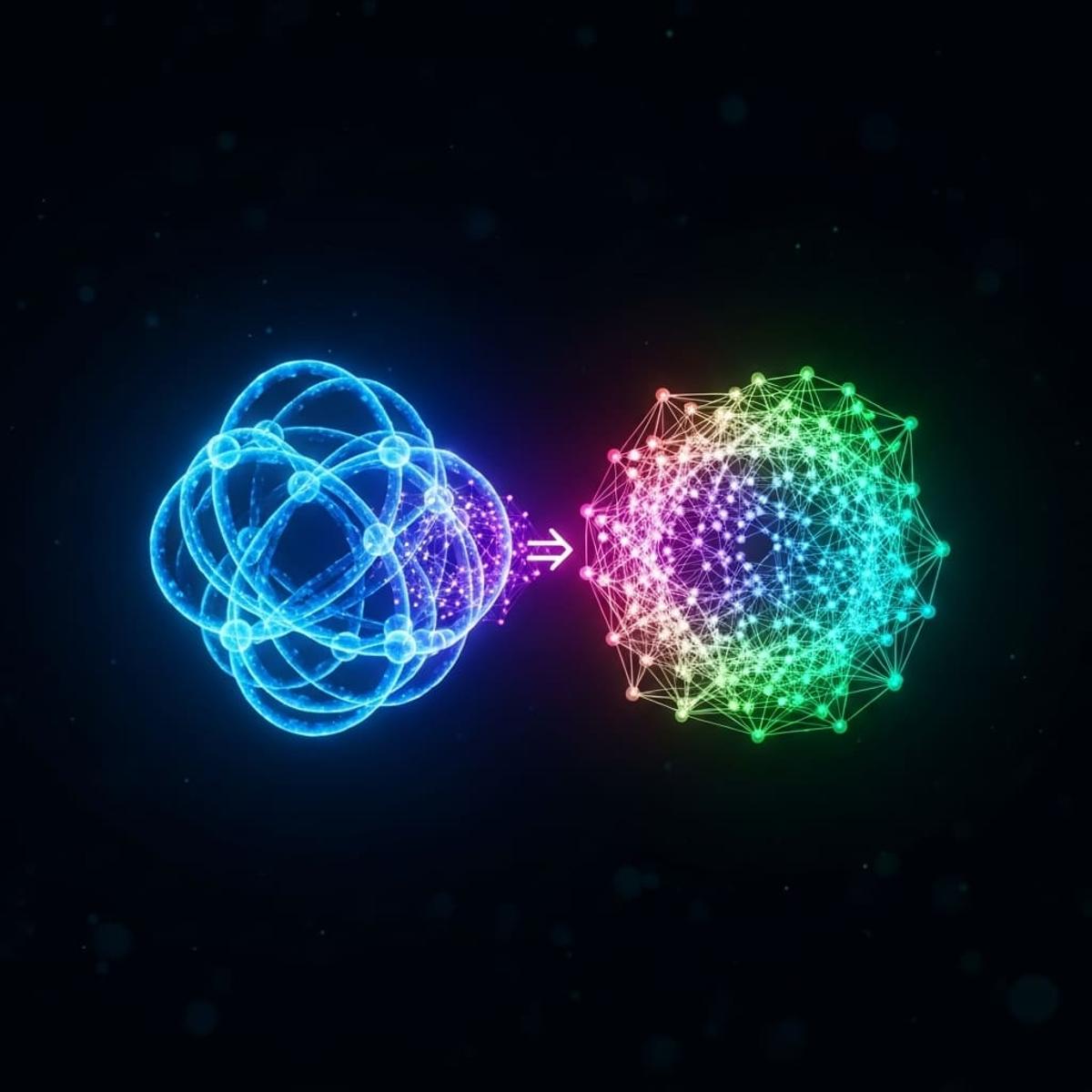
The recent protocol introduced by Choudhary, Sen and Halder overturns this paradigm by showing that just two copies of rank‑two biseparable states suffice to produce a pure, genuinely multipartite entangled state in a three‑qutrit system. The method extracts entangled bipartite pairs through adaptive local measurements, then consumes these singlets to stitch together a global GME state, all while operating on one copy at a time. Crucially, the scheme avoids any collective measurement on multiple copies, a feature that simplifies hardware requirements and makes the approach readily extensible to an arbitrary number of parties.
This resource‑efficient activation carries immediate implications for near‑term quantum networks. By reducing the number of required copies and eliminating complex joint operations, the protocol lowers the threshold for experimental fidelity and tolerates higher noise levels, accelerating the rollout of multipartite protocols such as secret sharing and distributed sensing. Moreover, the simultaneous emergence of genuine nonlocal correlations strengthens security guarantees beyond entanglement alone. Future work will likely explore optimization for higher‑dimensional systems, integration with error‑corrected platforms, and real‑world demonstrations on photonic or superconducting qubit architectures.
Two Copies of Biseparable States Achieve Genuine Multipartite Entanglement
0
Comments
Want to join the conversation?
Loading comments...