University of Toronto Centre Awards Bell Prize for Neutral Atom Research
•March 4, 2026
0
Key Takeaways
- •Neutral atoms scaled to hundreds of addressable qubits.
- •Reconfigurable optical tweezer arrays enable flexible architectures.
- •Rydberg interactions provide fast multi-qubit gates.
- •Coherent transport preserves entanglement during movement.
- •Prize highlights commercial momentum via QuEra Computing.
Summary
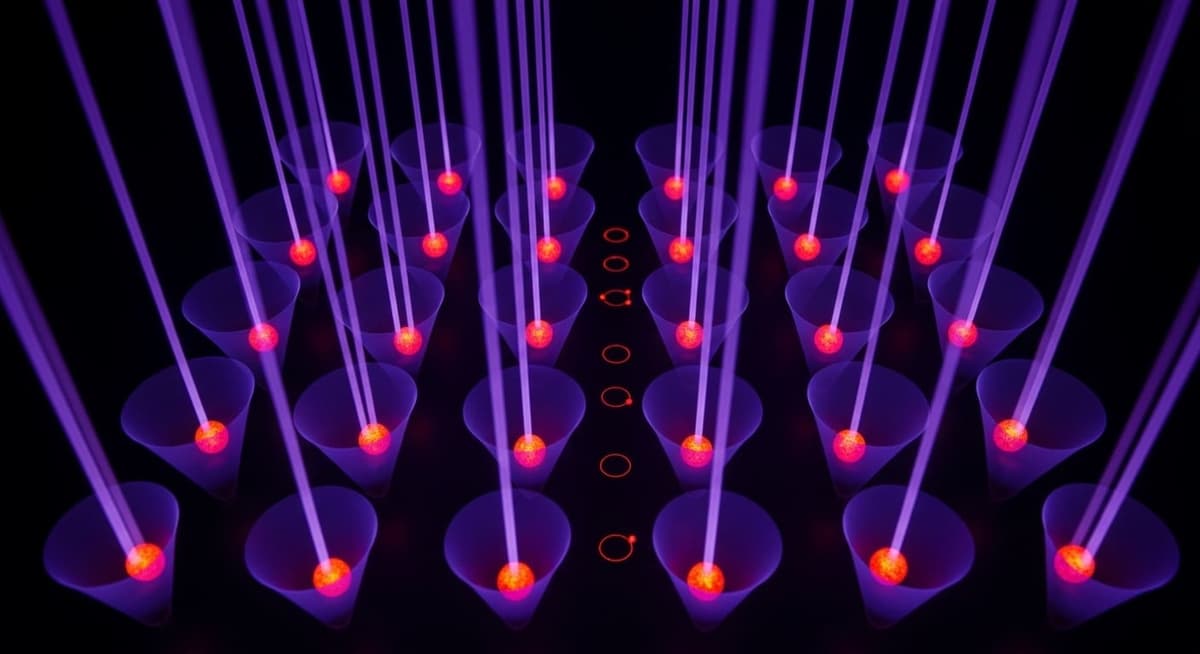
The University of Toronto’s Centre for Quantum Information and Quantum Control awarded the ninth John Stewart Bell Prize to Mikhail D. Lukin, Antoine Browaeys, and Mark Saffman for pioneering neutral‑atom quantum computing. Their work demonstrated reconfigurable optical‑tweezer arrays that can trap and control hundreds of individual atoms, while using Rydberg‑mediated interactions to execute coherent multi‑qubit operations. The prize also recognized their advances in transporting entangled atomic registers without loss of coherence. These breakthroughs address the long‑standing hurdle of scaling quantum processors while preserving experimental control.
Pulse Analysis
Neutral‑atom quantum computing has emerged as a compelling alternative to superconducting and trapped‑ion approaches, largely because individual atoms can be trapped with focused laser beams—optical tweezers—and manipulated with high fidelity. The principal challenge has been scaling these systems beyond a few dozen qubits without sacrificing the precise control needed for error‑corrected operations. Recent advances now demonstrate arrays of several hundred atoms, each individually addressable, marking a decisive step toward the qubit counts required for meaningful quantum simulations and algorithmic benchmarks.
The Bell Prize‑winning research introduced three technical pillars that together unlock this scalability. First, reconfigurable tweezer architectures allow researchers to rearrange atom positions on the fly, tailoring the hardware to specific problem geometries. Second, the exploitation of Rydberg‑mediated interactions provides ultra‑fast, long‑range entangling gates, essential for multi‑qubit circuits. Third, coherent transport techniques move entangled atomic registers across the array while preserving quantum coherence, enabling modular circuit designs and reducing crosstalk. These capabilities collectively expand the computational envelope of neutral‑atom platforms, making them viable candidates for both quantum simulation of many‑body physics and the execution of error‑corrected logical operations.
Beyond the laboratory, the award underscores the growing commercial relevance of neutral‑atom technology. QuEra Computing, co‑founded by Lukin, is translating these scientific breakthroughs into hardware that can be accessed by industry and academia, signaling a maturation of the ecosystem. As investors and governments prioritize quantum readiness, the recognition of scalable neutral‑atom processors signals a diversification of the quantum hardware landscape, promising more robust pathways to fault‑tolerant quantum computing and broader adoption across sectors.
Comments
Want to join the conversation?