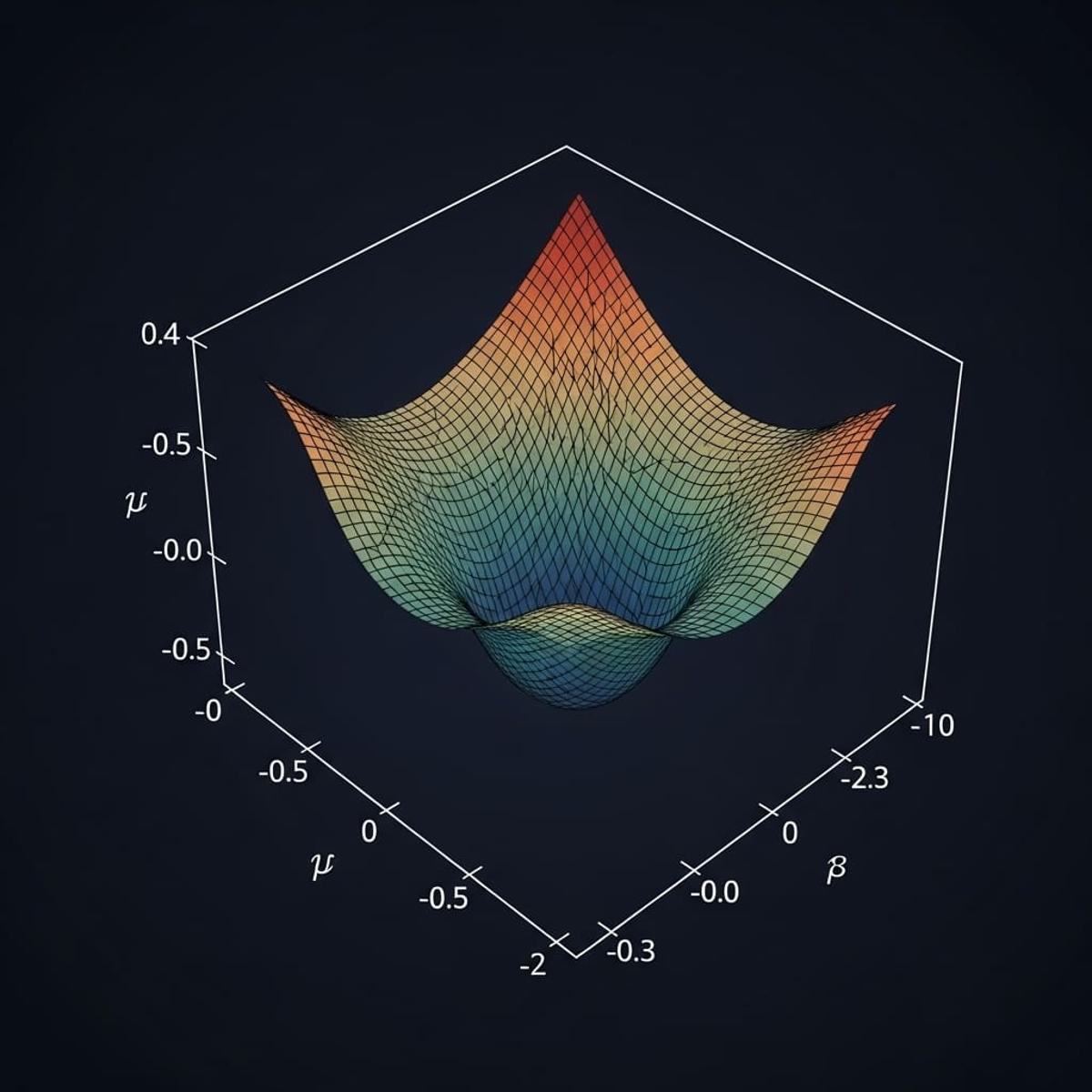
Wh Statistics Achieves Unified Framework with Λ, \K{appa} & Γ Parameters
•January 23, 2026
0
Why It Matters
WH Statistics provides a versatile tool for modeling partially distinguishable particles, unlocking new insights for condensed‑matter physics, quantum computing and materials design.
Key Takeaways
- •Introduces λ, κ, γ parameters for particle behavior
- •Unifies Bose, Fermi, Maxwell statistics under single framework
- •Predicts exotic quasiparticles called WHons
- •Links quantum exclusion with thermal fluctuations via κ weight
- •Enables continuous indistinguishability modeling in correlated systems
Pulse Analysis
Traditional statistical mechanics assumes particles are either fully identical or completely distinguishable, a simplification that breaks down in strongly correlated quantum materials. The WH Statistics paper challenges this binary view by defining a continuous distinguishability parameter λ, ranging from 0 (classical particles) to 1 (identical quantum particles). This innovation allows theorists to quantify wave‑function overlap directly, linking microscopic indistinguishability to macroscopic observables such as spectral peak widths and occupation numbers. By embedding λ alongside an exclusion‑weight κ and a topological symmetry γ, the framework captures the competition between quantum exclusion principles and thermal fluctuations, offering a more realistic description of particle ensembles.
The authors derive a generalized entropy and occupation‑number equations that reduce to Bose‑Einstein, Fermi‑Dirac, Maxwell‑Boltzmann, or anyonic limits when λ, κ, or γ reach their extreme values. In the thermodynamic limit the unified WH distribution function reproduces standard statistical results while simultaneously predicting a new class of quasiparticles—WHons—characterized by unconventional pressure and heat responses. This unification not only resolves longstanding paradoxes in mixing entropy but also provides a single analytical lens for exploring exotic phases of matter, from topological insulators to fractional quantum Hall systems.
Beyond theory, WH Statistics opens practical pathways for designing quantum devices. By quantifying how thermal noise and interaction strength (through κ) modulate exclusion effects, engineers can better predict decoherence in qubits and anyon‑based platforms. The framework’s flexibility supports experimental fitting of λ and κ from Hong‑Ou‑Mandel interferometry, enabling real‑time calibration of particle indistinguishability in photonic and solid‑state systems. As research pushes toward scalable quantum technologies, WH Statistics offers a robust statistical backbone for modeling the nuanced behavior of partially distinguishable particles.
Wh Statistics Achieves Unified Framework with Λ, \k{appa} & Γ Parameters
0
Comments
Want to join the conversation?
Loading comments...