Seed
Iceberg Quantum Raises $6M Seed Round Led by LocalGlobe
•February 14, 2026
•Feb 14, 2026
0
Participants


Why It Matters
By cutting error‑correction overhead, Iceberg accelerates the arrival of utility‑scale, fault‑tolerant quantum machines, reshaping cryptographic security and the broader quantum‑hardware market.
Key Takeaways
- •$6M seed round led by LocalGlobe, Blackbird, DCVC.
- •Pinnacle cuts RSA‑2048 qubits from millions to under 100k.
- •Uses quantum LDPC codes for order‑of‑magnitude lower overhead.
- •Partnerships span PsiQuantum, IonQ, Diraq hardware platforms.
- •Could bring cryptographically relevant quantum computers within 3‑5 years.
Pulse Analysis
The quantum computing industry has long wrestled with the "overhead problem"—the massive number of physical qubits required to protect fragile quantum information. Traditional error‑correction schemes demand extensive redundancy, inflating hardware costs and delaying practical applications. Iceberg Quantum’s Pinnacle architecture introduces a new class of quantum low‑density parity‑check (LDPC) codes that dramatically streamline this process, offering an order‑of‑magnitude reduction in the qubits needed for complex algorithms. This technical leap not only eases the engineering burden but also reshapes the roadmap for achieving fault‑tolerant quantum systems.
At the heart of Pinnacle’s promise is its ability to break RSA‑2048 encryption with fewer than 100 000 physical qubits, a target previously thought to require several million. Numerical simulations validate the architecture’s lower overhead, suggesting that cryptographically relevant quantum computers could emerge within a three‑to‑five‑year horizon. By aligning the error‑correction framework with multiple hardware modalities—photonic platforms from PsiQuantum, trapped‑ion designs from IonQ, and superconducting approaches from Diraq—the solution remains hardware‑agnostic, accelerating adoption across the quantum ecosystem.
The $6 million seed investment underscores investor confidence that this reduction in qubit requirements will unlock commercial quantum advantage sooner than expected. Backed by venture firms LocalGlobe, Blackbird and DCVC, Iceberg is poised to translate theory into silicon, delivering a scalable, fault‑tolerant stack that could disrupt cybersecurity, materials science, and optimization markets. As governments and enterprises brace for the post‑quantum era, Iceberg’s progress signals a pivotal shift: the transition from experimental prototypes to deployable quantum processors capable of solving real‑world problems.
Deal Summary
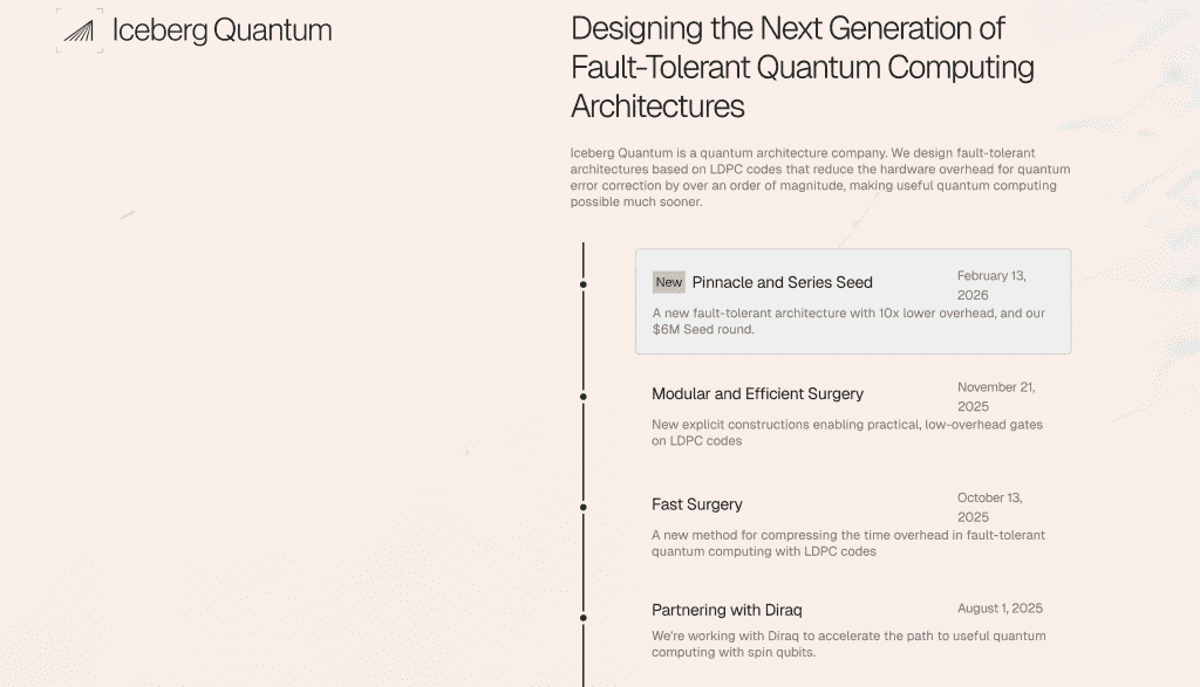
Sydney‑based quantum computing startup Iceberg Quantum announced a $6 million seed round to accelerate its fault‑tolerant Pinnacle architecture. The round was led by LocalGlobe with participation from Blackbird and DCVC. The funding will support development of the architecture that could dramatically reduce qubit requirements for breaking RSA‑2048 encryption.
0
Comments
Want to join the conversation?
Loading comments...