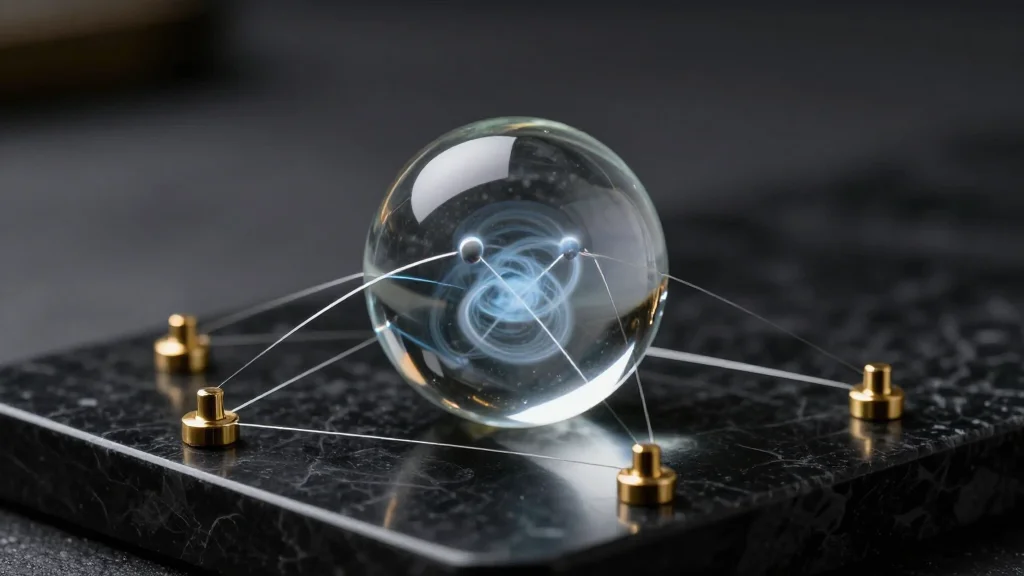
A Universal Scheme Can Verify Any Quantum State
Why It Matters
The method lets users verify quantum computers and sensors without assuming internal device integrity, bolstering security and commercial confidence as quantum technologies move toward widespread deployment.
Key Takeaways
- •Universal scheme self-tests any quantum state
- •Uses star‑shaped network with Bell inequality correlations
- •Enables device‑independent certification of mixed states
- •Reduces trust requirements for quantum hardware
Pulse Analysis
Quantum verification has long been a bottleneck for scaling quantum hardware, because traditional methods require detailed knowledge of a device’s inner workings. Self‑testing, or device‑independent certification, sidesteps this by inferring the underlying quantum state solely from measurement outcomes, a concept rooted in quantum nonlocality and Bell‑inequality tests. While earlier protocols handled only limited bipartite states, the new universal scheme expands the toolbox to any state, including mixed ones, by embedding the device in a star‑shaped network where a central node interacts with multiple peripheral links.
The core of the breakthrough lies in a family of Bell inequalities tailored to the star topology. By jointly measuring correlations across the network, researchers can uniquely map observed statistics to the target state or measurement, guaranteeing correctness without any hardware assumptions. Experimental validation on a modest number of external nodes demonstrates feasibility, and the protocol’s modular nature means it can be scaled as quantum networks grow. Importantly, the approach resolves a theoretical gap: mixed‑state certification, previously impossible in standard bipartite Bell scenarios, becomes achievable, opening new avenues for robust quantum protocol design.
For industry, the ability to certify quantum devices in a device‑independent manner could accelerate adoption of quantum computers, sensors, and communication links. Vendors can offer provable performance guarantees, while users gain confidence that results stem from genuine quantum processes rather than classical spoofing. Future work will focus on reducing the number of required Bell tests, enhancing noise tolerance, and integrating the scheme into existing quantum‑information workflows. As quantum networks mature, such universal verification tools will be essential for maintaining security, reliability, and regulatory compliance across the emerging quantum ecosystem.
A universal scheme can verify any quantum state
Comments
Want to join the conversation?
Loading comments...