Advances Coherence in Cos(2) Qubits by Balancing Charge and Flux Noise Trade-Offs

Key Takeaways
- •All designs share a common multi‑harmonic SQUID Hamiltonian
- •Charge‑flux noise trade‑off limits dephasing to microseconds
- •Optimised bias away from frustration balances noise sensitivities
- •Simulations predict T1 exceeding milliseconds with current parameters
- •Parity protection suppresses single Cooper‑pair tunnelling
Pulse Analysis
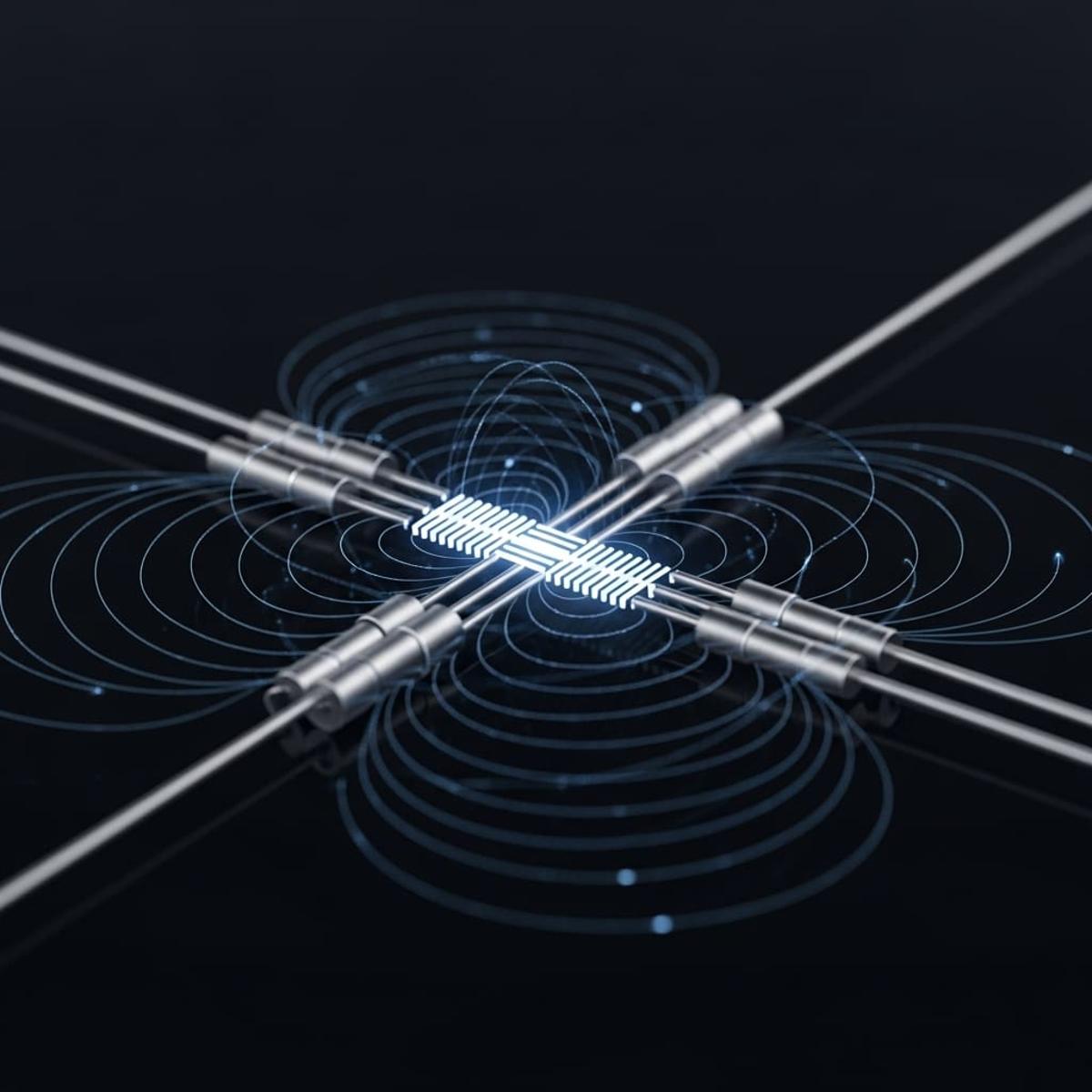
The quest for longer‑lived superconducting qubits has led researchers to explore interference‑based cos(2φ) potentials, where two Josephson elements generate a π‑periodic energy landscape. By arranging bi‑harmonic junctions in a SQUID loop, the resulting Hamiltonian mirrors that of flower‑mon, KITE, rhombus and semiconducting‑junction architectures, providing intrinsic parity protection that blocks single Cooper‑pair tunnelling. This unified description simplifies design optimisation and aligns the new class of qubits with the broader toolbox of circuit quantum electrodynamics, positioning them as a viable alternative to conventional transmons.
Numerical analysis in the Grenoble study reveals a fundamental trade‑off between charge‑noise and flux‑noise dephasing channels. While the engineered parity protection extends energy‑relaxation times (T1) into the millisecond regime, dephasing (Tφ) remains capped at a few microseconds because any bias away from the frustration point reduces one noise source at the expense of the other. By deliberately detuning the external flux, designers can balance these sensitivities, achieving microsecond‑scale coherence without sacrificing the millisecond‑level T1. This insight offers a practical pathway to tune qubit performance for specific algorithmic requirements.
With achievable circuit parameters already delivering T1≈1 ms and Tφ≈5 µs, cos(2) qubits approach the coherence benchmarks of state‑of‑the‑art transmons while retaining parity‑based error suppression. If fabrication tolerances and material losses continue to improve, further extensions of Tφ may become realistic, opening the door to scalable quantum processors that exploit both long‑lived storage and fast gate operations. Industry stakeholders should monitor these developments, as the ability to trade charge and flux noise could inform next‑generation quantum‑hardware roadmaps and influence funding priorities across the superconducting qubit ecosystem.
Advances Coherence in Cos(2) Qubits by Balancing Charge and Flux Noise Trade-offs
Comments
Want to join the conversation?