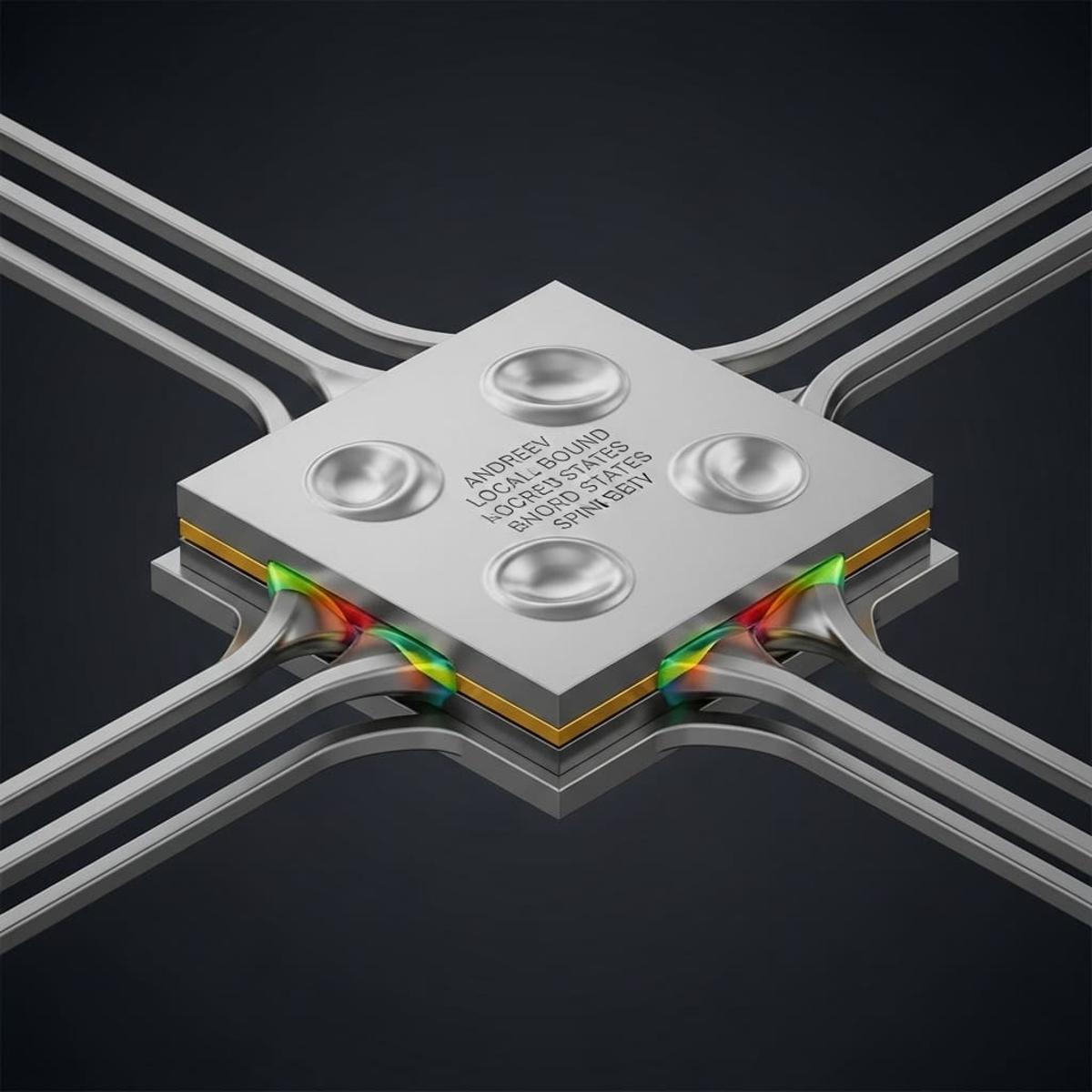
Andreev Spin Qubits: Research Shows Realisation Via 2D Topological Insulators
•February 6, 2026
0
Why It Matters
The work provides a viable pathway to scalable, low‑decoherence solid‑state qubits, addressing a key bottleneck in quantum‑computer hardware development.
Key Takeaways
- •Magnetic doping enables electric dipole transitions in helical junctions
- •Simulated NOT and Hadamard gates achieve high-fidelity control
- •Topological protection reduces decoherence compared to nanowire qubits
- •Feasible with HgTe/CdTe or InAs/GaSb quantum wells
Pulse Analysis
Topological insulators have emerged as a fertile platform for quantum information because their edge states are protected against many sources of disorder. When these helical channels are proximitized by superconductors, Andreev bound states form, offering a natural two‑level system for qubit encoding. The novelty of the recent study lies in exploiting magnetic doping to break the strict selection rules that normally forbid electric dipole transitions in such systems, thereby opening a microwave‑driven control channel that is both fast and electrically addressable.
The authors model a Josephson weak link whose length and transparency are tuned alongside a controlled magnetic impurity profile. This configuration produces a spin‑dependent texture in the Andreev spectrum, allowing microwave photons to induce coherent transitions between spin‑polarized bound states. Simulations of realistic device parameters demonstrate that elementary quantum logic—specifically NOT and Hadamard operations—can be performed with error rates compatible with fault‑tolerant thresholds. Importantly, the use of materials such as HgTe/CdTe quantum wells or InAs/GaSb bilayers means the proposal can be integrated with existing epitaxial growth and nanofabrication pipelines.
If experimentally validated, this architecture could reshape the roadmap for solid‑state quantum processors. The topological edge states inherently suppress hyperfine interactions, mitigating one of the dominant decoherence channels in nanowire‑based qubits. Moreover, electric‑dipole control sidesteps the need for large magnetic fields, simplifying wiring and reducing cross‑talk in multi‑qubit arrays. Future research will need to refine magnetic‑doping precision, quantify coherence times, and develop scalable interconnect schemes, but the demonstrated gate functionality marks a decisive step toward practical, topologically protected quantum hardware.
Andreev Spin Qubits: Research Shows Realisation Via 2D Topological Insulators
0
Comments
Want to join the conversation?
Loading comments...